|
|
 |
|


Home Page
Cocktails
Groups of Things
Horoscopes
Phobias
Pictures
Zodiac (Chinese)

All About Rastas
Cannabis Timeline
Ganja in The USA
Rolling - Lego Story
The Good Drinking Guide
Wicked Recipes

Alcohol Guide
Drug Guide
Holiday Guide
Rolling Guide
Rolling Guide (Advanced)

Articles:
Drug Addiction
Drugs:
Alcohol
Cannabis
Ecstacy

Erowid
Drum&Bass Arena
Ravislayer
Stagg's Site

About Us
Contact Us
Sign Guestbook
View Guestbook

Skip to:
Introduction | History
| Effects | Dangers
| Combinations | The
Law | Myths | Top
Tips | Sciency Bit
|
Legal Status |
Class B |
|
Drug Type |
Hallucinogen |
|
Pharmacological Class |
SSRI |
|
Chemical Class |
Cannabinoid |
|
Normal Duration |
1-6 hours |
|
Aliases |
Pot, gear, hash, ganja, draw, green, brown, jib, marijuana, dope, grass, weed, bud, etc. |
|
Dose |
Depends on potency |
|
Price (per dose) |
£5 |
Of the two main species, Cannabis Indica, is the strongest, and is used to make hash and stronger grasses, like skunk. Indica grows from 3 to 6 feet high with fat dark green leaves, purple-ish buds and a distinct stinky skunky smell. This is what purple haze comes from and is probably why it's common myth that purple haze is laced with LSD (because it gets you proper fuked). Cannabis Indica is found mainly in the middle east, India and Central Asia.
Cannabis Sativa, also known as hemp, is traditionally used to make rope and fibres but can be smoked for a more cerebral high, over Indica's sleepy groggy effects. The plants are very tall (8 to 12 feet) with thin light green leaves (the five leaf one in all the pictures), reddish buds, and a sweet fruity smell.
There is also a third species, Cannabis ruderalis, grown in Poland, Siberia and some Eastern European counties but this sucks balls as the plant contains little THC (so keep away from the dodgy Russian skunk).
There are three types of cannabis:
Skunk:
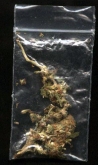 |
There are in fact too broad types of cannabis that look like this, skunk and weed. Skunk is very strong and you'll need only a little to get you royally fucked, weed is less potent and you'll need more of it to have an effect. It is possible to tell the difference between the two just by sticking your nose in the bag and having a sniff. Good skunk will have a very potent smell to it and if it's kept nice and fresh (like in a baggy) then it will also be a bit sticky which is also a sign of quality stuff. The skunk is what you want (obviously) because it comes off the bud of the plant rather than crushed leaves like weed does. As a result what you'll get is often clumped together in buds which, if not broken up can be up to an ounce in weight! Skunk usually contains between 1 and 5% THC in the US and up to 12% in the UK and Europe. |
Hashish:
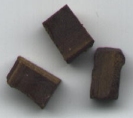 |
Hashish is made from the resin of the flower clusters
and top leaves of the plant. To smoke it the hash must first be
burnt with a lighter for several seconds before it can be sprinkled
in. The smaller the sprinkle the better as the larger rocks
will not burn completely and will waste the gear. Generally the
quality of hash in the US is bollocks but here, in Britain it can
be quite excellent (especially down south).
Hash is often used for cooking, as skunk and weed tend to give a
better high when smoked than hash. Hash contains around 2 to 20%
THC but is easier to adulterate than grass, paper pulp or caryophyllene
(a constituent of cloves) is usually
used. |
Hash Oil:
 |
Hash oil is a thick potent oil made from hashish. It is very rare to find this stuff in Europe and even more unusual in the US. It is very thick and sticks to everything and anything, it is also very potent (the oil will contain around 60-80% THC). The buzz is very relaxing, to the extent that you won't be able to move (paralysing in the extreme). Generally it is used by smearing a small amount of the oil on some cigarette papers but putting a big blob of it in your bong (with backy of course) is really good too. For some reason cannabis oil is more of a creeper than hash or skunk and can take up to 10min for the effects to be fully realised (but when they are, you will know about it). Be warned though that cannabis oil is considered a class A drug unlike the other types of cannabis which are a class B. |
Most people known
that the active ingredient of cannabis is THC but what you don't know
is that there are over 60 different cannabinoids to be found in cannabis
(delta-9-tetrahydrocannabinol being the main one).
Different strains of cannabis will have different amounts of these cannabinoids
in them, the ratio of which will dictate the strength and 'high' characteristics.
Cannabinoids produce their psychoactive effects by binding
with special receptors which are extraordinarily abundant all over the
brain and body. Your brain in fact makes its own kind of cannabinoid (anandamide)
which is thought to be involved in pain sensations, memory regulation
and the immune system.

Cannabis was first referred to in the world's first medical text (Shen Nung's Pen Ts'ao) as a 'superior' herb in 2737 BC. It was also used as an intoxicant in India around 1000 B.C., and soon became an integral part of Hindu culture. Cannabis was also used as an intoxicant in other parts of the world prior to 500 A.D. but its use was not as well documented as that of opium.
It is unclear
when hemp was first used in the United States, some historians say the
Spaniards brought the plant with them in the 16th century, other say marijuana
smoking came in with the slave trade or with the Asian Indian migration
of the late 18th century. Cannabis was an often used medicine in the United
States in the 19th century. It was easily available without a prescription
and was also widely prescribed by physicians. The hemp plant was a major
crop in Kentucky, Virginia, Wisconsin and Indiana, and was one of the
most important southern agricultural products, after cotton. Presidents
Washington and Jefferson even used to grow it in the White House garden
for their own personal consumption.
Intoxicant use in the United States is also traced to the large influx
of Mexican labourers in the 1910's and 1920's and became illegal along
with the depression of 1929 when these cheap Mexican workers were largely
replaced by an American workforce to boost economy.
Check out the cannabis timeline for more historical information.
General Effects
|
Positive:
Mood lift
Relaxation, stress reduction
Creative, philosophical or deep thinking (i.e. ideas flow more easily)
Increased appreciation of music
Increased awareness of senses
Pain relief (headaches, cramps)
Reduced nausea (used medically for this)
Neutral:
General change in consciousness
(as with many psychoactives)
Increased appetite (the munchies)
Slowness (slow driving, talking)
Tiredness (especially with hash)
Blood shot eyes (especially common for inexperienced users)
Mouth dryness (drymouth)
Interrupts linear memory (difficult to concentrate)
Cheek, jaw, facial tension (rarely)
Negative:
Nausea
Coughing, asthma, upper respiratory problems (with smoking)
Short term memory problems during use
Agitation
Increased
heart rate (by 20-50%)
Mild to severe anxiety
Panic attacks at very high doses (usually oral) or in sensitive users
Headaches
Dizziness, confusion
Paranoid & anxious thoughts more frequent
Possible psychological dependence on cannabis
"mild" withdrawal symptoms may occur after daily use in some
users include anxiety, anhedonia (reduced experience of pleasure), headaches,
General unease/discomfort, difficulty sleeping, and a desire to smoke
pot.
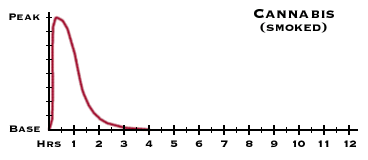
Cannabis
is quick acting. Smoked, the first effects are usually felt within seconds.
The peak follows within minutes and then declines sharply after thirty
minutes.
You feel a general sense of well being and relaxation, giggliness and
euphoria. You may also experience introspective dreaminess, increased
appreciation of music, sleepiness, time distortion and impaired short-term
memory. Cannabis also stimulates the appetite (especially, it would seem,
for Wheat Crunchies and chocolate flavoured milk). These short bursts
of extreme hunger are known universally as the 'munchies'.
Short Term: Heavy users of Cannabis can become more lethargic (have a lack of energy) than normal, there are also reports of anhedonia (reduced experience of pleasure) and insomnia. However, these side effects are mild and not permanent, disappearing in 1-3 weeks after abstaining. Cannabis can leave you feeling a little groggy and forgetful the morning after a session but this wares off within hours of waking up.
Long Term: There are now many people who have used Cannabis regularly or occasionally for more than 40 years and research has down that long-term use of Cannabis does not cause lasting damage to physical or mental health. As with smoking any substance frequent breathing in of cannabis smoke can lead to bronchitis and other chest related disorders and may cause lung cancer. One joint is equivalent to about 4 cigarettes in terms of how much tar is deposited on your lungs but since users generally smoke a lot less joints than they do fags, it'll probably be the fags that give you lung cancer not the joints. Cannabis does not produce a physical dependency but mixing it with tobacco can certainly produce a nicotine addiction.
Withdrawal: If you are a heavy user and you stop smoking, you may experience restlessness, irritability, mild agitation, insomnia, nausea, sleep disturbance, sweats, and intense dreams. These symptoms however are mild and short-lived, lasting 2 to 4 days.
Paranoia: A common side-effect, usually for first time or early users, is anxiety, panic, paranoia and feelings of impending doom. However these effects disappear within hours. Reassurance and a supportive environment help. There are also the occasional reports of long-term users 'turning a corner' in their cannabis use, where they can no longer enjoy the experience as cannabis triggers paranoia and anxiety attacks.
Schizophrenia: There is a lot of misinformation presented about cannabis and schizophrenia. There is general agreement that heavy cannabis use can precipitate schizophrenic episodes in those with the disorder but there is no evidence that it can cause the underlying psychotic disorder. Heavy cannabis users can exhibit symptoms of schizophrenia if they cain it too much that can be - dangerously - diagnosed as a schizophrenic illness.
Addiction: Around 9% of users become addicted, although some studies estimate that over 50% of users have "impaired control" over their use of cannabis. The UK Department of Health summed it up neatly: "Cannabis is a weakly addictive drug but does induce dependence in a significant minority of regular users."
Tolerance:
Short-term tolerance builds up rapidly after a few doses and
disappears rapidly, usually by the next day. First timers will always
be effected more than regular users but after a few weeks or months of
caining you will gain a natural tolerance to it. Everyone has their own
natural tolerance it seems and this tolerance will not increase
or decrease once it has been reached, even after abstaining.
Statistics: The following statistics show the annual American death toll caused by various substances (according to the National Institute on Drug Abuse and the Bureau of Mortality Statistics).
| Drug | Deaths P.A. |
| Tobacco | 400,000 |
| Alcohol (excluding 50% of all road fatalities and 65% of all murders) | 125,000 |
| Prescribed drugs | 18,675 |
| Other illegal drugs | 15,000 |
| Caffeine | 5,800 |
| Cocaine | 2,390 |
| Heroin | 2,147 |
| Aspirin | 956 |
| Cannabis | 0 |
Contradictions:
-
Do not operate heavy machinery.
-
Do not Drive (although driving stoned if fairly safe as you'll never dare to go above 20mph).
There are no major health risks when taking cannabis in conjunction with other drugs.
Alcohol: Makes both drugs stronger (synergic effect); manageable at low doses, but can cause vomiting, dizziness, and increased paranoia with large amounts of both (I certainly enjoyed it). Makes your head spin as if you're very drunk but is a much nicer feeling (if a little intense).
Amphetamines: Cannabis can take the edge off the harsh speed buzz
Cocaine: Unusual combination (uppers and downers) but can help modulate the grinding intensity of coke
Ecstasy: Extends and expands the E experience; used to help bring on the high, it mellows the intense rushes and helps with the come-down; makes the ecstasy more psychedelic. Taking cannabis on the comedown may also help prevent some of the long-term brain damage that ecstasy can cause.
Heroin: Complimentary effects
Ketamine: No reported problems, but make sure you stub your joint out before taking K. K amplifies certain cannabis effects (especially closed eye visuals and mind tunnels).
LSD:
Cannabis dulls the experience in the come-up; heightens the
peak; brings back the effect during comedown
Mushrooms: See LSD (above)
Tobacco: Clouds the high slightly
(Note this is British, not American law)
At the moment regular cannabis is a Class B drug (cannabis oil is Class A), as such it carries a maximum 5 year or 14 year sentence for possession or supply respectively. However, the maximum sentences are rarely imposed and there are plans that will degrade cannabis to a Class C in the near future.
Drug Testing: Cannabis can be detected for in the urine or blood for 3-40 days depending on how much you take, how often and how often the equipment used is. Cannabis can also be detected for in the hair (for a long time, depending on how often yon cut it) but since hair drug tests are notoriously inaccurate and expense they are rarely performed.
Cannabis stays in you body and keeps you high for months: Much to the disappointment of the mindless anti-drug protesters who's comprehension of science is rather more limited than the features on a Sköda, and, perhaps to a greater extent, your average user, cannabis does not get you high for months. It is true that THC can stay in the fat cells of your body for several months (that's how it is detected), however, this is one of the inert forms of THC that is formed when your body metabolises the active compound and so it doesn't get you high.
Cannabis causes brain damage: No, not even slightly. This rumour stemmed from a poorly performed and unscientific experiment in the 60s that attempted to show that cannabis damages brain structures in monkeys (it was severely criticized by a medical review board). However, the results for this experiment are still being printed in anti-cannabis leaflets even today. A recent study (within the last 5 years) on Rhesus monkeys - using technology so sensitive that scientists could actually see the effect of learning on brain cells - found no damage resulting from the intake of cannabis (and those monkey's got well fuked).
Cannabis causes short-term memory impairments: The effect of cannabis on memory is its most dramatic and the easiest to notice. Many users find that they have very strange, sudden and unexpected memory lapses. These usually take the form of completely forgetting what you were talking about when you were right in the middle of saying something important. However, these symptoms only occur while a person is `high'. They do not carry over or become permanent, and examinations of extremely heavy users have not shown any memory or thinking problems when actually sober.
Cannabis makes you lazy and lethargic: According to a study carried out by the US army, no. A number of other scientific studies have shown that smoking cannabis does, in fact cause similar symptoms to amotivational syndrome. However, these symptoms only occur in adolescents, not adults and is not permanent.
Cannabis is worse for you than smoking: It is true that cannabis contains more tar per mass than tobacco (by about 4x) however there have been studies which show that there is no correlation between the amount of tar and the chances of getting cancer. In fact, according to the US Surgeon General C. Everette Koop, it is the Radium 226 in tobacco (from phosphate fertilizers) which poses the real danger, not the tar. In any case, while it may be possible to smoke as many fags in a day as you want there are few people who regularly smoke more than a few joints a day, so overall, the amount of tar deposited from cannabis would be less anyway. Nicotine also breaks down into a chemical called 'N-Nitrosonornicotine', which is cancer causing. Cannabis actually acts as a bronchial dilator and opens up your air ways in much the same way as one of those asthma spray things does, whereas Nicotine is the opposite, a bronchial constrictor.
Cannabis is a gateway to other drugs: This is more of an opinion than fact but I would say that cannabis isn't a gateway to other drugs. Since cannabis does not cause any major tolerance to form in users (even heavy users) there is nothing to cause them to start using other drugs other than peer pressure and to see what other drugs are like. Stats show that 75% of cannabis users in the US never use harder drugs and it's certainly no worse than alcohol as a 'gateway' drug. Take Holland as an example, hard drug use has actually declined since cannabis was partially legalized in the 70s.
Cannabis is stronger than it used to be: While it is true that today's cannabis is stronger due to selective breeding techniques the strength has not been increased substantially. Certainly the claims of it being 10 to 30 times stronger than it was in the 60s are totally unfounded. I've been eyeballing the stats, applied some moving average calculations and as a guess I would stay potency has increased 12% on average worldwide.
Cannabis reduces your immune system: A study on rats showed that cannabinoids do have an immuno-suppressive effect, they act on certain cells in the liver, called macrophages and shut them down. However, it is unclear whether this test is relevant to human subjects and should be noted that the doses used in the test were far beyond that of a recreation dose (even for a rat). The Immuno-suppressant effect was only temporary, however, and wore off after a few hours. Others studies have shown that cannabis doesn't reduce the numbers of lymphocytes, macrophages or other immune fighting cells in human's and some studies even suggest that THC increases some forms of immunity.
Cannabis makes you sterile: Think about it, if cannabis made you sterile would there be any Rasta's left? THC reduces lutenising hormone (LH) which triggers ovulation in women and is involved in sperm production in men. This results in a short-term (4-5 hours) decrease in the reproductive system but heavy users develop a tolerance to this side-effect and are immune.
Cannabis decreases testosterone: THC doesn't turn us blokes into lanky, girly looking wimps, no. This was another scare tactic from the Reefer Madness II movement in the 70s based on studies which are citied as faulty or have been misinterpreted.
You shouldn't smoke and drive: While probably not the best plan, as smoking leads to a slight impairment of psychomotor and cognitive function, stoned drivers appear to compensate for this by taking few risks and driving slower. This is because you get serious brick-shitting sensations if you drive too fast due to paranoia of crashing (you may have witnessed the effect in a certain episode of 'The Detectives'). One thing is certain, stoned drivers are alot safer than their pissed up, nuttah bastard counterparts.
Eating Hash: I highly recommends eating some hash, not only will it be cheaper (because you can get high with only half a teenth (1/32 of an ounce, 0.9g) but the experience is often superior to that of smoking it. Remember that THC only dissolves in alcohol and lipids (fatty stuff) thus is must be either baked in something that contain fats (I recommend a chocolate fudge cake) or dissolved in alcohol (the higher the ABV the better; remember to shake the mixture a lot). Eating half a teenth (in either a fatty food or alcohol) will start working in 30-90 minutes (the more you've eaten, the longer it will take to work). The effects will last approximately 4-5 hours. Be warned that munching much more than a teenth at any one time will probably paralyse you for a few hours. Eating cannabis gives particularly strong effects because the liver metabolises THC into 11-OH-delta-9-THC, a compound three times more psychoactive than delta-9-THC itself (which is nice).
Novelty Joints: Check out the advanced rolling section for a variety of amusingly shaped joints and step by step instructions on how to construct them. Some joints demonstrated will actually smoke much better than those which you are used to and most of them will floor an inexperienced user.
Bonging It: The effects from bonging cannabis is approximate to the effects of eating it, however, more is often required to produce the equivalent effects and if the bong is made improperly it will truly kane your throat. Check out the 'Art of Bong Making' article for more info.
Cannabis & Alcohol: This combination of drugs is recommended to the more hardcore type person. For the best effects it is recommended that you drinking 3-4 pints to get mildly tipsy then have a few joints. The effects of this combination could be compared to being very pissed (similar head spinning sensation) but much more pleasant. Closed-eye hallucinations are possible with large amounts. For best results lie on the floor with your eyes closed, in a dark, quiet environment.
Weighing Cannabis: It is useful to know that the weight of a one penny piece is roughly equal to 1/8 of an ounce (especially if you don't have any decent scales).
Toasting Fags: Toasting a cigarette before putting it in a joint removes most of the nicotine (and some tar). Toasting is reasonably simple, just run your lighter up and down the fag so that most of the paper turns a browny colour (turn the fag round as you go, making sure not to light the paper), do this for about a minute then blow through the butt. This blows out the vaporised nicotine and tar. Toasting a fag works particularly well when the tobacco is going to be used in a bong mix or if you're going to roll a skunk spliff.
Buffing Hash: If you want to sprinkle all your hash in one go then buffing is the way to go. Wrap your chunk in a bit of tin foil (the foil you get in a cigarette packet works fine), making sure it's totally covered and there's a bit of foil that you can hold onto without getting burnt. If you're using the foil off a fag packet do it so the paper is facing inwards and the gold/silver part is on the outside. Now all that is required is that you burn your tin-clad chunk, make sure you turn it around for an equal burn. The larger the chunk the longer it will take, as a rule of thumb it is ready when the foil catches alight (if you're using foil off a cigarette box anyway). You may now sprinkle it as normal. For chunks larger than a 1/4 it is recommended you use a high powered heating source, such as a gas hob.
Name: Cannabis
Chemical Name: THC (delta-9-tetrahydocannabinol)
Chemical Formula: C21H30O2
Molecular Weight: 314.47
Boiling Point: 200 °C
LD50: unknown, no-one has ever died from it
Pharmacological action: delta-9-THC (the main active constituent of cannabis) is an SSRI and works by sticking to re-uptake proteins that would normally remove serotonin from the receptor sites and back into storage. With these out of the way, the pleasure-causing serotonin builds up on the receptor sites and causes the high.
Copyright CUBE 2003
