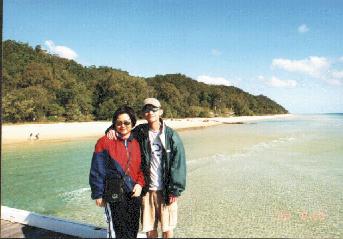
My girlfriend Siok Hwee and me at Tangalooma, Moreton Island
My girlfriend Siok Hwee and me at Tangalooma, Moreton Island
Many have asked, when was the first time I became enchanted with whales and other marine mammals. My reply would undoubtedly be seeing them live and in the wild. Its ironic but there was nothing really spectacular about the encounter. In fact, it was more like a teaser to a movie, seeing enough just to whet your appetite! I still remember that fateful day on the sunny, windswept, grass covered headlands of Point Lookout, Straddie (North Stradbroke Island). We (my girlfriend Siok Hwee, two other friends and a host of other avid whale watchers) were scanning the horizon, hoping to spot that elusive blow that would indicate the presence of whales. Then from out of the corner of my eye, I spotted something unusual, a faint puff followed by a rolling black back. I shouted exitedly "whale, whale". In an instant, I connected with the great whales, with nature in some indescribable way. As my interest grew, so did my knowledge of these magnificent beings and their role in the marine environment. As I researched, I began to learn about the atrocities inflicted upon all ceteceans by us.....humans. We have to do something. To me, the only way to educate people about their importance is to experience them first hand.
But whales are not my only interest. I am also immersed in developmental biology, astronomy....in general science and nature. The study of mechanisms that govern development, like why an axon projects into a specific fascicle in the central nervous system (CNS) or why certain cells originating from common ancestral precursors take on a specific cell fate in oppose to its sibling cell is equally intriguing. But the thing that really whets my appetite for developmental biology are the genes that specify how and what develops in a specific regions of the body, in short, the homeotic genes. These amazing genes, originally discovered in the fruit fly Drosophila melanogaster, have been shown to be highly conserved from lowly animals like nematods to highly evolved beings, like humans and can cause exotic transformations (i.e. causing a leg to form where the antennas should be).
And my oldest obsession, Astronomy. I have always been fascinated by nature, and the night sky is just one of nature's most magnificent displays. From the comets I have seen...Halleys in 1986, Hyakutake in 1996, Hale-Bopp in 1997 and Soho in 1998 to nebulae such as M42, the Orion Nebula and galaxies such as NGC 5128 in the constellation of Centaurus, there is something new to see every night.
I have been blessed to be able to enjoy all these at my time in Brisbane, Queensland with my girlfriend (who incidently, is into molecular genetics and aquaculture). From watching the whales (humpbacks and orcas) and dolphins (bottlenose, humpback and common) to working on effects of homeotic gene mutations on the peripheral nervous system (PNS) and gazing up into the heavens to catch celestial events such as the comets Hale-Bopp and Soho and the Leonids in November.
And last but not the least, thanks for taking
the time to browse and read about our marine mammal cousins. I hope I have
sufficiently inspired you to do something about the world we live in. Remember
that an individual can make a difference in the fight to save our seas
and its inhabitants. All we need to do is look deep into our hearts and
make that extra effort.
Cheers!
Darren Wong
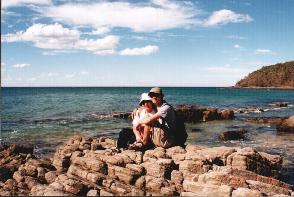
Taking up the sun in Noosa, another whale watch hot-spot
ps: While you are at it, check out my all new tribute to Straddie and a page dedicated to my newly adopted whales Venus and her extended family, Falco, the biggest mother on Stellwagen Bank and Cyrano, a New Zealand Southern Right Whale.