Whale Watching in Queensland, Australia
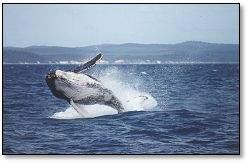
The mighty Humpback breaching, Hervey Bay
A Brief Introduction
Due to the migration patterns of the magnificent humpback whales, their yearly migration brings them north from the cold waters of the Antarctic to the tropical waters of Queensland. Hervey Bay (pronounced Harvy), just 3 1/2 hours drive from Brisbane is touted to be the whale watch capital of the world due to its viewing conditions. The whales stop by the lake-like Hervey Bay to play, rest and frolic in the sun. Whales can also be seen off the coast of Moreton Island and North Stradbroke Island and as far north as the central Great Barrier Reef (The Whitsundays and Capricorn Bunker Group) where they calf during the months of July, August, September and October. However it was back here in Brisbane that I got hooked on whales. The rest is history. Read on to find out more about these gentle giants and an account of my trip to see these leviathans of the deep.
Fast Facts about Humpback Whales
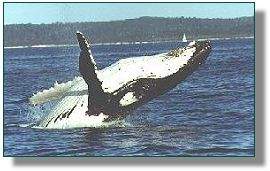
The humpback whale (Megaptera novaeangliae) belongs to the zoological order "Cetacea" and is a baleen whale in the suborder Mysticeti. Its latin name Megaptera, meaning big winged and novaeangliae, which refers to the old whalers of New England briefly describes these great leviathans. The term humpback is used due to the characteristic nature of these marine mammals as they hump their backs while diving. These huge mammals are the 5th largest animals on the face of the earth, averaging 15 meters in length (although the record length for a female was a whopping 19 meters) and weighing about 45,000kg each, an equivalent of about 11 elephants or 600 persons. The calves are about 3.5 meters long when they are born and weigh an average of about 1,500kg. The calves are suckled underwater and grows about 45 to 60kg per day. Humpback whales also sing the most complicated love songs but do not possess any vocal chords. These songs actually form complex and ordered patterns and appear to be sung by only solitary males in the coastal breeding grounds of the tropics. Also, there are two distinct populations of humpbacks, that is the northern population (mostly all black in color) and the southern population (mostly white and black in equal proportion).
The annual migration to warmer waters
Each year, these magnificent creatures migrate 12,000km from their feeding areas of the Antarctic to the warm waters of the Great Barrier Reef, where they mate and give birth to their calves. They stop over at Hervey Bay before continuing their migration back to the Antarctic. The whales are not in transit by the time they reach the tranquil waters of Hervey Bay area. It is here that they rest, play and teach their young while allowing their calves to develop sufficient blubber for their migration back to the Antarctic. This usually occurs between the months of July and early November, the best time to catch the antics of these huge mammals. In Hervey Bay, whales are seen from the end of July to late October. The whales enter Hervey Bay in three phases with the adults coming into the bay in August, followed by the sub-adults (juvenile's) / mother and calves in September and finally mothers and calves in October. As to why the whales choose to rest and play in Hervey Bay, several theories have been put forward. These include protection from killer whale and pack shark attack and the shape of the land countours. Due to the shape of the bay and the presence of Fraser Island, the whales are funnelled into the bay. From their migration patterns, there are three spots where whale watching can be achieved, that is, the Whitsundays in the north, Hervey Bay, undoubtedly the best place for such pursuits and off Moreton Island and North Stradbroke Island in the south.
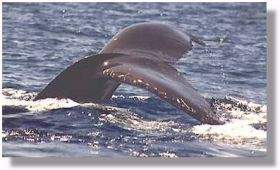
"The Fluke Up"
Fast Facts about Bottlenose Dolphins
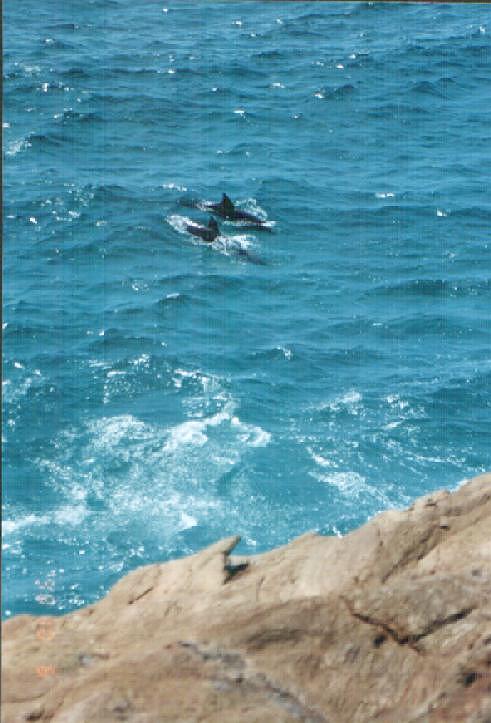
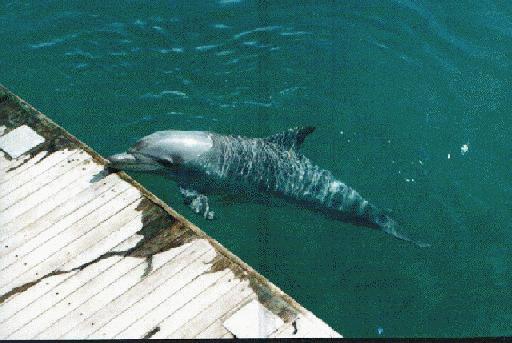
"Bottlenose dolphins off North Gorge, Point Lookout!"
Contents
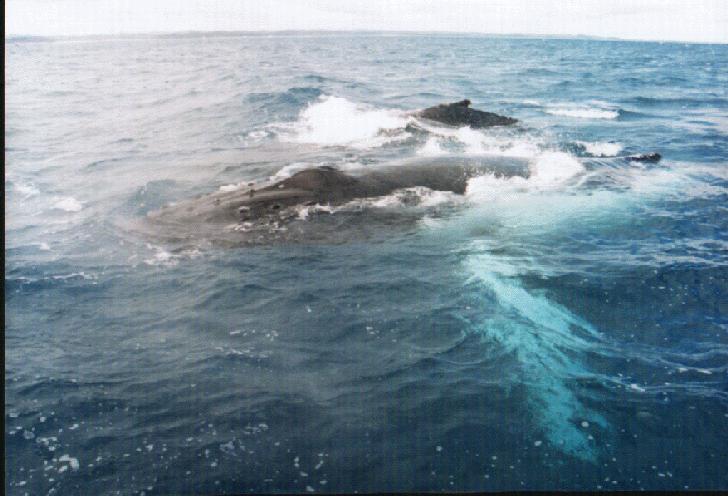
"Two humpbacks, Hervey Bay 1998"
"Whales are our heritage. Help us fight against whalers who deceive the world with their so-called "scientific" hunting and hunt whales for profit. We must strive to preserve these magnificent creatures of the deep". For more information on various whales and marine mammals check out Graham Clark's "Whales on the net" ." To support a worthy cause and fight to preserve the whales sign the popular resolution! Also, while you are at it, you might want to check out Malcolm Thomas's "Humpback whales of Hervey Bay- Australia". It has heaps of information regarding humpbacks and loads of pictures, all taken by professional photographers on board cruise ships of the Hervey Bay whale watch fleet. Also, check out Wally and Trish Franklin's Oceania Project website. It details their research on humpbacks in Hervey Bay. For the latest cetecean related news, check out The Oceania Project's "Soundnet"page. Wally and Trish need your help. They need funds to obtain a video workstation for field work. Click on the logo below to help......
- NEWSFLASH - NEWSFLASH - NEWSFLASH - NEWSFLASH -
"NEWS"My first whale watching adventure for the 2003 season happened at the end of September. Not much activity, just two whales spotted from the restaurant at Point Lookout. they were pretty close and stayed for a while .Check out my report at personal accounts 2
"NEWS"My only whale cruise for the year 2003. Finally got some breaching shots, if far away! I think my technique has improved. Now all I need is luck! Anyway we did not have to go very far out this time as the mothers and calves were all in the bay in shallow water. Check out my report at personal accounts 2
"NEWS 2004"The 2004 season is underway and guess who has showed up on our eastern shores....non other than celebrity whale Migaloo. Here is the snippet about Migaloo's appearance: "White Whale Returns to Australia's East Coast. Thursday 17th June 2004, Sydney: This week the world's only known albino whale has excited whale watchers along the Australian East Coast as it returned to our shores on its annual northern migration. Known popularly as Migaloo but also known by the names H2 and Lotus, the first sighting for this season was on Thursday 17th June from Botany Bay National Park in Sydney".
"NEWS 2004"18th of July 2004. My first whale sighting of the season and from the Surfers Paradise on Gold Coast at that. We were there for a night and two days just to relax as the wifey wanted a break from thesis writing. And what a way to end the short holiday. Spotted 6 humpback whales from the 18th story balcony of Breakfree Resort's Beachcomber on a Sunday morning from 9am-10am. 2 of the whales were a mother and calf pod and they hung around for a while. Through my now official whale watch binoculars ;)10x50's, I watched as the mother and calf breached a couple of times. Lost count as the baby breached a couple more times. Looking forward to a great whale watching season".
"NEWS 2004"28th of August 2004. Second whale expedition this time to my second home Straddie. Read about it at personal accounts 2".
"NEWS 2006"1th of August 2006. Its been a while since I updated this page due to the lack of whale watching activity. Last year (2005) I spent a dismal single day of whale watching on Straddie but I plan to change that for this year as I plan to go on a "whale watch cruise" and make at least two trips out to Straddie to reconnect with the humpies. It has been a long time coming. Oh and by the way Migaloo was spotted late June travelling up the cost accompanied by several other humpies. Its going to be a great whale watching year!".
New links have also been added. You can now access up to date whale watch sightings report at IFAW. Also you can get the latest on whales at The Australian Cetecean Network
ps: I have recently taken a big step forward to help preserve the marine environment and to help our marine mammal cousins, the whales. Check out my adoption pages
Venus and her extended family, Falco, and Cyrano."LAST SEASON (2000) HIGHLIGHTS"The white whale "Lotus" was spotted off Point Stephens, north of Newcastle on June 20. There were also unconfirmed sightings off Point Lookout on Straddie, south east Queensland, read about it
"Researchers chase the white whale" . Also Something very unique happened in Hervey Bay during the 2000 whale watching season. In September 2000, a rare southern right whale and calf was spotted by the Pacific Whale Foundation team led by Greg Kaufman in the bay interacting with a mother and calf humpback. Read about it here.Get a whale and dolphin screensaver now at:-

Updated 1th of August 2006
All images copyrighted by me with the exception of the professional images which are public domain. To use images, please mail me first (or at this address).
Do send me feedback by mailing me or at dhumpie!