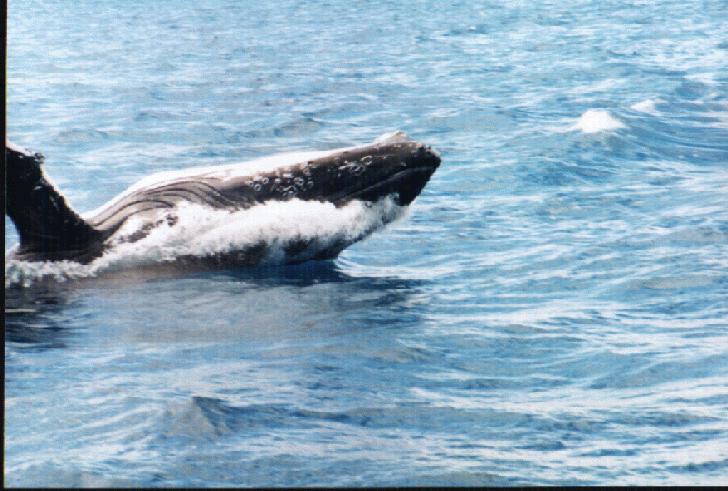
It has been suggested that the stock growth rate
is approximately 11% per annum indicating a very high survival rate among
the area 5 humpbacks (Cato and Patterson, 1994).
An estimate 20,000 humpbacks used to migrate up the
east coast of Australia. Today with the estimated 11% recovery rate, in
excess of 4000 (1998) migrate from the cold antarctic waters up the coast
(in the range of 5000 for the year 2000).
Calves may be born en-route while migrating north.
New calves have been spotted on the trek north from Coff's harbour and
Cape Byron. A calf less than a week old has been spotted passing north
off Cape Byron (Wally and Trish, pers. comm.).
Around 10% of the whales are singing when passing
Point Lookout, Straddie, South East Queensland (Cato et. al., 2000).
There is a skewed sex-ratio in migrating humpback
whales off eastern Australia with a predominance of males over females
(Valsecchi et. al., 2000).
The largest whales recorded in Hervey Bay are Brutus
and Caeser (both females) with an estimated length of 13 metres. The average
length for whales in Hervey Bay is 9 meters (Wally and Trish, pers. comm.).
Lotus (H2) the all white albino whale (strongly suspected
to be a male since he has been recorded singing in the bay) has been spotted
in Hervey Bay three times in 1992, 1993 and 1998. This whale was first
spotted from Cape Byron in 1991 by Paul Hodda of the Australian Whale Conservation
Society.
Numbers of whales entering Hervey Bay in a 10 week
period: 371 (1996), 672 (1997), 917 (1998) individual whales. All figures
include resights. Figures will change after photographic analysis (Wally
and Trish, pers. comm.).
Other whales and cetaceans spotted in Hervey Bay
and surrounds include the minke (the smallest rorqual whale, averaging
9 to 10 meters in length, spotted on average 1 per week), bryde's whale
(pronounced broo-dahs, spotted only twice in the Bay area), bottlenose
dolphins, common dolphins, sousa (south pacific humpback) dolphins. There
have been reports of pilot whales, melon head whales and in the sixties,
there was a sperm whale mass stranding just north of Point Vernon (Wally
and Trish, pers. comm.).
Orcas (killer whales) used to be a common sight in
Hervey Bay. As the numbers of humpbacks increase, orcas in the bay should
become a more common sight. Fishermen have spotted orcas outside near Fraser
Island since two years ago (Wally and Trish, pers. comm.).
Humpback calf mortality. There seems to be a high
mortality of calves (due to strandings) in June/ July during the nothern
migration. Also, from a recent list of observed attacks off Cape Moreton/
Point Lookout suggests that attacks by Orca's are most likely to occur
in the month of October (Janetzki and Paterson, 2000).
The largest whale ever caught at the Byron Bay whaling
station was 15.9 metres in length.
NOTE : For more information on year 2000 entries,
consult the abstracts booklet of the "Humpback Whale Conference 2000, Queensland
Museum, Brisbane, Australia, 29 August - 1 September 2000".