Tips to obtaining excellent
whale photographs
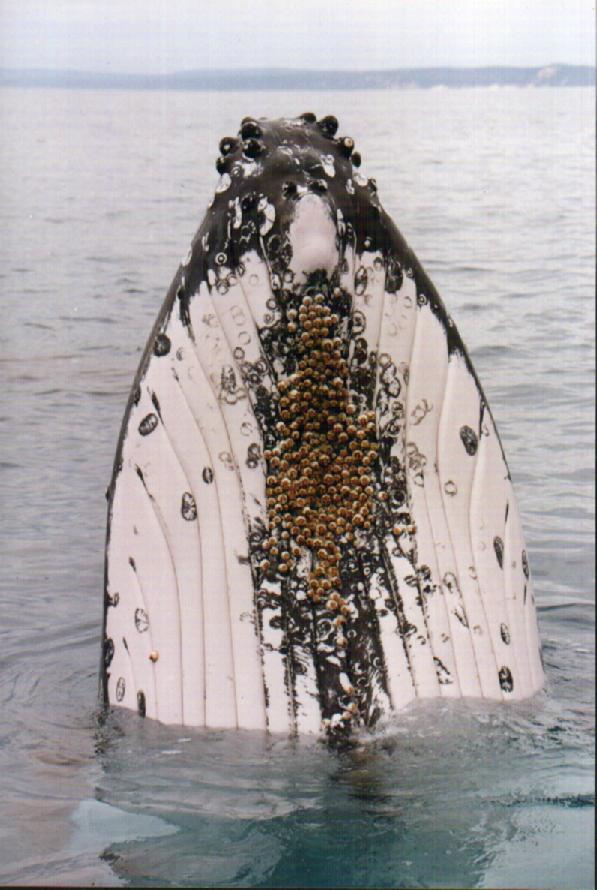
"Magnificent spy hop. Hervey Bay"
The dream of every avid whale watcher is to capture
spectacular whale photographs rivalling photos taken by professionals.
The main difference is of course, the experience and the equipment. Listed
below are a list of things one could do to improve the quality of their
marine photography:-
-
Use SLR (single lens reflex) 35mm cameras with a
80-200mm zoom (bigger lenses give closer shots but may not be suitable
due to their bulk and time required for change on a rocking ship). As a
guide, a 50mm lens portrays the image as the eyes beholds it. A 100mm lens
gives a 2x magnification, a 200mm lens gives a 4x magnification, a 300mm
lens (the biggest zoom lens that can be steadily held without the aid of
a tripod) gives a 6x magnification and so forth
-
Choice of film (ie. ASA 200 or 400). A faster film
(ASA 400) requires less light and hence is suitable for low light conditions
(i.e. overcast days). However, they tend to be grainier. Slower film tend
to give finer image resolution but a balance must be struck. A ASA 200
film is usually the best bet for a 200-300mm lens
-
Make sure the horizon line is level in your viewfinder
(harder than it sounds on a rocking ship)
-
Depress the shutter slowly and do not follow the
whale through its movements. This will cause the image to blur
-
Set shutter speed to 1/500th of a second (I use 1/2000).
This will freeze any movement
-
If your camera has a light meter, set the correct
aperture by aiming the camera at the water (the whales are in the water,
not in the sky). This will ensure that your photos have proper color balance
-
Filters enhance the quality of your photographs.
A UV or skylight filter will reduce the brightness of the sky while a polarising
filter will greatly reduce the glare and increase water penetration (but
may result in loss of 1 or 2 f-stops)
-
Practise makes perfect. That means taking lots of
crappy photos before you get it right. Have fun experimenting.
Tips on selecting the best whale
watching trip and getting the most out of your money!
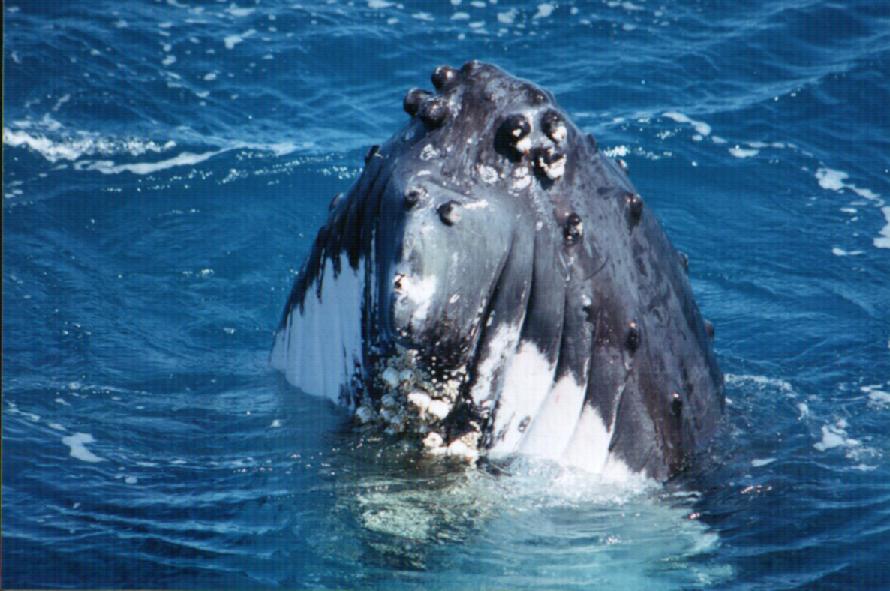
"Headrise leading to a spyhop? Whitsundays"
Most whale watch enthusiast would want to get
the most out of their day whale watching. Selecting that perfect whale
watch tour can be very difficult, especially if there is a wide range of
tours and cruises to select from (like in Hervey Bay). Several factors
can influence this decision. Below are some tips that might help you to
make the all important decision for that trip of a lifetime.
-
Type of cruise ship and speed. The type of ship is
essential as generally, monohull vessels tend to be less stable than double
hull catamarans. The last thing you want is to try the balancing act while
fiddling with your video recorder or camera. Also, the size of the vessel
might influence its stability. Speed is also essential as most cruises
need time to get out to the prime whale watching areas. A faster vessel
can get you there in half the time, allowing for more time with the whales.
In Hervey Bay, this can take anywhere from 45 minutes to an hour. Take
into account the time required for travel! Some of the hours stated on
brochures for day tours can be very misleading.
-
Number of people and viewing areas. This is also
essential. In general, go for vessels which offer 360 degree viewing, preferably
with a large open deck. Also go for cruise ships with a lower number of
people. Such trips are better for video recordings and photography.
-
Profile of the vessel. In general, low set vessels
are ideal for close encounters and sometimes, whales can come within touching
distance. However, the best photos are normally obtained from top view
so high profile vessels might enjoy this benefit.
-
Choice of tours. Its recommended that you choose
full day tours (if you have time to spare) over half day tours. Half day
tours are designed for travelling whale watchers who are on transit (like
the whales, pun intended!). Its advisable to stay the night before heading
out for the whale watch cruise the next day. For full day tours, try to
choose the tour with the longest time out in the waters. And don't forget
to take into account the speed, stability and of course, for backpackers,
the price.
-
For those with money to burn, there are long duration
whale watching opportunities in Hervey Bay. One is offered by Mimi Macpherson
and the other by the Oceania Project group. Both are research based and
you will get a chance to learn how to assist in whale and dolphin research.
Both run for a duration of about 6 days and 5 nights.
-
One last word, dawn tours may be short but they are
well worth it. In Hervey Bay, two operators run dawn cruises, Volante and
Hombre. The sea is calmest and the whales are most active during that time
of day.
-
One last tip, try going with one of the operators
listed below. I have weighed the pros and cons and found these to be the
best:- MV Mikat (Catamaran; 8.30am - 4.30pm 8 hours; $55au), Princess II
(Monohull ship; 7.30am - 3.30pm 8 hours; $55au) and Fraser Princess (Monohull
ship; 9am - 4.45pm 7 3/4 hours; $60au). However, going with any full day
tour, you just can't lose!
| Homepage|
Behaviour| Facts|
Account| Data file|
HB whales| Spotting|
Photos| Tips|
Links| Author