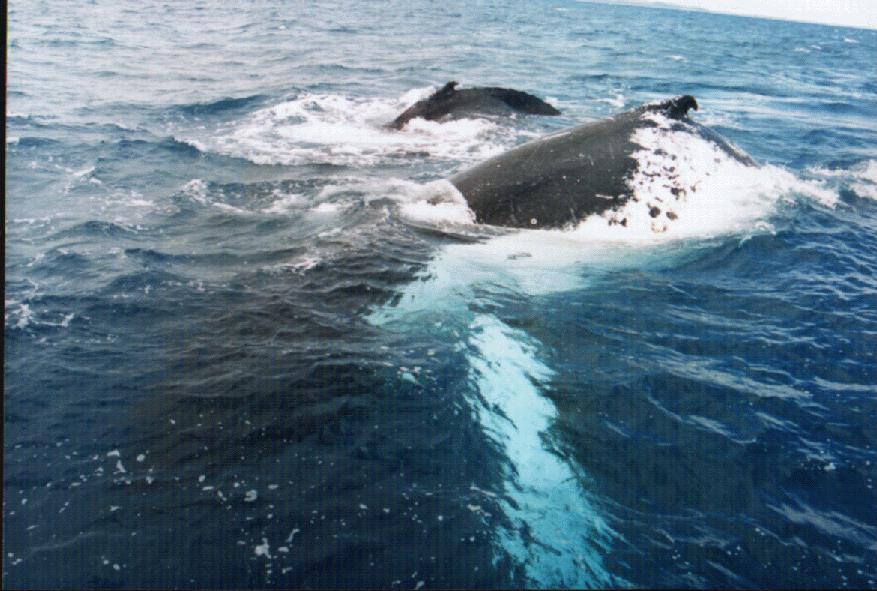
Humping humpbacks, Hervey Bay,1998
Humping humpbacks, Hervey Bay,1998
Introduction
Whales and dolphins are categorised under the zoological order cetecea and there are currently 81 described species. They can be found in all oceans, rivers and estuaries of the world but most species are not readily visible the whole year round. Most "baleen" or "whale bone" whales such as the great whales (which include the blue, minke, fin, sei, bryde's, humpback and southern right) migrate between their preferred feeding grounds in the Antarctic and their winter mating and calving grounds in tropical or sub-tropical waters. Therefore, in order to spot and observe these whales, one would have to be there at the right time and at the right place. Certain species of dolphins are common the whole year round and are more readily observed. Below is a guide to whale and dolphin spotting in and around the east coast of Australia (in particular Queensland waters). Also given is a brief description of each. There may be more species that can be visible from time to time, such as spinner dolphins (Stenella longirostris - there have been reports of sightings in Hervey Bay - unconfirmed), pilot whales (Globicephala species - there have been reports of strandings on Fraser Island and Point Vernon, Hervey Bay - unconfirmed. I have also heard rumours that pilot whales can be spotted in and around the outer reef's in Whitsundays, although I am not certain if they are short finned or long finned, but I believe they are short finned as the long finned species are usually found in temperate waters in the south) and other species of large whales (e.g. sei whales - Balaenoptera borealis - have beeen spotted from Cape Byron) though most occur in deep waters surrounding the east coast.
Baleen Whales
Humpback whales (Megaptera novaeangliae)
This is the most widely encountered whale in Australian waters. They are a very common sight along the coastlines between the months of May and December (depending on the location up and down the east coast). For land based observation, there are several vantage points where whales can be spotted. Most whales are spotted from as early as May off Cape Byron (Australia's most easterly point) and Coff's Harbour in NSW. This year two humpbacks were spotted on the 28th of April, 1999 (Wednesday) from Cape Byron. The peak of the whale migration for the northbound leg is in June and July, while there is no observed peak for the southbound leg. The whales tend to be more playful during the southward migration in comparison to the northward migration where they are focussed on reaching the mating and calving grounds in the shortest time. In Queensland, the major vantage points from which to view these magnificent leviathans include North Stradbroke Island (Straddie), Cape Moreton on Moreton Island and Noosa Heads National Park. There have also been reports of whale spotting at Point Arkwright and Coolum Beach on the Sunshine Coast although these are less well known. My personal favourite spot is off North Gorge Headlands, Point Lookout on Straddie, the most accessible vantage point from Brisbane city. Straddie is readily accessible by fast water taxi from the Cleveland jetty. To get to Cleveland, simply take the Brisbane City Train from Roma street (board the Cleveland line) and stop at the last stop. A courtesy bus service is provided, plying between the train station and the jetty where the water taxi's departs. The water taxi cost about $8 (student concessions)/ $10 (adult tickets). To get to Point Lookout, you will have to take the internal bus on the island which cost about $7 (there are no student concessions here). The best spot to view the whales from Noosa Heads is the Granite Pools and Hell's Gates (both accessible by walking coastal tracks). Noosa can also be accessed via the Brisbane City Train. Take the train from Roma Street (Nambour line) and stop at Nambour. A train link bus will then take you all the way to Noosa Heads (remember to purchase a ticket for Noosa Heads and not for Nambour). For Moreton Island, you would have to take a ferry across from Pinkenba jetty. To access Cape Moreton, you would need to have a 4WD as Moreton Island is a sand island. For catamaran and cruise ship based whale watching, the best places to visit (all have commercial whale watching vessels) include Moreton Bay (two commercial whale watching vessels: Akarma Whale Watch cruises which depart from the Scarborough boat jetty in Redcliff, 30 minutes drive north of Brisbane city, and Tangalooma Wild Dolphin Resort whale watch cruise which departs from the Pinkenba jetty in the heart of Brisbane), Hervey Bay (there are currently 19 commercial whale watch cruises available. All depart from Urangan boat harbour) and the Whitsundays (I only know of one operator in this region, the "FantaSea" whale watch expedition operating out of Shute Harbour in Airlie Beach). In the NSW region, humpbacks can be spotted from Cape Byron and Coff's harbour (with cruises) from May to November and at Merimbula (True Blue whale cruises) and Eden (Cat Balou whale cruises) on the Sapphire Coast from October to December.
Minke Whales (Balaenoptera acutorostrata)
The minke whale is the smallest of the rorqual whales (consisting of the streamlined blue's, fin's, sei, bryde's and minke's) growing to an average length of approximately 10 meters and weighing about 10 tons. It is also the most numerous of the great whales, enjoying natural protection from hunting due to its size. This baleen whale has about 60 throat grooves running from the chin to the navel. Distinguishing features that help identification of this species at sea include its pointed head with a prominent ridge, small size, its coloring which is black on the back with a grey-white belly, a light colored chevron behind its head and a light colored flare on the upper surface of the pectoral fins (only in south pacific minke's). In Australian waters, another sub species is seen, the dwarf minke, which grows to a mere 7 meters. Due to its size, the height of the blow and its habit of not raising its flukes when diving, this whale is very difficult to spot from shore. This whale is, however, quite common in Australian waters and has be spotted in Hervey Bay (an average of once per week. Trish and Wally Franklin, pers. comm.), from vantage points at Cape Byron and from commercial cruises off Merimbula and Twofold Bay, Eden in southern NSW. A unique situation has developed in tropical north Queensland (Cairns, Port Douglas) where dwarf minke's have been coming in close and interacting with divers and snorkellers alike (March to October, peak June and July). This small whale is extremely inquisitive and will not hesitate to approach cruise ships. However, it has a habit of slinking away when spotted hence its nickname "slinky minke" (Ross Issacs, Encounter with Whales).
Bryde's Whale (Balaenoptera edeni)
The bryde's whale is also known as the "tropical whale" and is fairly common in Australian waters. This mid-sized whale grows to about 14 meters in length and weights, on average 20 tons. It has about 40-50 throat grooves and the distinguishing features that allows its identification include its three prominent ridges on its head, its dark grey back and lighter coloration on its bottom. This whale occurs in tropical and sub-tropical waters (hence its nickname). It has been spotted in Hervey Bay, from Cape Byron (thought infrequently) and off Lockhart River in Cape Yorke country (northern reef waters, tropical north Queensland, in December). A complete skeleton of a bryde's whale can be seen in the Queensland Museum, Brisbane.
Blue Whales (Balaenoptera musculus)
Blue whales are the largest animals on earth, dwarfing even the great dinosaurs. On average, a blue whale measures 25 meters in length and weights about 200 tons. However, the largest female ever recorded was an amazing 33.6 meters (110 feet) across. They have about 100 throat grooves and are blue-grey at the top and motted spotted pattern yellow on the bottom (from the cold water, yellow colored diatoms), giving them the nickname "sulphur-bottom". There are three sub-species of blues living in the oceans today with the largest living in the Antarctic, a smaller sub-species living in the northern oceans and an even smaller one, dubbed the "pygmy blue whale" living in southern oceans. Blues rarely venture near the coastlines but have been observed from land and from cruise ships off Merimbula and Eden in southern NSW, making these vantage points very unique. Also, in the south, blues have been observed close to coastlines. Just early this year (6th of April, 1999), a blue was spotted feeding off the coast of Port Fairy, Victoria. There have also been reports of blues off the coast of Portland and Port Campbell earlier this year. The Queensland Museum has a skull of a juvenile Blue on display.
Southern Right Whale (Eubalaena australis)
The stocky southern right whale is a robust creature, growing to an average length of 15 meters and weighing approximately 80 tons. Easily distinguished from the other great whales due to its characteristic callosites (hardened patches of skin) on its head (these occur in different configurations allowing photo identification of individual whales) and the lack of a dorsal fin. They were named "right" whales as they were deemed the suitable whale to hunt due to their characteristics. Southern right whales calve very close to the shore, float when they are dead and have vast amounts of blubber reserves. The southern right whales are one of the most endangered whales today, alongside the northern right whales which are on the brink of extinction. They gather in great numbers off the cliffs of the Great Australian Bight (at the Head of Bight) in south Australia from May to October (up to a hundred whales have been reported). From the east coast, they are spotted from time to time from headlands at Merimbula and Eden in southern NSW and even in the busy waterways of Sydney's harbour. Like their counterparts, the humpbacks, the southern right whales are the next most frequently encountered whale in Australian waters (particularly in southern waters). They also exhibit all the antics shown by the humpbacks, like breaching, tail slapping, fluking and pec slapping.
Toothed whales and dolphins
Killer whales (Orcinus orca)
The killer whales or "orca's" are the largest marine predators of the oceans, growing to a length of about 9.5 meters and weighing approximately 10 tons. Orca's are easily identified at sea due to their black and white "tuxedo" coloring and their unmistakable tall dorsal fins (in males, they are 1.8 meters tall, as tall as an average person!). Known as "wolves of the sea", orca's hunt in packs and eat everything from fish to the largest marine mammals (even the blue whale). In Canada, orca pods are classified as resident, off-shore and transient. The resident orca's feed on fish and have a very narrow home range while the transient orca's travel long distances and prey on larger marine mammals like dolphins, sea lions, seals, sea birds, sharks (even the great white shark!), minke's, humpback's, bryde's and the mighty blue whale. Resident orca's have been shown to use echolocation to locate their prey (by vocalising) while transient orca's remain silent and only vocalise after they have killed or eaten their prey (probably so as to not give away their location to prey). In Australian waters, orca's are becoming increasingly common due to the resurgence of the humpback whales. Orca's have been spotted as far north as Cairns, in the waters outside Hervey Bay and can be seen off the headlands of Straddie, Cape Byron and further south at Merimbula and Eden in NSW.
Bottlenose dolphins (Tursiops truncatus)
Bottlenose dolphins are the most commonly encountered cetecean in Australian waters. They can be seen the whole year round from Hell's Gates at the Noosa Heads National Park, from North Gorge headlands in Straddie, from Cape Byron (famous for their wave surfing dolphins) and undoubtly off Merimbula and Eden. Feeding the wild in-shore bottlenose dolphins from the jetty at Tangalooma Wild Dolphin Resort in Moreton Bay is a dream come true for most cetecean lovers. A pod of some 6 to 9 dolphins come in everynight to be hand fed by guest. Not to be missed!
Common dolphins (Delphinus delphins)
Common dolphins range on average 2.6 meter in length and are commonly spotted bow riding or wake riding (as in my case) in Hervey Bay, Queensland. They are unmistakable with the hourglass pattern and the black eye patch (though not as distinct). I have not seen any common dolphins from any of the vantage points I have mentioned though. It has been reported that they can be seen from time to time from Cape Byron.
Indo-pacific humpback dolphins (Sousa chinensis)
The indo-pacific humpback dolphins or the "sousa"
grows to about 3 meters in length and is whitish grey or pinkish grey (as
are the sousa's of Hong Kong) and is one of the more elusive dolphins to
spot. They have smaller eyes than the other dolphins and have their dorsal
fin raised on a hump (hence the name humpback dolphin).They are generally
found near river channels, bays and mangrove swamps. I have personally
seen sousa's (nothing more than its dorsal fin) at the mouth of Brisbane
river, when cruising out to Moreton Bay. Other places where there have
been reports include the area around Urangan boat harbour in Hervey Bay
and the now famous Tin Can Bay south of Hervey Bay where these dolphins
come in to mingle with visitors on the beach.