 |
Next: The Years of Growth |
| |
Next: The Years of Growth |
|
I. Recognizing a NeedPhotos this section:
Soon after the appointment as the new bishop of Monterey-Los Angeles in 1917, John J. Cantwell said prophetically that Los Angeles would become "the second-largest city in the United States." Among the reasons for this growth, demographers have subsequently attributed the development of hydro-electric power, agriculture, petroleum discoveries, climatic advantages, and advertising. The Rossmore District of Los Angeles had the additional stimulus of the growing movie industry, which had established Hollywood as its international seat. The overflow of employees and aspirants from this exciting new business would soon be pouring into the still largely vacant Rossmore area. What was here consisted mostly of wood frame houses surrounded by large, open spaces. Much of what is now industrial buildings and lots was then bean fields and walnut orchards. However, with keen foresight, Bishop Cantwell saw the need for a new parish in the area. As early as 1925, he had already suggested to his consultors the boundaries for "a proposed new parish for the Hollywood District." The intended boundaries would make for a parish over a mile and a half long by about a mile in depth. |
|
(Untimately the original boundries he suggested were simplified to) Western Avenue on the east, Beverly Boulevard on the south, Highland Avenue on the west and Santa Monica Boulevard on the north. The new parish would take its territory from the surrounding parishes of St. Brendan, Blessed Sacrament and St. Kevin. By the spring of 1962, Bishop Cantwell had come to his final decision on the foundation of the new parish. Now he needed two important ingredients: a name for the parish and a pastor to start the work. The name was easily chosen. In an encyclical in 1922, Pope Pius XI had alluded to "Christ the King of all nations." Then in 1925 the Pope decided to proclaim a day to honor Christ the King. Bishop Cantwell saw Providence at work in this proclamation and chose the name of Christ the King for the new parish in the summer of 1926. Thus, the official founding date was on the new Feast of Christ the King on October of 1926. |
|
|
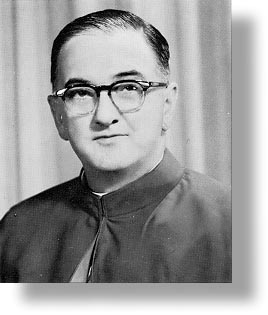
The choice of Christ the King's pastor was equally providential. Bishop Cantwell had grown to know and respect a young priest named Peter Corcoran. Father Corcoran had been ordained in Ireland for service in the Diocese of Monterey-Los Angeles in June 1921 and had arrived soon afterwards to take up his first assigbnment as assistant pastor of St. Basil's Church in the Wilshire District. His work at St. Basil's gave him a familiarity with the district to which he would be assigned as pastor. In 1923, Father Corcoran was appointed diocesan superintendent of schools and principal of the present Bishop Conaty High School. In the summer of 1926, Father Corcoran had received permission to go back to Ireland for his first vacation since ordination. He had barely arrived home when he received a cable from Bishop Cantwell informing him of the appointment to his first pastorate and requesting him to return as soon as possible. Father Corcoran returned to take up the task of building the parish of which he would be pastor the next thirty-eight years. His first task was to find a suitable location for the Church. He found it on the corner of Rossmore Avenue and Melrose Avenue when he purchased four lots with two houses on them. One house was torn down in order to begin the building of the Church. The other, larger house, a one-story building facing Arden Boulevard, was converted into a rectory-parish hall and temporary church by taking out some of the wall partitions. There Mass was celebrated and all parish activities took place. Los Angeles architect Thomas F. Power was commissioned to draw up the plans for the Church. He chose an Italian-Byzantine style modeling the building and its decorations after St. Sophia Basilica in Constantinople and St. Mark Cathedral in Venice. The contractor for the Church was Joseph A. McNeil, a Catholic layman well known to Bishop Cantwell for his work in the Los Angeles area. The building project was begun at once, and in a little more than a year, the new Church was dedicated by Bishop Cantwell on November 11th, 1927. |
|