 |
 |
|
A History of the conflict
|
|
|
|
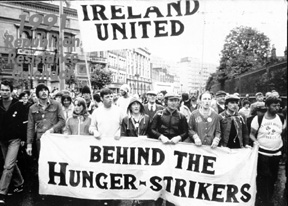
The picture opposite comes from the 1991 Republican Resistence calender. It was taken at a
march to commemorate the death of 10 Irishmen on hunger strike for refusing to accept being classed as
criminals. Huge crowds came out on the streets to call for an end to British rule in Ireland.
|
|
 |
|
|
|
|
The Truce between the IRA and the British army breaks down. The British government unilaterally withdraws
the political status won by republican prisoners and introduces a "criminalisation" policy to remove
the embarrassing acknowledgement to the world that the conflict is a political struggle. This leads to
the blanket protest, where republican freedom fighters refuse to wear a prison uniform. The IRA volunteer
Frank Stagg (a brother of current Labour TD, Emmett Stagg ) dies on hunger strike in an English prison.
|
|
|
The party's successes, despite repression and censorship, place it center-stage and thwart British government
efforts to impose an internal partitionist solution in the Six-counties. Having always pursued a durable
peace settlement based on national self determination, the party redefines its Peace strategy in key
documents, including Scenario for Peace (1987) and Towards a Lasting Peace in Ireland (1992). The pursuit
of that strategy lays the groundwork for the efforts to achieve a lasting peace settlement.
|
|
|
The European court of Human Rights rules that interrogation techniques used on internees in 1971 amounted
to "inhuman and degrading" treatment.
|
|
The prison protest against the ongoing British policy of "criminalisation" is taken to new levels in
1980 and 198, with the hunger strikes for the restoration of political status. Ten prisoners, led by
Bobby Sands, protest to the death in 1981. The prisoners win their demands in the wake of the hunger
strikes.
|
|
 |
|
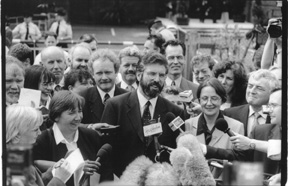
Gerry Adams addresses the public, flanked by important members of the party, at the start up of the
Assembly in Stormont, following the Good Friday Agreement. Shown beside him is Minister for Health, Bairbre
de Brun, and just behind is Minister for Education, Martin Mc Guinness.
|
|
|
|
As the IRA's campaign to secure a British withdrawal continues, Sinn Fein re-emerge as a real political
force in the 1980's, attempting to build mass support for its demand for self-determination for the Irish
people. The result is substantial electoral success, including the election of Gerry Adams as MP for
West Belfast in 1983. The same year 38 IRA prisoners make a daring escape from the H-Blocks.
|
|
|

