|
" Irelands right to Sovereignty, Independence, and Unity are inalienable and indefeasible. It is for
the Irish people as a whole, to determine the future status of Ireland"
- Sean Mc Bride, winner
of the Nobel Peace Prize.
|
|
|
|
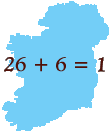
Irish Unity and Independence
|
|
Sinn Feins objectives are National re-unification, independence, sovereignty and socialism
- the right to determine our own political, social, economic, and cultural destiny and to determine our
relationship with, and in, the wider international community.
|
|
The beginning of the Peace Process
|
Sinn Feins peace strategy evolved over a period of ten years. It began with the key documents, Scenario
for Peace (1987), and Towards a Lasting Peace in Ireland (1992). At the core of the Peace Strategy, was
the need for a Peace Process to resolve the causes of conflict. The basic tenets of this were:-
-
To politically engage with our political opponemnts.
- To bring about the exercise of the right to
national self-determination by the Irish people as a whole, and
- To put a peace process in place
to bring this about
|
|
With others, for almost a decade we set about the task of putting such a process together. The
embryonic Peace Process emerged publicly in 1993, in the first joint statement by Sinn Feins President
Gerry Adams and the leader of the SDLP, John Hume. Irish America which played a strong and supportive
role throughout the struggle, took on a greater significance in the emerging Peace Process. Engaging
the American Adminitration as a significant player, ensured an international dimension to the Irish Peace
Process.
|
|
The Irish Peace Initiative.
|
The Irish Peace Initiative developed as a 3 way contact between Gerry Adams, John Hume and the Irish
Government, led by Albert Reynolds. This 1993 initiative was based on the core principles that
-
there can be no internal settlement within the Six Counties.
- Any agreement must be based on the
right of the Irish people to national self determination exercised by the agreement
- a lasting settlement
could only be acheved through all party talks led by both governments
- It must be inclusive
|
On August 31 1994, the Irish Republican Army took the courageous and unprecedented step of calling a
complete cessation of military activity. The IRA statement said
" We believe that an opportunity
to secure a just and lasting settlement has been created. We are therefore entering into a new situaion
in the spirit of determination and confidence: determined that the injustices which created this conflict
can be removed an dconfident in the strenght and justice of our struggle to achieve this"
|
|
The Sinn Fein Peace Strategy, the Hume/Adams dialogue, the Irish Peace Initiative, the involvement
of the White House and Irish America, and the IRA cessation generated a new political climate in which,
for the first time since partition, there was a real prospect of a negotiated settlement, and a lasting
peace.
|
|
Despite many setbacks, subsequent political engagemants and negotiations involving the British and Irish
governments and the political parties in the North of Ireland - with the aid of independent chairs -
led to the Good Friday Agreement, on the 10th of April 1998.
|
|
The Good Friday Agreement
|
On May 22nd 1998, more than two million people accross Ireland voted for the Good Friday Agreement,
an international agreement which was the collective product of inclusive negotiations and a compromise
between political opponents.
While the agreement itself does not resolve the causes of conflict,
it does, if implemented, set out a political and institutional framework within which many of the causes
of conflict can be addressed. It is an important staging post of the Peace Process, which can, like many
others before it in recent years, create the conditions for further advancement.
|
It promised new political structures which were to be based on three central elements -
-
The primacy of politics and the effective delivery of change through politics.
- The sharing of power
equally between Unionists and Nationalists in the North, and
- Substantive All-Ireland institutions.
Mechanisms were also provided to deal with :
- The Equality Agenda
- A New policing service
- Justice Matters
- Human Rights
- Cultural Rights
- Demilitarisation
|
|
Britian defaults on Agreement
|
|
For 18 months, David Trimbles Ulster Unionists and Ian Paisleys Democratic Unionist Party blocked the
formation of the instutions and the implementation of the Agreement. In November 1999, the new political
instutions were finally established. Seventy four (74) days later, on February 11th 2000, the British
secretary of state, Peter Mandelson, collapsed the instutions at the demand of unionists.
|
On the fifth of May 2000, the Irish and British governments published a joint statement agreeing to
re-establish the institutions and setting out the mechanisms necessary for the full implementation of
the outstanding aspects of the Good Friday Agreement. Sinn Fein welcomed this statement saying that change
was essential.
The following day the IRA issued a statement stating that it will "initiate a process
that will completely and verifiably put IRA arms beyond use"
At the end of May power was once
again restored to the political institutions including the assembly, executive, an dthe All-Ireland bodies.
|
|
On the next page you will find a full chronology of the current Peace Process
|
|
|