Modern Irish Republicans trace their political origins to the movement of the United Irishmen of the
1790's. The United Irishmen took thie inspiration from the French Revolution and fought to break the
political link between Ireland and Britian, believing that only an independent Ireland could guarantee
equality and prosperity for the Irish people.
Most of the leading figures figures of the United
Irishmen were Presbyterians and a key part of their programme was unity between Irish people of all religions
and none in the cause of liberty. Their rebellion in 1798 was ruthlessly suppressed but their ideas continue
to inspire Irish nationalists and republicans today.
The name Sinn Fein ("We ourselves"), first
emerged in the early 1900's as a federation of nationalist clubs.
The Sinn Fein party, inspired
by the proclamation in 1916, reorganised in 1917 based on the demand for an Irish Republic. It won the
1918 general election with an overwhelming majority and established Dail Eirann ("Assembly of Ireland").
Following three years of guerilla warfare, led by the underground republican government, the party split
in 1922 on the issue of the Treaty which partitioned Ireland.
Throughout the 1920's, following
a devastating Civil War, Sinn Fein continued as the republican party. Its fortunes ebbed and flowed in
the late 1950's and the early 1960's with the IRA's border campaign, during which Sinn Fein enjoyed significant
electoral success.
In the 1960's, Sinn Fein adopted a more radical stance on social and economic
affairs. But differing approaches to the Civil Rights movement and to the outbreak of the present conflict
in the six counties led to another split. One section of Sinn Fein was in the process of abandoning the
republican demand for British withdrawal from Ireland and went though various transformations such as
the Workers Party and Democratic Left, before eventually merging with the 26 county Labour Party.
It was in the early 1980's that Sinn Fein really began to make an impact as a serious political
force again.
The re-evaluation of Sinn Fein strategy and reorganisation, resulting from the mass
campaigns for the Republican prisoners in the "H-blocks" of Long Kesh and Armagh jail before and during
the 1981 Hunger Strikes ( when ten Irish men died ), set Sinn Fein on its present course today.
|
|
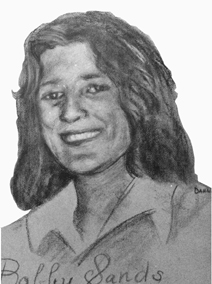 |
A sketch of Bobby Sands, the first hunger striker to die on the 1981 Hunger Strike campaign. Bobby
was the first of 10 men to die at that time. The reason behind the Hunger Strike was that the British
government, and the Prime Minister Margaret Thatcher, in particular refused to recognise the prisoners
as "political". She wished to treat them the same as common criminals. The sketch is a drawing of the
famous photograph that is shown the world over of Bobby. Many people think that the smiling young man
was photographed at a party or some other happy event, but this picture was actually taken inside the
Maze prison while he was already on Hunger Strike, using a camera smuggled in by visitors.
"May
God shine on you Bobby Sands, for the courage you have shown,
May your glory and your fame be widely
known"
- Lines from the song "the ballad of Joe Mc Donnell"
A dheis De, go raibh ar aimn.
|
|
|