 |
 |
|
A History of the conflict
|
|
|
Throughout history, the island of Ireland has been regarded as a single national unit. Prior to the
Norman invasion of Ireland in 1169, the Irish had their own system of law, language and culture, and
their own political and social structures. Following the invasion, the island continued to be governed
as a single political unit, as a colony of Britian, until 1921.
At variuos times over the next 800
years Irish men and women resisted British rule and attempted to assert Irish independence. Between the
years 1916 ans 192, Irish nationalists waged a combined military and political campaign against British
occupation. In 1920 partition (dividing Ireland into two sections - the 26 counties and 6 counties) was
imposed by a British Act of Parliament. The consent of the Irish people was never sought nor freely given.
|
|
 |
|
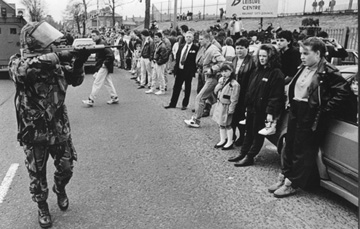
A British soldier lines up a group of people in his sights. As you can see he is aiming
a high powered rifle at a line of children, who are frightened that even a mistake by the soldier would
mean instant death.
|
|
|
Throughout the 19th Century and until partition in the 20th Century, the British government provided
its colonial rule in Ireland with a cover of "democracy". In the changed condotions of a partitioned
Ireland, in now used the wishes of Irish Unionists in the North East of Ireland as justification for
its continued ocupation.
Within the six-county statelet the British government fostered political
division between Irish Catholics and Protestants, through a system of political, social and economic
privilege. The in-built manafactured unionist majority meant continous government by the Unionist party.
Today the unionist community represent some one in five of the Irish nation.
For nationalists,
life under Stormont rule meant institutionalised discrimination, electoral gerrymandering, human rights
abuses and sectarian pogroms instanced by a sectarian state. Indeed patterns of discrimination which
existed at this time remain today with nationalists still 2.5 times more likely to be unemployed.
|
|
The following pages give a brief outline of the struggle in Northern Ireland over the last three decades.
For more in-depth, historical study of these times, known in the North as "The Troubles" click the following
link.
|
|
|
|
|
Organised discontent began to emerge in the late 1960's, leading to the formation of the Northern Ireland
Civil Rights Association (NICRA). Their moderate demands were :
- One person , One vote.
-
An end to the gerrymandered local government boundaries.
- An end to discrimination in the allocation
of local housing.
- An end to discrimination in employment.
- The Repeal of the repressive Special
Powers Act.
These demands were viewed by the unionist majority as a threat to their privileged
position. But the violent reaction of the British state shocked the world as television cameras relayed
scenes of unprovoked attacks on civil rights marches and demonstrations.
As widespread political
unrest spread, on August 14th 1969, British soldiers were deployed in Derry and Belfast. Within a relatively
short period came the intrduction of curfews in nationalist areas, internment without trial, and this
came to a head with the murder of 14 unarmed civilians at a civil rights march in Derry on 30th of January
1972, by the British Paratrooper regiment. This became known as Bloody Sunday. Within weeks of this massacre
the British government abolished the assembly at Stormont and resumed direct rule from Westminister.
|
|
|
|


