 |
 |
|
A History of the conflict
|
|
|
|
Continued from previous page
|
|
|
A history of the current conflict from 1968 - 1992.
|
|
|
|
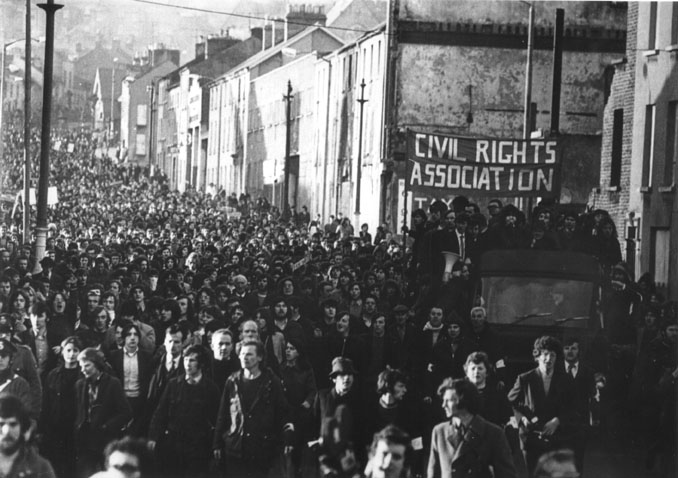
The picture opposite shows the lorry carrying leaders if NICRA, on Bloody Sunday in Derry 1972. The
lorry was supposed to go to the Guildhall in Derry where speakers including civil rights leaders Bernadette
Devlin, and Eamonn Mc Cann among others were to speak to the crowd. However the authorities banned the
march from entering into the centre of Derry. When the march was turned back at military barricades,
the British Army sent in a numbers of regiments to make arrests. The most notorious of the units sent
in were the 1st Regiment Paratroopers, who opened fire indiscriminately on the marchers, killing 14 people
ranging in ages from young teenagers to middle aged people. After the massacre public pressure forced
the British Government to hold a judicial enquiry into the events of Bloody Sunday, but what came from
this enquiry, known as the Widgery Report, was a whitewash which put all the blame for disturbances on
the peaceful marchers and totally exonerated the British Army. After years of campaigning for the truth
into the events of Bloody Sunday the British Govermment finally opened a new enquiry, which is being
currently held in the Guildhall in Derry under Lord Saville.
|
|
To find out more about Bloody Sunday click here, or on the picture opposite.
|
|
|
|
|
|
|
Inspired by the student protests in France and the Civil Rights campaigns in the United States, the
Civil Rights movements takes to the streets, rejecting the sectarian structure of the Six county state
and campaigning for equal rights for all. They are beaten off the streets by the RUC and unionist mobs
backed up by the RUC reserve, the B-Specials. British troops are deployed allegedly to keep the peace
but effectively to back up the RUC.
|
|
Republicanism splits amid differing attitudes towards the deteriorating situation in the Six counties.
One section was in the process of abandoning the demand for complete British withdrawl from the Ireland,
and went on to become Sinn Fein, the Workers Party (the remnants of which were recently subsumed into
the Labour Party). Sinn Fein emerges as a party of resistence for the nationalist people in the Six counties
and becomes the leading advocate of British withdrawal and a 32 county socialist republic. While the
IRA, in response to the Battle of the Bogside in Derry, and unionist pogroms in Belfast, and the introduction
o finternment without trial, goes on the offensive.
|
|
The British government introduces internment without trial, rounding up hundreds of nationalists (and
a handful of loyalists) in dawn raids. The Civil Rights movement launches a civil disobedience campaign,
including a rent and rates strike.
|
|
|
After the massacre by British army paratroopers of 14 Civil Rights marchers in Derry, in what has become
known as "Bloody Sunday", the IRA intensified the war against the Crown Forces in the Six-counties. The
British government introduces direct rule. The British government and the IRA call a truce, and the government
flies Republican leaders (including Gerry Adams and Martin Mc Guinness) to London for talks with the
Secretary of State, William Whitelaw. The British Army then breaks the truce and invades "Free Derry
and "no-go" areas in Belfast.
|
1974 :
The power-sharing "Sunningdale Executive" is brought down by an Ulster Workers Council strike,
supported by Unionist politicians and enforced by loyalist paramilitaries.
1974 :
IRA volunteer,
Michael Gaughan dies on hunger strike in an English prison.
1975 :
A new truce between the
IRA and the British army leads to "Truce monitoring centres" liasing between Republicans and British
government officials. There is a heightened campaign by loyalist death squads. Constitutional Convention
to discuss future government of the Six-counties meets, but is collapsed by the Ulster Unionist Party
tne following year.
|
|
 |
|
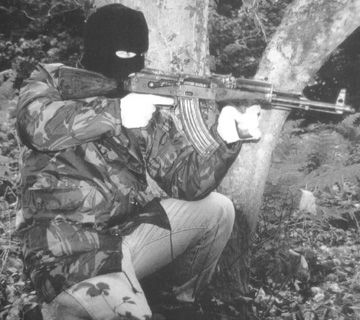
The picture on the left is of an IRA volunteer training at a secret location. After the massacre
in Derry on Bloody Sunday, and the pogroms in Catholic areas in Belfast it was increasingly left up to
the IRA to defend Catholic areas. This was in spite of the fact that the original deployment of the British
army was specifically for this purpose. However loyalist death squad were indiscriminately killing Catholics,
often in collusion with the British army and the State police force, the RUC.
|
|
|
|


