#1 Pat says to ** Keep
it small! ** for your practice piece.
It will make a nice wall quilt or table runner, then if you love it, go
bigger, but later on your own.
DRAW THE TRIANGLES:
#2: PAT sez...
NOT TOO TINY. the Minimum size should be 6" on a side, and the Maximum
is 15" They should be not too THIN either.. at least 5 inches across the
middle. |
MAB thinks... remember
that we will be sub-dividing the triangles you draw first into three
more triangles later. I didn't get that at first and was going by Pat's
quilt picture seeing all the smaller triangles. So, keep that in
mind when you draw. |
 |
#3:
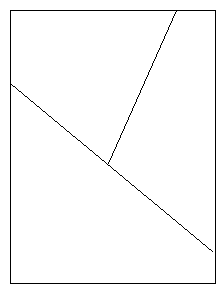
PAT sez... Try drawing ONE line on
a slant, and then use that line to be the side of several triangles. Note
that IF the triangles all converge at one point, you will not only have
a big bump of fabric there, but you will have created a STAR, not triangles.
MAB thinks... Okay, so we are to try drawing
one line on a slant, so I draw two lines on a slant. That will for
sure make it easier to piece it all back together... I am drawing
this in my CAD program and then I will be able to print it out any size
I want to so I really don't know at this point how large mine will end
up.
These lines might not be right and I might
have to end up changing it... we shall see.. |
 |
#3:
PAT sez... Now, using your ruler and
pencil, you will draw Triangles. Try to not have more than 3 or 4 come
together at the same point. What you do to avoid this, is extend the line
so the next triangle will be LONGER than the one it touches. You may not
have NON Triangles except for the edge.. (well, you can,
but I am not going to tell you how to piece them).
MAB thinks: I choose to make all the
triangles within the picture and not extend them... just thought it would
be easier that way. |
| #4
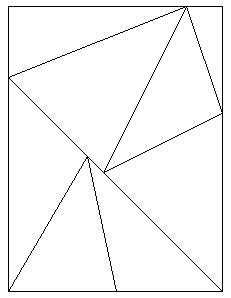
MAB thinks... So here is my interpretation
of Pats above directions. I did end up changing the line that went
from the upper left to the lower right. When I tired to make a triangle
in the lower right I couldn't get it to come out right from the way I had
the line ending above the corner before. (go back and look!)
I have eight triangles now. I think that
is enough! |
#5
MAB thinks... Now I have three of the
"rules" that Pat stated:
1) Try to not have more than 3 or 4 come together
at the same point. What you do to avoid this, is extend the line so the
next triangle will be LONGER than the one it touches,
2) NOT TOO TINY...
3) not too THIN either." So,
right in the middle there, I made the triangles *avoid* each other.
Otherwise, I think you will end up trying to match up all those points
and this way you don't have to match anything! I might have to change
that triangle in the upper right, it looks too small. |
| Don't copy
mine! Do it your own way. We want to see pictures of all the
done quilts and we want them all to show each of our creativeness. I
bet Pat will be real proud that we made some lovely works of art from her
directions and pattern.
Pat's
quilts
Quilts
of Pats students |
Go take a look at the
quilt pictures that Pat and her students have on the WWW. Study how
they drew their lines and see what *look* you like best. Remember
that each of the above triangles will be divided into three more triangles
that are shaded light, medium and dark. So keep that in mind when
you look at the finished quilts.
Oh, and while you are there, take a look at
the colors... they are so gorgeous! Each one is different and so
exciting. |