

-
Your Gateway To Oman
|
|
|
- |
|
Your Gateway To Oman |
||
|
|
Social Welfare Employment I Health & Safety I Expatriate Labour I Demand for Employment I Omanisation I Labour Legislation I Scouting I Health Inspection Every Omani has not only a right to work butt also a duty to find work. His Majesty the Sultan has stated that he does not wish to see Omanis unemployed and has urged them to take jobs even though they may not always find jobs to their taste. The Ministry of Social affairs , Labour and Vocational Training has attempted to translate this directive into reality by creating suitable job opportunities for Omanis. In recruitment system registers the names of nationals who are searching for jobs, advises them and tries to place them in positions that suit their abilities and experience. Their applications are followed up and help is given with settling in to employment for the first time. The Ministry endeavours to protect the workforce from accidents and occupational hazards at work by monitoring the use of industrial safety equipment, ensuring compliance with health and safety regulations and educating the workforce in the safe working practices. The enormous development programme over the last thirty years created a need for manpower and skills that could not be met locally. It became necessary to recruit skilled and qualified manpower from abroad until such times as national could be trained to replace them. The private sector was therefore allowed to recruit manpower from abroad. Fewer and fewer expatriates are currently being recruited, but for development to continue at a steady pace, they are still needed for work in established enterprises or on vital projects. Expatriates are not allowed to be recruited for vacancies in the private sector when Omanis are available to fill these positions. They can only be recruited for specific jobs. Certain jobs are reserved for Omanis only. Under no circumstances, these certain jobs can they be filled by expatriates. There is a total of just under half a million expatriates working in Oman, in the private sector in the construction industry, in agriculture and fisheries and in domestic service. Others are employed at various levels in government departments and in other public Organisation where special regulations apply. The demands for jobs is continually increasing due to the growing numbers of graduates from education and vocational training programmes. There is often a reluctance among some young Omanis to work in the private sector, which has to be overcome. Every year about 20,000 job seeker are registered with the Ministry. The number of applicants placed in jobs is steadily increasing. The Ministry makes every effort to replace expatriates with suitability qualified Omanis, by encouraging employers to recruit and retain Omanis. At the same time Omnis are encouraged to become better disciplined and to improve their performance in their own interest and that of the country. In the event of a dispute between employer and employee, the Ministry will arbitrate and try to resolve the problems. At the same time it ensures that both abide by the labour laws and their work agreements. The Omani Labour Law allows the government to set a minimum wage. After an exhaustive study of the question, the government decided to set a minimum monthly wage of Omani Rial 100 for Omanis employed in the private sector, together with accommodation and transport for the Omani employee or an allowance in lieu of omani rial 20, according to circumstances. At the same time , employers and employees are allowed the contractual freedom to agree on a higher figure than this minimum sum, depending on qualifications , experience, market forces, productivity, performance and job type. Waste Water & Recycling High priority has been given to sewerage and waste water treatment projects in order to protect water resources and safeguard public health. Waste water is recycled wherever possible and is used for watering trees and gardens in public parks.
Health inspectors monitor all foodstuffs and food outlets. Regional laboratories are being established to relieve the pressure on the country's sole food testing laboratory. Marine Pollution Oman's first piece of legislation was enacted in 1974 to monitor and control marine pollution. With such a long coastline much of it close to shipping lanes, this was a vital measure , not only to protect the marine environment in general, but also to preserve Oman's fishing industry in particular.
|
HIS MAJESTY |
|
INTRODUCTION |
 His Majesty the
Sultan His Majesty the
Sultan |
|
|
History |
Royal Tours |
|
|
Geography |
Sultan Qaboos Rose |
|
|
National Security |
FEATURES |
|
|
Social Welfare |
The National Flag |
|
|
Environment |
The Grand Mosque |
|
|
Regions |
Forts |
|
|
WILDLIFE |
Khanjars |
|
|
Arabian Oryx |
Dates |
|
|
Arabian Leopard |
The Al-Falaj System |
|
|
Arabian Gazelle |
TRADITIONS |
|
|
Reem Gazelle |
Ship Building |
|
|
Arabian Tahr |
Halwa |
|
|
Birds |
Bee Keeping |
|
|
MAPS |
Camel Breeding |
|
|
Oman |
Horse Breeding |
|
|
|
|
|
Make Crazy $$$ With Your Website | /// |
|
Copyright© Hareesh Networks® |
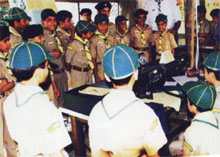 Scouting
is the Sultanate's oldest organized youth activity; the first scout pack was
formed in 1932. The National Organisation for Scouts and Guides (NOSG) was
established in 1975 with the aim of instilling in young people a sense of
service and devotion to their country. Scouting for girls (guides) was
introduced in 1972 and in 1997 the girl guides celebrated their silver
jubilee. His Majesty was installed as Chief Scout in 1983 and under his
patronage the movement has expanded to 655 packs.
Scouting
is the Sultanate's oldest organized youth activity; the first scout pack was
formed in 1932. The National Organisation for Scouts and Guides (NOSG) was
established in 1975 with the aim of instilling in young people a sense of
service and devotion to their country. Scouting for girls (guides) was
introduced in 1972 and in 1997 the girl guides celebrated their silver
jubilee. His Majesty was installed as Chief Scout in 1983 and under his
patronage the movement has expanded to 655 packs.