|
|
History
The Pre-Islamic Times I
Coming of Islam I
Invasions I
The Two Dynasties
The Pre-Islamic Times
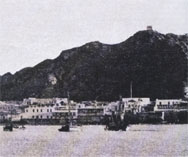 Oman
is a country as old as time. Although we know a little about the first
fisherman and hunter-gatherers, it is clear from recent archeological
discoveries and research that an early form of civilisation existed at least
5000 years ago. Sumerian tablets refer to a country known as 'Magan' for its
copper mines, which is almost certainly a reference to Oman's early mining
industry and regional trade. 'Mazoun', another early name of Oman, is
thought to refer to the abundance of water, which made it possible to
establish the first farming communities. The name Oman is said to come from
the fact that a number of Arab tribes migrated to the country from a place
in Yemen called Uman. It is certain that many tribes settled in Oman from
elsewhere in ancient times. Oman
is a country as old as time. Although we know a little about the first
fisherman and hunter-gatherers, it is clear from recent archeological
discoveries and research that an early form of civilisation existed at least
5000 years ago. Sumerian tablets refer to a country known as 'Magan' for its
copper mines, which is almost certainly a reference to Oman's early mining
industry and regional trade. 'Mazoun', another early name of Oman, is
thought to refer to the abundance of water, which made it possible to
establish the first farming communities. The name Oman is said to come from
the fact that a number of Arab tribes migrated to the country from a place
in Yemen called Uman. It is certain that many tribes settled in Oman from
elsewhere in ancient times.
The Coming of Islam
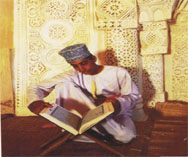 The
Omanis were among the first Arabs to embrace Islam , when the Prophet
Mohammed sent Amr ibn al-As to the rulers of Oman, inviting them to the
embrace the Faith.Oman responded to the call and from then on became
stronghold of Islam, helping to spread the faith to many parts of the world,
most notably to eastern and central Africa. With the acceptance to Islam,
Oman in the Middle Ages became a prosperous seafaring nation, trading from
the great port of Sohar to Africa, India and the Far East. The
Omanis were among the first Arabs to embrace Islam , when the Prophet
Mohammed sent Amr ibn al-As to the rulers of Oman, inviting them to the
embrace the Faith.Oman responded to the call and from then on became
stronghold of Islam, helping to spread the faith to many parts of the world,
most notably to eastern and central Africa. With the acceptance to Islam,
Oman in the Middle Ages became a prosperous seafaring nation, trading from
the great port of Sohar to Africa, India and the Far East.
The Invasion & Occupation
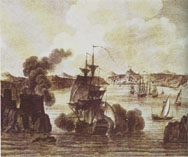 In the early 16th century, the Portuguese who were rivals for the lucrative
maritime trade developed by the Omanis , invaded Oman and captured Muscat.
The Portuguese occupation lasted for one hundred and fifty years in the face
of stiff resistance. The Portuguese were eventually defeated and expelled by
Sultan bin Saif al-Ya’arubi.
In the early 16th century, the Portuguese who were rivals for the lucrative
maritime trade developed by the Omanis , invaded Oman and captured Muscat.
The Portuguese occupation lasted for one hundred and fifty years in the face
of stiff resistance. The Portuguese were eventually defeated and expelled by
Sultan bin Saif al-Ya’arubi.
The Two Dynasties
The Ya'aruba Dynasty
Under the Ya'aruba Imams, Oman saw a period of great prosperity at home and
abroad. Many of Oman's historic buildings and forts date from this period.
Unfortunately civil war erupted between the tribes over the election of a
new Imam and Persian forces seized the opportunity to intervene and occupied
Muscat.
The Al Busaidi Dynasty
In 1744 Ahmed bin Said was elected Imam. He expelled the Persian Invaders
and restored national unity. Since then no foreign power has invaded Oman.
He revived Oman's fortunes and built a strong navy and merchant fleet.
During the last 250 years , Oman therefore not only freed itself from
foreign occupation and influence but, during the first half of the 19th
century , created a empire which included the possessions on both sides of
the Gulf and in East Africa. Oman reached its zenith in the mid-19th
century, becoming a regional power that dominated the Indian Ocean Trade.
Political links were established with great powers of age, namely Britain,
France and the United States. External factors and the world events then
intervened to cause a period of decline and isolation from which Oman only
emerged in 1970, with the accession of His Majesty , Sultan Qaboos who
restored the fortunes of Oman founded by his ancestors. |
HIS MAJESTY |


 His Majesty the
Sultan
His Majesty the
Sultan