

-
Your Gateway To Oman
|
|
|
- |
|
Your Gateway To Oman |
||
|
|
The Grand Mosque
|
HIS MAJESTY |
|
INTRODUCTION |
 His Majesty the
Sultan His Majesty the
Sultan |
|
|
History |
Royal Tours |
|
|
Geography |
Sultan Qaboos Rose |
|
|
National Security |
FEATURES |
|
|
Social Welfare |
The National Flag |
|
|
Environment |
The Grand Mosque |
|
|
Regions |
Forts |
|
|
WILDLIFE |
Khanjars |
|
|
Arabian Oryx |
Dates |
|
|
Arabian Leopard |
The Al-Falaj System |
|
|
Arabian Gazelle |
TRADITIONS |
|
|
Reem Gazelle |
Ship Building |
|
|
Arabian Tahr |
Halwa |
|
|
Birds |
Bee Keeping |
|
|
MAPS |
Camel Breeding |
|
|
Oman |
Horse Breeding |
|
|
|
|
|
Make Crazy $$$ With Your Website | /// |
|
Copyright© Hareesh Networks® |
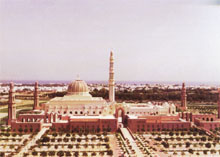 Work
began on the construction of the Sultan Qaboos Grand Mosque complex on a
site by a main road between Muscat and Seeb early in 1995. It was completed
six years later and inaugurated by His Majesty the Sultan in may 2001. the
developed part of of the site , including the fully consolidated areas and
landscaping, covers 416,000 square meters. The Mosque complex (covering
40,00 sqm) is constructed on a raised podium in keeping with the tradition
of Omani mosques that were built elevated from street level. It can
accommodate up to 20,000 worshippers and consists of a main prayer hall,
ladies prayer hall , covered passage ways , a meeting hall and library which
will eventually contain up to 20,000 books. The whole interior of The Grand
Mosque is paneled with off-white and dark grey marble paneling clothed in
cut tile work. Ceramic floral patterns adorn arch framed mural panels set in
the marble forming blind niches in a variety of classical Persian,
predominantly Safavid , designs.
The ceilings are inspired by
those of Omani forts. The
mihrab
in the main prayer hall is framed by a
border of
Quranic verses. The dome comprises a series of ornate, engraved stained
glass triangles within a framework of marble columns and a Swarovski crystal
chandelier with gold-plated metalwork hangs down for a length of 14 meters.
A major feature of the main prayer hall is the hand-made Persian carpet
consisting of 1,700 million knots , weighing 21 tones and made in a single
piece measuring 70 x 60 meters. From design stage it took four years to
complete and 600 female weavers from the province of Khurasan in Iran were
involved. The Grand Mosque inspired the founding of contemporary institute
dedicated to advanced Islamic studies with appropriate educational
facilities and accommodation. The institute is situated to the south of the
Mosque complex site.
Work
began on the construction of the Sultan Qaboos Grand Mosque complex on a
site by a main road between Muscat and Seeb early in 1995. It was completed
six years later and inaugurated by His Majesty the Sultan in may 2001. the
developed part of of the site , including the fully consolidated areas and
landscaping, covers 416,000 square meters. The Mosque complex (covering
40,00 sqm) is constructed on a raised podium in keeping with the tradition
of Omani mosques that were built elevated from street level. It can
accommodate up to 20,000 worshippers and consists of a main prayer hall,
ladies prayer hall , covered passage ways , a meeting hall and library which
will eventually contain up to 20,000 books. The whole interior of The Grand
Mosque is paneled with off-white and dark grey marble paneling clothed in
cut tile work. Ceramic floral patterns adorn arch framed mural panels set in
the marble forming blind niches in a variety of classical Persian,
predominantly Safavid , designs.
The ceilings are inspired by
those of Omani forts. The
mihrab
in the main prayer hall is framed by a
border of
Quranic verses. The dome comprises a series of ornate, engraved stained
glass triangles within a framework of marble columns and a Swarovski crystal
chandelier with gold-plated metalwork hangs down for a length of 14 meters.
A major feature of the main prayer hall is the hand-made Persian carpet
consisting of 1,700 million knots , weighing 21 tones and made in a single
piece measuring 70 x 60 meters. From design stage it took four years to
complete and 600 female weavers from the province of Khurasan in Iran were
involved. The Grand Mosque inspired the founding of contemporary institute
dedicated to advanced Islamic studies with appropriate educational
facilities and accommodation. The institute is situated to the south of the
Mosque complex site.