Ultramarine Pigments are one of the oldest type of
pigments. Actually, these pigments are found in blue color with little
red tinge solid form. These have been used in paints for last fifteen
hundred years. But, as a colorant, these have been used for much longer
time. In the ancient period, these pigments were manufactured from
natural gemstone lapis-lazuli which is one kind of limestone.
Chemically, these pigments are the most complex out of all inorganic
class pigments. Ultramarine Pigments consist of sodium aluminum,
silicate lattices and these pigments have polysulphide (-S-S-S) chains.
The chemical formula of these pigments is Na8-10Al6Si6024S2-4
or 3Na2o.2A2.6SiO2.2Na2S.
| Range of Applications |
What Ultramarine is used
to color |
Characteristics of
Ultramarine that make it useful |
| Paints |
Oil, water and acrylic paints;
water-based emulsion paints, architectural coatings, floor paints,
sealants and mastics metal finishes and lacquers. |
Light fastness, heat resistance &
non-migratory. But, in acidic atmosphere it can be decolorised. |
| Domestic Applications |
Tooth paste, eyeliner, pencil &
crayon, detergents, lipstick, food packaging & containers,
childrens paints, mineral water bottles, toilet soaps. |
These pigments are not toxic in
nature. |
| Inks and coatings |
Leather and paper coatings, coloring
papers, printing inks, textile printing inks. |
These pigments have shading and
tinting effect like most of the other colorants. Ultramarine
pigments can be mixed with other colorants to generate a wide range
of colors. |
| Plastics & Fibers |
Plastic pipes, thermo plastics,
plastic film and containers, vinyl and linoleum floor coverings,
natural and synthetic rubbers and synthetic fibers. |
Ultramarine does not cause shrinkage,
distortion or warping of polymers in which it is incorporated (it
gives "dimensional stability").
Ultramarine does not "leak" poisonous effluent in a
landfill site in which the plastics or fibers are dumped. |
Ultramarine Pigments are classified
into two major groups:
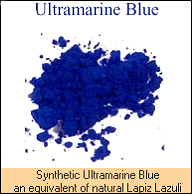
 Ultramarine
Blue
Ultramarine
Blue
These kind of ultramarine pigments are non-hazardous, safe blue color
pigments. These pigments have wide range of applications. Full control
can be imposed on their synthetic manufacturing process and close
control can be kept over theirs physical, chemical and color
characteristics. This makes possible the wide range of applications of
these pigments. Several types of blue ultramarine pigments are accepted
by manufacturers of plastic, printing inks, cosmetic and many other
industries. These blue ultramarine pigments are also environment
friendly.
These blue ultramarine pigments have wonderful heat resistance capacity
up to 350 degree C, these are of non-bleeding nature, having superb
lightfastness and don't cause any distortion in polyolefins. These
pigments are used for stoving finishes, power coatings, industrial
paints, decorative gloss paints etc.
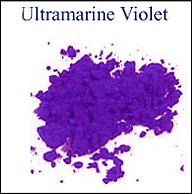
Ultramarine
Violet
Ultramarine Violet Pigments are also very safe at the time of their
applications and non-hazardous, non-toxic in nature. These pigments are
used for a number of applications as colorants. The main uses of these
pigments are for printing inks, paints, plastics and cosmetics.
Ultramarine violet pigments are used for artist's colors, industrial
finishes, paper & plastics, decorative paints and all kind of color
corrections. These pigments are totally non-bleeding, very high heat
resistance and can be dispersed very easily.





 Different
Applications of Synthetic Ultramarine Pigments
Different
Applications of Synthetic Ultramarine Pigments