The oldest evidences that we have found about the use
of Effect Pigments are the cave paintings of the ice age people. These
cave paintings depict the uses of the variety of colors and their
emotional attachments with those different colors. In the 18th century,
the first reference of Pearl lustre pigments came. These Pearl lustre
pigments were the traditional type, but today, a lot variety of effect
pigments have come into existence in every aspects of our lives.
By using the effect pigments, one can get access many unique effects.
These effects include the visual world effect with a decorative look,
flickering lights and amazing effects. These pigments bring a new
feeling and give new effect to the colors with sparkle and
tremulousness.
 Absorption
Pigments
Absorption
Pigments
In Absorption Pigment category, all the conventional organic or
inorganic color pigments come. These pigments absorb a particular
wavelength of the incoming light. These pigments don't produce any
lustre, because of their irregular shapes.
Metallic
Pigments
Metallic Pigments comprise of very small platelets of aluminum, copper,
zinc. The formation and distinguishtion of opaque pigments are possible
due to these metallic pigments on the basis of the surface lustre.
Pearl
Lustre Pigments
Pearl lustre pigments are semi-transparent. These pigments are based on
guanin or bismuth oxychloride, mica minerals. In these pigments, the
light reflects in between the different layers of the pigments. This
phenomena makes these pigments very lustre.
Optical
Variable Pigments (OVP)
Optical Variable Pigments are the new addition in the group of
effective pigments group. From new substrates, like aluminum oxide and
silica oxide, these pigments have been developed.
Today, the two driving forces are appreciation of
beauty and design in markets. These two driving forces can be seen in
packaging industry, automotive industry, electronic industry, appliances
and toys and all the other fields. To bring appreciation of beauty and
product differentiation, the use of effective pigments are very useful.
The other reasons of the uses of effective pigments are as follows:
- The addition of special effect pigments into plastics allows
formulators.
- To call up the quality, luxury and durability in various
applications.
- To bestow an emotional aspect upon the products.
- To bring sophistication and depth in the packaging process.
- To strengthen the concept of product differentiation and branding
of different product categories.
- To provide a gorgeous and attractive appearance in the materials.
The special effect pigments may bring a metallic look
into plastic materials. These are lamellar flakes. The very thin
platelets of special effect pigments can be readily obtained due to
their shapes. On the basic of transparent and opaque effects of the
effective pigments, they can be classified into two more groups.
Opaque Pigments
The platelets of the opaque pigments don't transmit light. These
platelets only reflect the the light and during reflection they also
absorb light partially.
Transparent Pigment
The platelets of Transparent Pigments can partly transmit light and for
this phenomena these pigments can produce a special kind of shimmery
lustre. The refractive index of these platelets is low. The figure
describes the light mechanism of Transparent Pigments. Transparent
Effect Pigments have affinity with almost all thermoplastics.





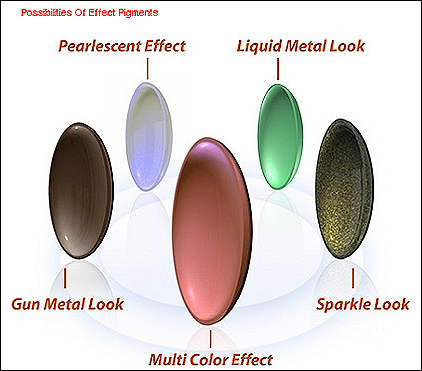
 Types
of Effect Pigments
Types
of Effect Pigments