A lot of different types of natural pigments are
found from different kinds of natural sources. Some of the important
natural pigments are: Cochineal, Aeppo galls, Annatto, Indigo. The first
two pigments are obtained from insects and rest two are obtained from
plants. These pigments belong to cosmetics and have affinity to all such
foods and drugs which require color additives.
Natural pigments are good for use in the shower gel, bath bombs, bath
salts, shampoo, soap, lotion and in many more other products. These
pigments have good quality of bleed protectiveness in soap and these are
also water dispersible. But, these pigments don't have high intensity in
light.
Annatto natural pigments have reddish-orange
colorant. This colorant is derived from seeds of Achiote trees. Annatto
pigments are given 'annatto' name because these pigments are derived
from Annato shrubs. The concentration of annatto pigments in the annatto
shrubs, vary from place to place.
Uses of Annatto Pigments
When the foodstuffs require hues of yellow to orange, annatto based
pigments are used. The main food items in which annatto dyes are used
are: in making cheese (around 50%), for fish processing (around 20%),
confectionery (around 10%), diary products except cheese (around 20%).
Apart from the above mentioned natural pigment, some
other types of natural pigments are there. These are:
 Plant
pigment like chlorophyll-
Plant
pigment like chlorophyll- Acetone is required for the extraction of
plant pigments. Calcium carbonate must be present there for stimulating
the extraction process. Any other mild alkali can also be used for the
extraction of plant pigments. The alkali is used during the extraction
process due to neutralizing the acid which liberates from the plant
tissues. This neutralization prevents the formation of pheophytins
during the extraction process, unless the the pheophytins may block the
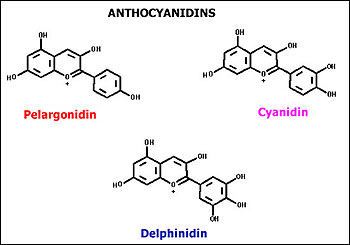
extraction process. Following diagram is the pigment structure of
anthocyanidin pigments (flower pigments).
 Carotenoid
Pigmets-
Carotenoid
Pigmets- Carotenoid pigments have color range from yellow to red.
Mixture of acetone and hexane in the 1:3 ratio is used for the
extraction of carotenoid pigments. The acetone layer on the extracted
carotenoid pigments is removed with water. To remove the hexane residue,
make treatment of hexane residue with activated MgO
2
diatomaceous earth column. In this way, remainings of hexane and acetone
can also be removed.
Betalain
Pigments- Betalains are the another type of color pigments which are
also derived from plants. These pigments are present in two forms. The
first is b-cyanin having purple-red color and in the high concentration,
these are obtained. The second is b-xanthine which is yellow in color.
In low concentration, these pigments are obtained. These pigments can
easily be extracted from plant tissues with water as these pigments are
highly soluble in water. The extracted water is then mixed smoothly with
ethyl alcohol in 1:1 ratio. The use of ethanol in the mixture is to
reduce the enzymatic action, otherwise the pigments will be degraded.
Anthocyanin
Pigments- Anthocyanin pigments are colored pigments and these are
found profusely in plant kingdom. The colors imparted by these pigments
are blue, red and purple. The color of fruits and flowers are also due
to the color impartation of these pigments. Anthocyanins are soluble in
water and their extraction from the plant parts is also easy. Slightly
acid mixed water is required for the extraction of these pigments. The
hydrolysis of anthocyanins in the extract is prevented by acidity is
water.




 Annatto
Natural Pigments
Annatto
Natural Pigments