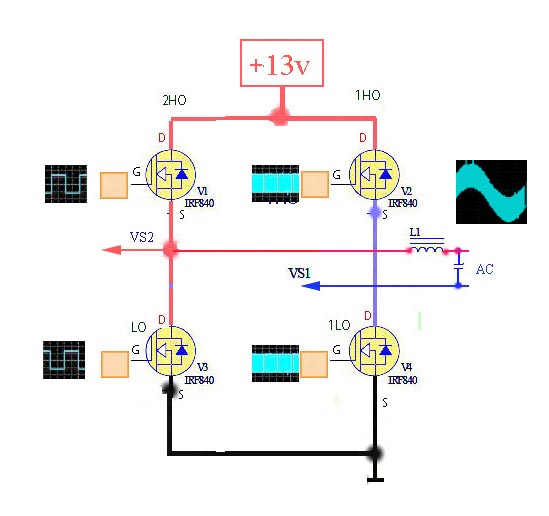
DC:AC Bipolar or Unipolar
Name unipolar is given as switched DC voltage applied to the load remain positive during positive cycle and negative during negative cycle.
The unipolar modulation normally requires two sinusoidal modulating waves vm and vm- which are of same magnitude and frequency but 180 0 out of phase.
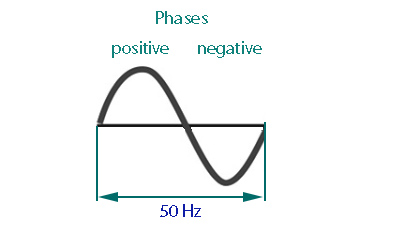
Unipolar system uses the full H-Br with 4 signals: 50Hz positive phase, 50Hz negative phase, carrier positive phase, carrier negative phase.
Disadvantages of Unipolar PWM Single Phase Inverter
- Unipolar PWM typically results in lower voltage utilization compared to other PWM techniques. Since the inverter switches are operated in a unipolar manner, a portion of the DC voltage source is not utilized effectively, leading to reduced efficiency in converting the DC input to AC output.
- Unipolar PWM may have limitations in achieving a wide output voltage range. The unipolar nature of the control scheme restricts the maximum and minimum voltage levels that can be generated, which may not be sufficient for certain applications requiring a broad range of output voltages.
- Although unipolar PWM can reduce harmonic distortion compared to other modulation techniques, it may still result in higher total harmonic distortion in the output waveform compared to more advanced PWM methods like multilevel PWM. The presence of harmonics can affect the quality of the output voltage and may cause issues with sensitive loads.
- While unipolar PWM can help mitigate electromagnetic interference (EMI) to some extent, it may still generate EMI due to the switching transitions and harmonic content in the output waveform. This can be a concern in applications where EMI compliance is critical or when the inverter is operating in proximity to sensitive electronic equipment.
- Unipolar PWM may have limited control resolution compared to other PWM techniques. The binary nature of the control signal (either fully on or fully off) limits the granularity of control, which may result in less precise voltage regulation and control over the output waveform.
- Unipolar PWM can impose higher stress on the power switching devices (such as MOSFETs or IGBTs) used in the inverter. The abrupt voltage and current transitions during switching can lead to increased switching losses and thermal stress on the devices, potentially affecting their reliability and lifespan.
- Unipolar PWM may not be suitable for all types of loads. Some loads, such as certain motor types or highly capacitive or inductive loads, may require more advanced PWM techniques to ensure proper operation and minimize issues such as torque ripple or power factor distortion.