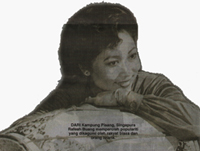
KUALA LUMPUR, July 24: Veteran singer Datuk Rafeah Buang was one of the few singers who managed to stay productively in the limelight for more than three decades.
While most of her
peers were only known as one-hit-wonders before disappearing from the
scene, Rafeah remained prolific. Since she started her singing career in
the '60s, Rafeah has recorded over 20 albums and was signed to four record
labels, most of which were with her first record company EMI.
The other companies were Senada Records, Polygram (now part of Universal
Music) and Life Records.
Among her albums are Ada Yang Chemburu Buta, Cita Ku, Kau Akan Mengerti,
Lagu Mu Teman Ku, Jarinya Merah, Itulah Harinya, Menanti Hujan Teduh,
Potret Seorang Biduanita, Bisikan Hati, Kan Ku Berikan Hati, Impian, Bila
Terima Puji Pujian, Don Juan II, Di Luar Jendela and Dalam Ketenangan.
From these albums emerged many hits including Kalau Rindu, Bisikan Hati,
Kecantikan, Pengorbanan, Pesan Bonda, Kenangan Di Rantau Abang, Don Juan,
Udang Sama Udang and Disebut Jangan Dikenang Jangan.
Rafeah was also one of the few singers who liked to be creatively
"involved" in her numerous projects.
She wrote most of the lyrics of her songs and was known to be passionate
about writing.
For a long time, in between her singing, Rafeah also had a column in URTV,
a local entertainment magazine which was — apart from being a memoir of
sorts — also her way of reaching out to the younger generation,
particularly those in the entertainment business.
Her family — husband Datuk Setia Perkasa Tengku Asmawi Tengku Hussain
(they were married in 1970) and her four sons (the youngest, Tengku
Ameerul Ashraf, died in an accident in 1993) — were the subject matter
she wrote about most in her columns.
Rafeah's interest in singing started at a young age, growing up in Kampung
Pisang in Singapore.
Her mother wanted her to be a religious teacher (ustazah) while her father
who was also a musician, seemed to be more supportive of her interest in
music.
In the late 60s, after she won her first competition Bintang Satria
Singapore, Rafeah never looked back.
Instead of going to Indonesia to become a religious teacher, she ended up
in Kuala Lumpur and won the Bintang Radio talent quest by singing an old
classic, Bakti Setia, which also caught the attention of record company
executives.
Soon, she was also part of a nationwide tour with P. Ramlee and Saloma and
that also made her famous in Indonesia, particularly North Sumatra.
Rafeah was also known for her duets with Ahmad Jais. Their song Juitaku
could perhaps have been one of the most-played numbers on the radio in the
early 70s.
Each Hari Raya, Malaysians would also get a dose of Rafeah through Bila
Takbir Bergema, one of the staples for 30 years now.
News about her illness was a little unexpected. An ultrasound scan
conducted at the Kuantan Medical Centre on Jan 2 revealed an intestinal
ulcer and a swollen right kidney, and two days later, a CT scan at the
Tengku Ampuan Afzan Hospital showed cancer. On Jan 10, Rafeah was admitted
to the HKL for 16 days. On Jan 27, she fell ill again and was admitted to
the Pekan Hospital.
The singer's condition worsened on April 26, and she lost consciousness on
May 4.