 |
 |
 |
 |
|
| On this page, I have selected some 'not so friendly' Australians to tell you about. Snakes, spiders and sea creatures, all of which are venomous and highly dangerous. Along with all of our flora and fauna, these creatures are also under total protection by law. Having so many dangerous creatures to share this wonderful land with, it's surprising the lack of confrontations that we have with them. We lose approximately 2 - 5 people per year to snake bite, usually those who were attempting to kill the reptile. Inumerable number of fatal cases of funnelweb spider bite have occured, however, no accurate records are available as to the exact number. In the oceans we lose approximately 2 or 3 people per year to the venomous sting of the Box Jellyfish more commonly called the Sea Wasp. Then of course we have our big bad nasties, the salt water crocodile. |
| BROWN SNAKE |
| There is no disputing the fact that the brown snake is responsible for more snake bite deaths in Australia than any other reptile. Afforded the dubious position of 2nd in the venom stakes in the world, it's out done, only by the Fierce Snake, also found in Australia. The brown snake is found all over Australia except in Tasmania. It's equally at home in the deserts, mountains, coastal areas and inland areas. It does tend to shun the rainforest areas. It prefers grassland and bush areas, but is fond of mice and rats for it's food source, which puts it on a collision course with humans, because it inhabits farms with their outlying buildings and grains. The places that mice and rats prefer to reside. |
| Snakes go to extrordinary lengths to avoid confrontation with man, are very sensitive to vibrations in the ground, and are normally long gone by the time anyone gets to the spot where the snake may have been. However occasionally a sleepy snake will be surprised, and there lies the danger. Or if someone is foolish enough to attempt to kill the snake, forseeing it as a threat, they risk being bitten because of lack of knowledge of reactions of reptiles and grossly understimate their speed. When aroused to anger, the brown snake is extremely aggressive, and coils the bottom half of it's body into an S shape, to give it more speed when striking. There are several types of brown snakes in Australia, the Eastern Brown, (Pseudonaja textilis) the Western Brown (Gwardir) and also the Dugite, which mainly inhabits the western states. The average length of a brown snake is 1.5 metres (4.9 ft) but some have been recorded as reaching 2.4 metres (7.8 ft). |
 |
 |
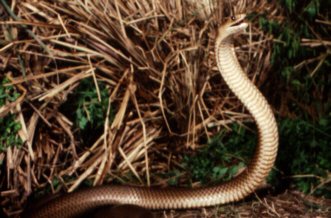
| Eastern Brown Snake |
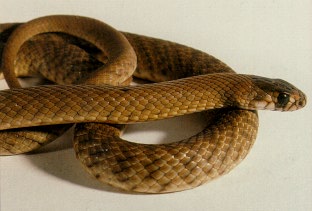
| Western Brown Snake |
 |
| Dugite - Often mistaken for a Western Brown Snake. |
| The venom of the brown snake is very toxic. Although only a minute amount of venom is injected in a bite, in fact only 4 milligrams (less than one thousandth of a fluid ounce) it is more than enough to cause death in an adult. Their fangs however are extremely small in size. All Australian hospitals, clinics and Drs surgeries have a supply of antivennene available. It is imperitive that the antivennene is provided quickly however, any delay has proven fatal to many. Most Australians believe in prevention rather than cure, and leave any snake they |
| encounter alone. Snakes are timid by nature and will flee, given the opporunity. When walking in long grasses and forest areas, long heavy pants, and good sound boots are also a prerequisite for safety first. BREEDING Male brown snakes have a peculiar ritual they perform whilst competing for a receptive female. They intertwine the top half of their bodies, much like a rope and sway back and forth, until one snakes head touches the ground. This ritual has been observed to take several hours at times, when the males are of similar size. Thus the successful male, copulates with the female by intertwining, this can also be for several hours. The female lays up to 15 eggs in one clutch. During spring to summer, September to January, she can have two clutches per breeding season. The females do not care for the nest, they simply lay the eggs, and leave them. The nest can be under a fallen tree log, stump or under a low overhanging rock formation. Several other females can also lay their eggs in the same nest. This nest is used from season to season. Incubation is 10 to 11 weeks in duration, the hatchlings are born independent and are as highly venomous as their parents, even though they only measure 250 - 270 mm (11.5 inches) long. |
| FIERCE SNAKE |
| (Oxyuranus microlepidotus) |
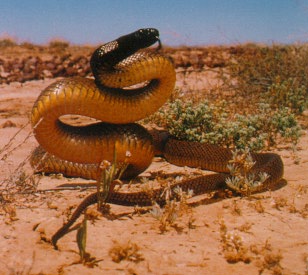
| Also known as the Inland Taipan, this is the deadliest snake in the world. The toxicity of it's venom far outstips any other snake venom. Surprisingly enough, not one death has ever been recorded from a bite from this reptile. This is definitely due to the fact, that |
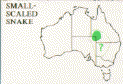
| it is only found in one or two small locations, and they are extremely sparsely populated areas. Where the 4 states of Queensland, New South Wales, South Australia and the Northern Territory converge, which is mainly blacksoil desert country. |
 |
 |
 |
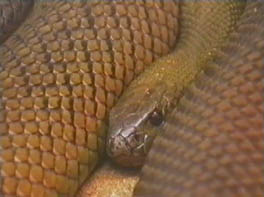 |
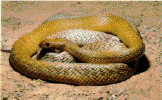
| * Note the colour variations, Fierce Snakes alter colours depending on seasons. Darker colours absorb the heat better in winter months. The average length is 1.8 metres (5ft 9 ins) but have been found to be as large as 2.5 metres (8ft 1 in). Their prey is native rats and other small mammals. When food is scarce their numbers diminish appreciably BREEDING The female lays between 12 to 20 eggs per clutch, these are laid in burrows of rabbits or marsupials, or in deep fissures in the cracked dry soil of the desert. Like the Brown Snake, the eggs hatch within 10 days, and the young are venomous from birth. |
| Of all the snakes throughout the world, Australia lays claim to the 5 most deadly and venomous. Fierce Snake, Taipan, Brown Snake, Tiger Snake and the Death Adder. Approximately 5,000 snake bites occur each year, 200 to 500 receive anti vennene treatment and fatalaties average 2 to 5. Surprisingly enough, many people never see a snake in their life, most of those who do, avoid them, the unlucky, receive a close encounter they'd much rather forget. |
 |
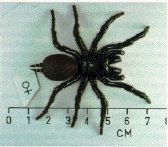 |
| FUNNELWEB SPIDER |
| Male 5 cms (2 inches) |
| (Atrax robustus) |
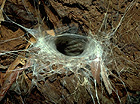
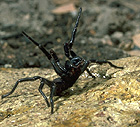
| Australia has several species of funnelweb spider, but the dreaded Sydney Funnelweb is the one most commonly refered to. It inhabits the coastal areas of NSW, but has been found up as far north as and into parts of south east Queensland. It prefers cool damp areas. It builds it's nest in the form of a silk burrow around the foundations of houses and sheds, crevices in rocks or similar suitable places. |
| The male is far bigger than the female, and 10 times more toxic. It is shiny black in colour, hairy, ugly and highly aggressive. Unfortunately, the male on maturity, leaves his burrow and wanders, looking for suitable females, in summer and autumn. This leads it into houses, sheds, garages and gardens. |
 |
| When striking, they lunge forward and downward, gripping their victim with their front legs, and plunging their huge fangs into the victim over and over again. The pain is instantaneous. Correct treatment of a bite is essential. A presure bandage must be applied |
| immediately, and the limb immobalised, any movement can accellorate the spread of the venom. Do not wash the wound area, as any excess venom is useful for exact identification of the spider. Antivennene has been available for many years now, and since it's introduction, we have not had any fatalities. But until it's introduction, innumerable victims died. Strangely enough, not all animals are affected by this venom, but all primates, including humans, are particularly susceptible. Cat and dogs seem impervious to it, mature rats also, however young rats are vulnerable. |
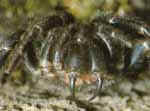 |
| Strike pose |
| Nest or burrow |
| Close-up of fangs |
| BREEDING |
| When mature, the male goes courting the females, locating their burrow by following their scent. Mating takes place cautiously, the male holding the female with his spurs to prevent her biting him, while he transfers his sperm sac with his palps. The female once impregnated, builds a pillow shaped silk egg sac, and lays at least 100 eggs. She tends this sac carefully over the incubation period of 3 weeks, turning it and cleaning it. She defends this nest vigorously and aggressively. Once the eggs hatch, the young stay with |
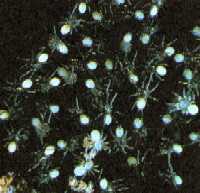 |
| the mother for the next 2 months. After their 2nd moult of skeletal shell, they then leave the nest and set up housekeeping nearby. It's not uncommon to find an infestation of more than 100 funnelwebs in one small area of house yard or bushland. They take 2 - 4 years to reach sexual maturity, males then go wandering seeking the females, but do not live much longer than 6 months after mating. The females on the other hand, take the same time to mature, but can live for up to 10 years. No death has ever been recorded from the bite of a female funnelweb. The males have been solely responsible, as their venom holds a different toxic substance to their female counterparts. |
 |
|
 |
| REDBACK SPIDER |
| Latrodectus hasselti |
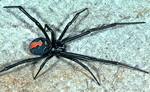
| First discovered around Rockhampton and Bowen areas in Queensland, in 1870, it had long been a theory, that the Redback Spider was an unwitting immigrant. However they have now been given their own genus, as they appear not to be found anywhere else in the world. They cover the entire continent, from east to west, with the exception of dry deserts and the mountains. Closely related to the Black Widow Spider found in several countries, and also the Katipo Spider found in New Zealand, which is the only venomous spider found in that country. |
| Before the introduction of antivennene in 1956, there were 13 recorded deaths. Since the introduction, there has thankfully been no deaths. The Redback Spider prefers to inhabit areas that have been disturbed by man, and is rarely found, if ever, in undisturbed bushland areas. In newer suburban areas, it's not uncommon to find heavily infested areas, and a careful eye must be kept on childrens outside toys, swings, rides etc. Although no longer considered a danger to life, a bite from a Redback can be painful and distressing, producing localised swelling, sweating and nausea. The venom takes several hours to several days to take full effect, so the urgency to reach antivennene is not so great as that of the Funnelweb Spider bite. Nevertheless, antivennene is essential for the survival of a bite. The female is the most dangerous, but the male is not considered a threat, as their fangs are so small, they cannot penetrate human skin. The female is 3 times the size of the small male, she has a shiny black, pea sized |
| Female Redback |
| abdomen, with a distinctive stripe on the back. This stripe can be pink, orange, red, or even a grey colour. It's the stripe that's important in identification, not the colour of the stripe. |
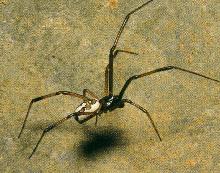 |
| Male Redback Spider |
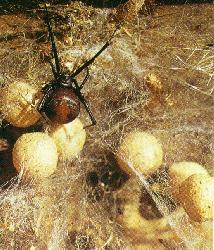 |
| BREEDING The courtship of the species is a perilous affair for the male Redback. He must approach the female with caution. Usually from |
| the opposite side of her web. Cautiously stroking and cajolling her into submission. Whereupon, on completion of copulation, the female turns and kills the male and devours him. |
| She then sets about building her egg sacs, several of them in fact, as many as 8 of them. Into which she can lay up to 300 eggs in each one. She guards these for the period of incubation of 10 to 14 days until they hatch. Normally a female Redback Spider is not aggressive and would rather feign death than bite. However she will attack anything disturbing her egg sacs during this period. After the spiderlings hatch, they stay close to the mother until they have moulted their skeletal shells a few times, before setting off almost fully grown to establish their own areas. |
| Most bites occur when the spider wanders into clothing, and the article of clothing is disturbed or worn. Bites usually occur when the spider has no escape, such as being crushed against the body in the apparel. The most bites to one person ever recorded was as recently as July 2001. When Darren Meehan, 25, of Alice Springs was bitten 20 times whilst sleeping. The spider had been in his apparel when he retired and bit him during the night. Requiring 16 doses of antivennene to survive the attack, it is the highest number of antivennene injections given to one person, ever recorded. The next being 8 doses to survive the venom. Darren survived the ordeal, which proves the effectiveness of the antivennene. |
|
| BLUE RINGED OCTOPUS |
| (Hapalochlaena sp.) |
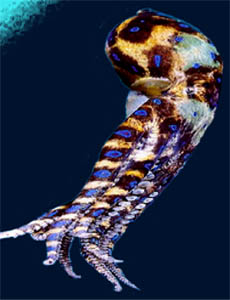 |
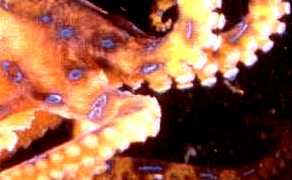
| The Blue Ringed Octopus is generally found in rock pools encompassing the entire Australian coasline. When it's not hunting for food, it hides for it's own protection from larger predators, in the rock pools and large empty shells of other sea creatures. This enchanting creature has been the downfall of many curious adult and child. About the size of a golf ball in body, with the normal eight tenticals. It's normally a pale colour, usually the same as the rocks it hides in as camoflage, but when it's disturbed and feels threatened, it produces vibrant electric blue rings as a warning sign. The toxin it produces is delivered via the saliva surrounding the beak, not by injection as a snake delivers venom. The venom acts as a neurotoxin and completely |
| immobilizes the victim, except for their cognitive facility...they remain completely concious throughout the ordeal, although they are unable to move, speak and eventually breath without assistance. It is important to remember this fact, and not alarm the victim by negative conversation about them dying, or the seriousness of their condition, especially when dealing with a child, as they are completely aware of what is happening around them. There is no antivennene for a blue ringed octopus toxin. The treatment of a bite is to immobilize the bite area by pressure bandage and keep the victim breathing, by mouth to mouth resuscitation until they can be admitted to hospital and put on a mechanical respirator. This can be required for up to 24 hours, until the toxin wears off. Recovery is normally achieved in 24 hours, with no harm done, and death is rare, but it has occured. The life of a Blue Ringed Octopus is a short one, lasting only one year. Shortly after mating the male dies, leaving the female to hatch the eggs alone. She lays approximately 50 eggs in each clutch, nursing them carefully under her tenticles for around 3 or 4 months until they hatch. During hatching she tends them lovingly, turning them, and squirting them with water to keep them free of parasitic sea creatures. The young are hatched around the size of a pea. Shortly after the hatching, the female dies, leaving her offspring to repeat the yearly life cycle of the species. |
 |
| The young grow rapidly, and reach sexual maturity in autumn, around April, May. The the breeding cycle continues. As rock pools seem to be a fascinating place for children, it's important when visiting a seaside area to ensure that your children are aware of the 'look but don't touch' policy, best applied to these most enchanting little sea creatures. |
|
| BOX JELLYFISH (or Sea Wasp) |
| (Carukia barnesi and Cheronex Fleckeri) |
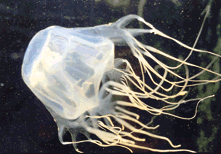
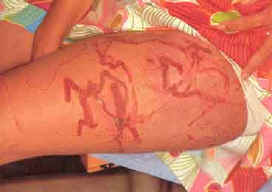
| A sting from one of the 6 different species of Box Jellyfish will produce what is called, Irukanji Syndrome. The small sub species Carukia barnesi, is the only known small jellyfish to cause the syndrome. The Box Jellyfish has tenticles which drape from each corner of it's square shaped body. The tiny Carukia barnesi, has just one tenticle from each corner, whilst the larger Cheronex Fleckeri has 15 tenticles from each corner. Both are almost transparent in colour and extremely difficult to see in the water. Each centimeter of tenticle (1/2 inch) contains 3 million sting cells, which creates excruciating pain instantly, and the victim is as much at risk of drowning with the pain as they are at risk from the toxin. Box Jellyfish are found north of Exmouth on the western coastline, and Gladstone on the eastern coastline, and extend up into the warm tropical waters to the tip of Australia. They are prevalent from September until June every year, although their numbers vary from year to year. Nothing is known of where they go to in the remaining 2 months of July/August, which is the middle of Australia's winter season. The immediate treatment for a sting, is to pour copious amounts of vinegar on the affected area, and hospitalization as quickly as possible for treatment for the pain. There is an antivennene, however this needs to be applied immediately for it to be |
 |
| effective. A badly stung victim has generally 2 to 3 minutes to live. Protective clothing whilst swimming is the best defence against being stung, such as a lycra body suit. Many beaches are netted to keep out the larger jellyfish, however the |
 |
| Cheronex Fleckeri |
| Sting scars on a hapless victim |
| Box Jellyfish have no brain, but they do have eyes. It is used to locate food, then using it's tenticles, stings it's prey, then draws it up into it's square body for devouring. They do not 'mate', both male and female release sperm and eggs into the water, where the eggs are fertilized. The cell then forms into a planulae, which swims or floats for a few days, before sinking to the ocean floor. Here it becomes a polyp, which grows and |
| becomes a 'medusa' or tiny jellyfish. It is now ready to swim away, to continue the life cycle of the Box Jellyfish. |
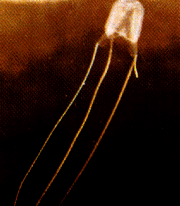 |
| Carukia barnesi |
| small Carukia barnesi, slips through this defence with ease. |
|
| SALTWATER CROCODILE |
| (Crocodylus porosus) |
| Australia has two types of crocodiles, the freshwater crocodile, which mainly eats fish, and is not considered a danger to man, and the saltwater crocodile, a true meat eater. Crocodiles are true dinasaurs, and have changed little in the evolutionary stakes over millions of years. The Saltwater Crocodile...or 'Salty' as Australians refer to it, is found as far down as Broome on the western coastline, and Rockhampton on the eastern coastline. It inhabits the surrounding islands off the coastline also, and has been known to swim as far as 1,000 klms (620 miles) by sea to reach it's destination. |
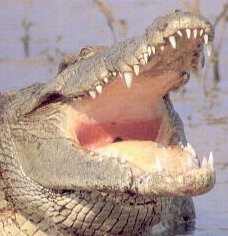 |
| In times of extreme drought, it has also been known to travel across land many klms to find a safe waterhole to ensure it's survival. Although it prefers salt water, it can survive quite readily in fresh water. It's diet consists of fish and small mamals and birds, which venture too close or unwittingly near the waters edge. The Salty spends most of it's time sleeping, and in summer avoids the hot sun, hunting mostly during the cooler hours of the day. When hunting for food, the usual procedure is to expose only it's eyes and nostrils above the waterline until prey is spotted, then sinking without a ripple, swims effortlessly underwater and attacks it's prey from underneath the water, lunging upwards. Or moving with amazing agility and speed, will spring from the water and up onto the bank. Razor sharp teeth, and astounding jaw pressure ensures a firm grip on it's prey, the salty then drags it's hapless victim into the water and procedes to go into the 'death roll', rolling over and over and in the case of larger prey, such as buffalo or cattle, dragging it's prey underwater where it consequently drowns. In order to eat it's food, it's impossible for the Salty to eat underwater, and food must be consumed on top of the water. A careful examination of the above photograph, you will notice a flap of skin at the back of the throat, this acts as a safety valve, closing whilst the mouth is open under water. This prevents it from drowning. |
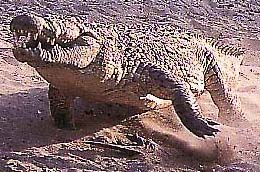 |
| Saltwater Crocodiles have been recorded as big as 7 metres in length (23 feet). Although the most common length of a fully grown male crocodile would average 5 to 6 metres (18 to 20 feet). It is impossible to judge accurately the age of a croc, unless a bone sample is obtained. Their bones have 'growth rings' much the same as trees. Salties mature sexually at around 16 years of age for males and 12 to 14 years of age for females. |
| BREEDING |
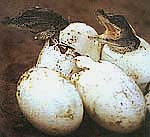
| Crocodiles are 'mound builders', the female carefully builds a nest of leaves and twigs and soft soil, just above the water level, and not far from the river. She lays a clutch of around 50 eggs, and guards them fiercely during the 80 day incubation period. When the first of the hatchlings begin their unique grunting sounds, she uncovers the rest of the eggs, carefully carries the hatchlings to the waters edge and breaks open any unhatched eggs to aid the remaining babies. They remain close to the female for protection for several months. The mortality rate is very high amongst young crocs, older crocs take their toll on numbers and only about 1% of hatchlings survive in the wild. Crocodiles do not have sexual chromosones, the sex of the hatchlings depend entirely on the temperature of the mound. For males to be born, the mound must be kept at a constant 31.6 degrees C (88.88 F) any variation up or down ensures that females are born. |
 |
| Since protection of the species began in 1971 there has seen a rapid rise in croc population, there are few deaths from encounters with these creatures. Australians are very well aware and educated in the ways of the croc. The deaths that have occured could well have been avoided had the proper care and attention to watching out for crocs been adhered to. Only 27 deaths have been recorded since 1971 from croc attacks. In almost all cases death occured whilst they swimming in crocodile country. |
| Saltwater Crocodiles live a long life by animal standards, the average would be around 70 years old, but have they been known to live to over 100 years old. |
|
 |
|
|
 |
|
|
|
|
|
|
|
|
|
| I do hope you've enjoyed seeing a few of our 'unfriendly' Australians, but as I said earlier here, the number of encounters with these creatures is very small. Most Australians are well versed in the ways of these animals, and so consequently take precautions to avoid them. |
|
|

|
| You are guest number |
| to visit this page |
|
|
|
|
|
|
 |
|
|
|
 |
| (Poem) |
| (Poem) |
| (Poem) |
| (Poem) |
| (Poem) |
| (Poem) |
|
|
|
|