| MARSUPIAL FRIENDS |
| These animals are not normally seen on a common basis in Australia, in fact some of them are quite rare today. Mainly because they prefer certain climates and environments, plus the fact that being nocturnal, makes sightings a very rare thing indeed. To see these cuties in their own habitat, in most cases, you would need to travel to very out of the way places. I do hope you enjoy seeing them, and reading a brief over- view about them. |
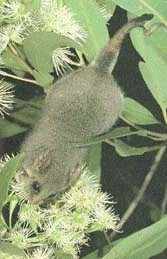
| PYGMY POSSUM |
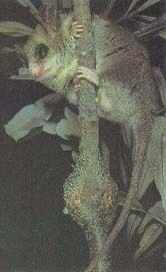
| Not rare, but difficult to find at night, they inhabit the entire east coast in bushland. Feed mainly on nectar & pollen from eucalypts, banksias & the bottlebrush. They also consume insects and soft fruits at times. They grow to around 14 inches including the tail, and weigh around 8 ozs. In winter when food is not so plentiful, they have the ability |
| to go into a torpor (hibernation) and live on the fat stored in their tail. They drop their body temperature to almost air temperature, rolls into a tight ball & covers it's eyes with it's ears. During this torpor, it's not necessary to eat. The female gives birth to around 4 young and carries them in her pouch, until they are too big, after which they stay in their rounded nest built in a hole in a tree, or under bark of the larger trees. The babies are usually weaned at around 2 months of age. |
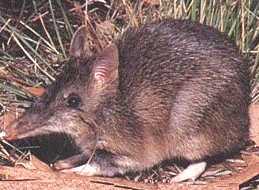
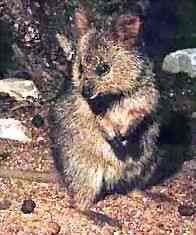
| QUOKKA These little marsupials are in plentiful numbers on Rottnest Island off the Western Australia coast, but on the mainland they are not common but thankfully their numbers are recovering. Unlike a lot of their larger marsupial cousins who are solitary, this group of little fellows are quite social in their habits. They can be seen drinking in large numbers over 100 at a time at waterholes, at night. They sleep in small groups in long grass and dense bushland during the |
| daylight hours. After a short gestation period of 4 weeks, the mother gives birth to a single joey. The joey lives in the pouch until around 9 months. After leaving the pouch,it continues to feed from it's mother for another 2 to 3 months. Quokkas eat native grasses and shrubs. They grow to about the size of a large rat and have been mistaken for rats, many times. |
| LONG NOSED BANDICOOT The bandicoot is a very common in the towns. Often of a morning, townsfolk find evidence of their nocturnal visitor, in the way of small holes having been dug in thier lawns. The bandicoot lives on small insects and the tender roots of grasses hence they dig for their supper in lawns, |
| also under the forest floor and rotting logs. Burrowing with their front legs, and inserting their long snout into the hole to reach the food. Bandicoots are solitary in habit, and defend their territory from all other bandicoots, except during mating season. The female usually rears two young, which stay in the pouch for a short period of 8 to 10 weeks, after which the young become independant, and reach sexual maturity at 5 months. There are around 11 main types of bandicoots, the long nosed bandicoot being one of the most prevalent. |
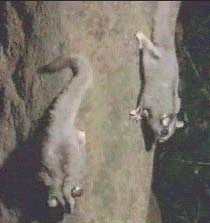
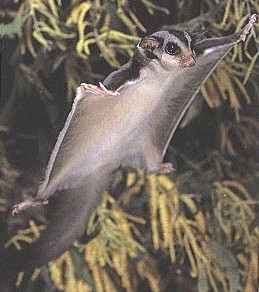
| SUGAR GLIDER Gliders are small, their body length around 6 inches and tail about the same. Front and back legs are linked by a membrane which enables them to glide freely from tree to tree, up to 100 metres. |
| They nest in hollows in trees, and share their nest with seven or more other gliders. Like the pygmy possum, gliders also are capable of going into torpor to survive cold weather. Found in areas where there are a good supply of acacias & eucalypts, the gliders feed on the sap and gum produced by the trees. They also eat insects that live on the trees, such as cicadas etc. Breeding takes place in the warmer months when food is plentiful. The mother rears one or two youngsters in her pouch until around 2 months, after which, they remain in the nest, lined with leaves, in a hollow tree trunk for a further 2 months or so, until large enough to learn to forage for food, alongside their parents. |
 |
|
|
|
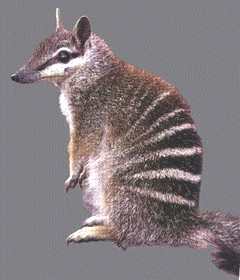
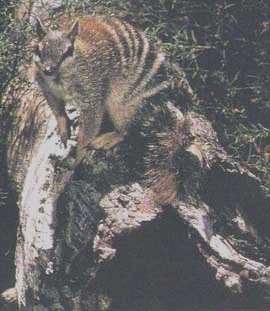
| NUMBAT Now here's a marsupial with a difference, they have no pouch and are not nocturnal. They prefer to be active in the daylight hours and sleep in hollow logs at night. They are very small, and fairly slow. They live on |
| termites (white ants). They are restricted to a small part of Western Australia in the south west area, prefering Wandoo Eucalypts and Jarrah forested areas. Because they are slow moving, this is probably the reason for their decline in numbers, as feral cats, snakes and birds of prey, have taken their toll on numbers. They have a very long pointed nose, and an extra long sticky tongue for extracting termites from their nests. Numbats eat around 10,000 termites per day. When first born they are hairless and blind and the young cling to their mothers belly fur. Remaining there until too large to safely cling on. After which they remain in the nest, the mother returning once per day to feed them. Once the young are old enough (around 6 months old) they then ride on their mothers back. |
|
|
|
|
|
|
| View My Guestbook |
| Sign My Guestbook |
| Visit My Archived Guestbooks |
| I do hope you enjoyed seeing just a few of our marsupials, there are far too many to list on my pages, I will endeavour to tell you about more of our animals and birds from Australia in later pages. If you found this interesting, please feel free to FORWARD it to your friends on the net, and by all means, please visit and sign my guestbook. Thank you my friends. |
| MY OTHER PAGES |
 |

|
| You are guest number |
| to visit this page |
|
|
 |
|
|
|
|
|
 |
|
|
|
|
 |
 |
 |
 |
 |
 |
 |
 |
|
|
|
|
|
 |
|
|
|
|
| (Poem |
| (Poem |
| (Poem |
| (Poem |
| (Poem |
| (Poem |
 |
|
|
|
|