| EXTRA SPECIAL FRIENDS Birdie's Birds |
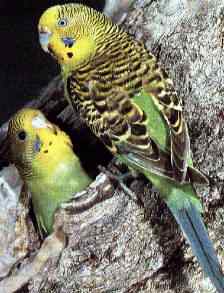
| BUDGERIGAR The most commonly known of our native birds is the budgerigar. They are by far the most popular pet bird in the world..and of their habits there is not much that I can explain about them. However, in the wild they are very social, and are seen in flocks of thousands in the western regions, especially in the wheat belts. Imagine the despair of farmers when literally thousands of these little birds descend on their wheat crop daily, the damage they can cause is quite extensive. The majority of Australians rarely see these |
| little fellows in the wild, as they tend to stay away from towns and cities and congregate in the rural areas where grain is grown in large quantities. In the wild, they are always green/yellow markings as seen here, but have been genetically manouvered by careful breeding programs in captivity, to have a remarkable variety of colours. There are few people who have not been enchanted by a 'budgie' at some stage. |
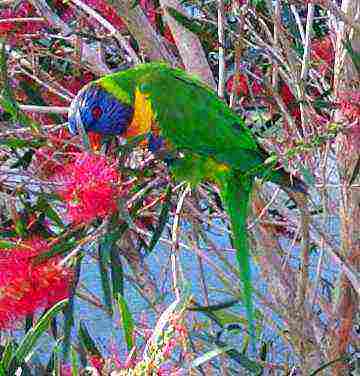
| RAINBOW LORIKEET This colourful bird can be seen almost anywhere in Australia, in and out of town, they have adapted to living quite happily in cities and towns. With the popularity of home owners growing native plants, these gayly coloured charmers readily take the nectar daily and congregate in small but noisy flocks. They tend to roost in large groups and can be seen just on dusk arriving by the hundreds |
| at their favourite roosting place, usually in tall eucalypts. The noise can be quite deafening until they all settle for the night. Lorikeets eat nectar and also seeds, they are very fond of wild bird seed that residents leave out to encourage them in. Their behaviour is quite comical at times, especially at mating time,when the male birds try to impress the females, with a clown like bobbing, bowing and a prance that defies description. Like most of our parrots, they build their nest in hollows of trees, they have an unlined nest, and lay 2 or 3 eggs. |
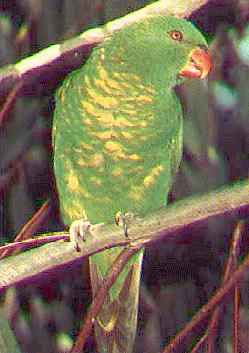
| SCALEY BREASTED LORIKEET Very similar to the Rainbow Lorikeet in habit, and quite often both species are seen flying and eating together. They are slightly smaller, and have bright yellow breast feathers interspersed amongst the bright green feathers, giving them the impression that they have yellow scales on their breast, unless startled, when they flatten their feathers, the scales disappear. Very colourful and rather unique green, with bright red beak. Nests in unlined tree hollows, lays 2 or 3 eggs. |
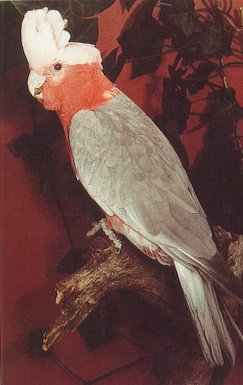
| GALAH Very common, seen almost everywhere, normally in flocks. Very noisy screech, but makes a wonderful pet, and readily mimics voices, in songs and whistles and speech. In the wild they build their nests in dead tree hollows, they raise 3 or 4 young, in a nest well lined with leafs from the eucalypt. The most beautiful combination of bright pink, grey and white feathers. The males have brown eyes, the females have red eyes. Lovely to see in the wild, but not in large numbers, they tend to be very destructive of vegetation if they are in large flocks. |
| SUPERB BLUE WREN Beautifully coloured fairy wren, found in bushland and homes on the eastern coastline. Tiny bird, with a lilting trill,often heard before you can find them. Only the males have the brilliant blue colourings, the females are a dull brown. They nest in low shrubs but in the bushland, build in the long grasses. They lay 5 or 6 eggs, and the older siblings from earlier hatchings, assist with the feeding of the new babies. |
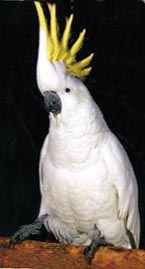
| SULPHER CRESTED COCKATOO A superb large white parrot, with a brilliant yellow crest. Seen in flocks of 12 or more, often fly with black cockatoos (another species). They have a racaus screech but in captivity, they mimic cleverly as do the galahs. They make lovely pets, and are very popular as such, but can deliver a nasty bite when angry or frightened, with such a large beak, that's not so suprising. It's been recorded that they have lived for around 80 to 100 years in captivity, so they are not a pet that you select lightly, it's a long term friendship. They, like all of our parrots, build nests in hollows of trees, lay 2 or 3 eggs. |
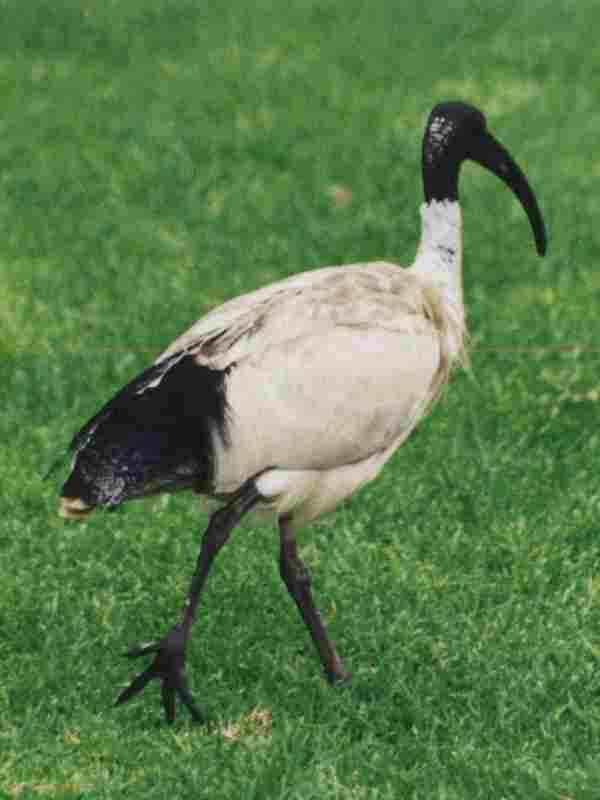
| IBIS This particular Ibis pictured, is of the coastal variety, it's the White Ibis,"Sacred Ibis"... the Ibis that frequent my inland local area is slightly different in markings and is the Straw Necked Ibis. They are featherless on their head and part of their neck, also have no feathers under their wings. A rather large bird. They are primarily a wading |
| bird, and are never far from a body of water, on the coast they frequent the mangroves, inland always near swamps or marshes, but like to forage on the ploughed fields and grasslands. Very social and always fly or hunt in a large flock of 30 or more. Very impressive when seen of an afternoon, soaring on the thermals in large circles. They build their nests of sticks and feathers, near water, usually in tall trees, they lay 4 to 5 white eggs. |
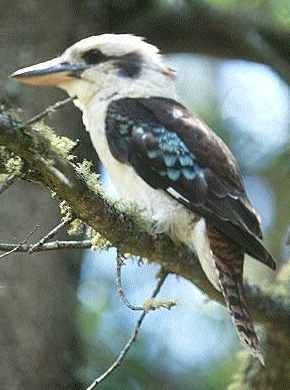
| KOOKABURRA Of all of our birds, this one is probably the best known world wide for it's song, or laugh. Kookaburra's are very territorial by habit, and the early morning chorus of laughs is their way of indicating to others, that this is their area. They are the largest of the Kingfisher family, of which Australia has many. They are primarily meat eaters, worms, small lizards, small snakes, some insects...they are not the innocent and jovial birds that is often protrayed, as they raid other bird nests with devestating results, by eating their |
| young hatchlings. However we do love our Kookaburra's, and their wonderful laugh, many people in the towns encourage them by feeding them slivers of meat, which they eagerly take, and then promptly try to 'beat to death' by banging it on a branch or clothes line. They can become quite sociable once they overcome their fear of humans. They nest in hollows in trees, or sometimes dig into the sides of tall termite mounds. They lay 2 to 4 eggs and both parents share the chore of feeding the young. |
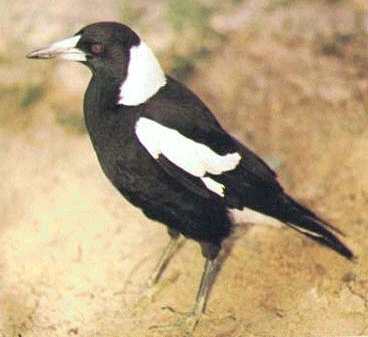
| MAGPIES This is the 'black backed' magpie. They are very 'family' oriented, and are in groups of family members consisting of one dominant male, and usually two females. Their wonderful song early in the mornings can be heard almost Australia wide. During nesting time, July through to around January, they are fierce protectors of the nest, and will swoop on anything or anyone, whom they percieve as a threat to their young. |
| The females provide food for the young entirely, the male is the protector and guards fiercly. Many an unsuspecting walker has found themselves under attack, as they strike from behind, and can deliver a nasty blow with their beak to the head, neck, ears etc. People have been quite ingenious in finding ways to prevent swoopings. Carrying a small branch over their heads in the fashion of an umbrella, and some have taken to pasting false eyes on the backs of their hats, as magpies rarely swoop from the front. At other times of the year, these lovely birds are quite sociable, and even compete with the Kookaburras for the household hand outs of meat. I have actually seen them eating seed from my wild bird seeder, although they are primarily a meat or insect eaters. They build a strong but untidy looking cup shaped nest made of twigs, sometimes wire and other softer materials. They lay 2 or 3 eggs of which the female hatches entirely alone. |
| For those of you who requested to see more of our Australian birds, I do hope you have enjoyed the few I selected. I chose some of the most common of our birdlife, from the vast numbers we are fortunate to have. |
 |
| MY OTHER PAGES |
|
|
|
|
|
|
| Sign |
| View |
| Archives |
| You are visitor number |
| to visit this page |

|
 |
|
|
 |
|
|
 |
 |
 |
 |
 |
 |
 |
 |
|
|
|
|
|
|
|
 |
|
|
|
 |
| (Poem) |
| (Poem) |
| (Poem) |
| (Poem) |
| (Poem) |
| (Poem) |
|
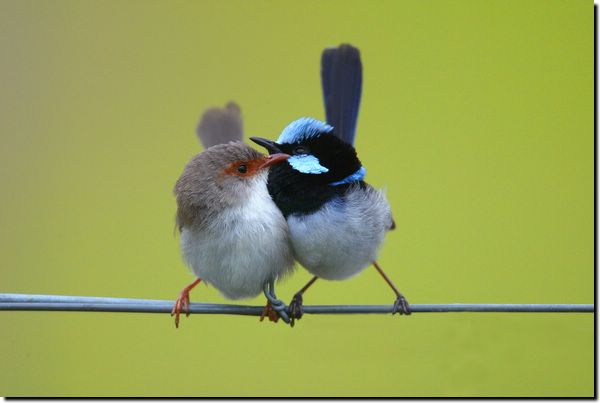 |
| Superb Blue Fairy Wren, female (left) male (right) |
|
|
|