| More Aussie Animal Friends |
| There are a considerable number of photographs on this web page, please be patient and allow them to load....it will be worth the wait.... |
| BILBY (Macrotis Lagotis) |
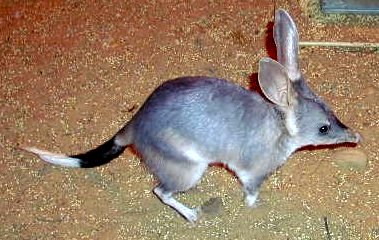
| The Bilby, is an endangered animal, belonging to the bandicoot family, in fact they are the largest of the bandicoots. Much research is now being conducted to preserve these precious animals. A breeding program has been introduced, and the last bastion of their habitat has been preserved and fenced to keep out predators. Mostly the introduced feral animals. |
 |
| An area of 25 square kilometers (10 square miles) is now vermin proofed. There were 2 species of bilbies at one stage, but the Lesser Bilby (Macrotis Leucura) has been extinct since the last sighting in central Australia in 1931. The remaining bilbies, of which there are two sub species, the Western Bilby (Macrotis Lagotis Lagotis) found in Western Australia and the Northern Territory and the Eastern Bilby (Macrotis Lagotis Sagitta) found only in Queensland. It's this area in Queensland that has been fenced. 200 years ago, Australia was inhabited by millions of Bilbies, now sadly there are but a few thousand remaining and only 700 of those are in Queensland. Prompting strong support from the people of Australia, a 'Save The Bilby Fund' was established, which finances research and preservation practices today. ABOUT THE BILBY |
| Bilbies have a blue/grey coloured fur, and are yellow to creamy white on the underside. They have very sharp, strong claws for digging, and a long thin snout.. Their tail is black but has a white clump of fur at the tip. The males are larger than the females, weighing in at between 1.5 to 2 kilograms, (3&1/2 to 4 lbs)the females weigh between 800 grams and 1 kilogram (1 & 1/4 - 2 lbs). They have very distinctive hairless ears, much like those of a rabbit. They have excellent hearing and smell...but their eyesight is very poor. |
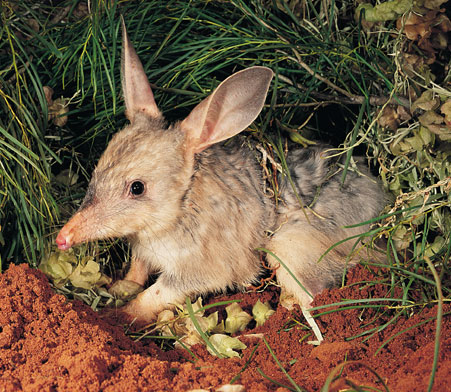 |
| Being of the marsupial genus, they are nocturnal and they sleep in their burrows, during the day,which they dig in a downward spiral about 2 metres deep. They can have up to 12 burrows in their territory and can dart into any one of them for protection, even digging another section on the move whilst trying to escape from danger. The entrances are usually concealed by a clump of grass, low bush or at the base of a termite mound. Although normally solitary animals, they have been known to group together in burrows at times when the necessity arises. The gestation period of reproduction is very short, only 14 days. They usually give birth to one to three offspring each time and they can breed up to 4 times per year, given the right conditions of food supply. The young are housed in a backward facing pouch, to protect the young from the dirt whilst burrowing. Inside the pouch are nipples which the young feed on, until around the age of 75 to 80 days. After which they become too large for the pouch. They then remain in the nesting burrow for a further 2 weeks. The mother returns periodically at night to feed them. Once old enough, around 6 months of age, they forage with their parents for a short time before being completely independant. Bilbies feed on a wide variety of food, ants, termites, grasshoppers, larvae, small seeds, centipedes, bulbs, fruit, beetles and underground fungi. Because their feeding is done amongst the dirt, their faeces contain a lot of sand and grit, in fact, it can be up to 90% sand and grit. DREAMTIME The Bilby plays a significant role in aborigine folklore. The Pintjantjatjarra call the Bilby "Nanu" whilst the Warlpiri call it "Walpajirtri". They tell stories of the Bilby from the Dreamtime. Some aboriginal peoples hunted the Bilby for food, it's fur and used it's tail tips as decorations. However they are lending their full support to the research of these beautiful little creatures these days, and their knowledge is invaluable in the efforts to save these docile little animals. There is also considerable effort by the 'Save The Bilby Fund' going into replacing the traditional 'Easter Bunny' with the 'Easter Bilby' to help bring the plight of the Bilby to the forefront of the public eye and increase support for the cause. |
 |
| Monotremes are an exclusive genre of animal. Only two monotremes are found in the world, and they are in Australia. The word 'monotreme' means single orifice, or words to that effect. Meaning for the entire process of urinating, passing faeces and giving birth, the animal has just one outlet. Our two monotremes are the ECHIDNA and the PLATYPUS. |
| MONOTREMES |
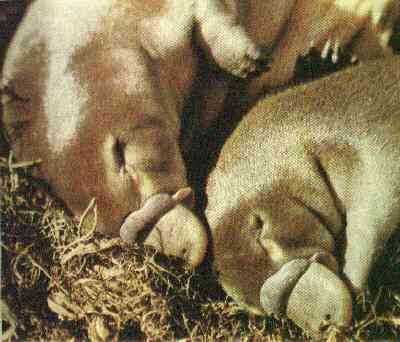
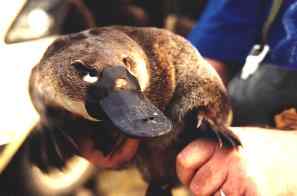
| PLATYPUS (Ornithorhynchus anatinus) |
 |
| In 1797 the early settlers first discovered the Platypus, in the Hawkesbury River in New South Wales. A specimen was sent to England for study. This triggered 82 years of controversy, with claims that it was a fraud, it baffled scientists all over the world. In fact one scientist in England actually tried |
| to prise the duck-like bill from the specimen. The marks of the removal attempt, can still be seen on the specimen today, held in the British Museum Of Natural History, London. Originally it was called the Water Mole, until in 1802 it was declared a genre in it's own right and given the scientific name of Ornithorhynchus. The Platypus had 'arrived'. |
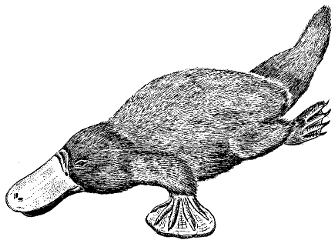
| This animal is so amazing, it defies all the rules of nature in that it's a warm blooded mammal, but lays eggs. It lays eggs, but suckles it's young as normal mammals. It suckles it's young, but not from nipples, the milk seeps from mammary glands that run almost the entire length of it's body and the milk gathers on clumps of fur for the young. It has webbed feet, but can retract the webbing to enable ease of digging. |
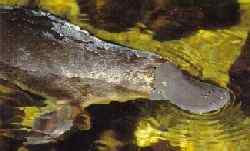
| It has a leathery bill, which when young also has teeth. It has a double coat of velvety fur which defies water even in temperatures of freezing point. It has a tail like a beaver which it uses with precision as a rudder. It searches for food with it's bill, by filtering the bottom of creeks and waterways with precision more sofisticated than our modern radar, sonar and metal detectors. It can detect the slightest movement of the tiniest of molluscs shrimps and worms,even under the mud and rocks. It stores it's food in pouches in the mouth, then surfaces to sort and chew the food. Although it spends up to 12 hours per day underwater, it can only stay submerged for a minute or two before surfacing. Whilst swimming for food underwater it's ears and eyes are firmly closed, so it is virtually swimming and searching blind. |
| When young, both male and female have venomous spurs on each of the hind legs. The females lose these spurs as they mature, but the males retain theirs. The venom, is strong enough to kill a dog, and delivers an extremely painful wound to humans, although no actual deaths have ever been recorded. |
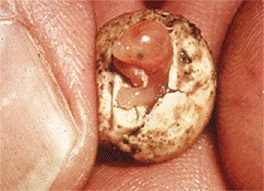
| This fact alone makes it a unique animal in that it's the only mammal in the world that can deliver venom, and the effect is much the same as a snake bite. These spurs are the only defence the Platypus has, and is used also for defending it's territory against other males during mating season. Maturity is reached at around 2 years of age. Mating takes place in spring from September onwards into summer, depending on temperature. The 20 metre burrows of a Platypus are rather intricate, in that they have one burrow which is used as a communal living room. Which doubles as a bachelor pad whilst the mother is hatching and caring for the young. A second burrow is dug seperately for nesting only. This burrow is used over and over and becomes more and more intricate and sophisticated as the years go by. The nursery burrow is always sloped upwards and always above water level, to protect it from any rising waters. If ever the entrances are for some reason covered by rising water, they are never used as an entrance again. Entrances are carefully concealed by overhanging grasses or shrubs, or at the base of trees, but always on the banks of creeks, rivers or lakes. The female carefully lines the nesting burrow with wet leaves to facilitate humidity while hatching the eggs. She lays normally two eggs, but occasionally 1 or 3 may be laid. They are leathery eggs and sticky on the outside, if 3 eggs are laid, they stick together in a triangular shape. The mother curls her body around the eggs to keep them warm during hatching. Incubation is 6 to 10 days duration. Once hatched the young are suckled with rich milk which seeps onto tufts of fur. The milk is incredibly rich in iron and solids, much moreso than cows milk. It contains 60% iron and 40% solids. Babies are born blind and completely helpless. |
| The Platypus has a life span of between 10 and 15 years. They hunt for food at night and mostly sleep during the daylight hours. Diving continuiously for their food, which they then bring to the surface to eat. Before entering their burrows, they carefully groom themselves, on the banks of the creek or river, removing as much moisture from their fur as they can. |
| They have few predators, but goannas, python snakes (carpet snakes) and water rats are very fond of raiding their burrows and eating the eggs and the new borns. Once the young leave the burrow, the added danger of the introduced foxes and feral cats, also take their toll on numbers. |
| DREAMTIME In aborignal folklore, the Platypus is known as Mallangong, Boonaburra or Tambreet, depending on tribal area. One 'dreamtime' story is of Duck, a young female, who disobeyed her elders rules and strayed too far from the pond one day. The elders had warned her of Molluka, the Water-Devil. Finding herself alone in a strange patch of grass, which was the territory of the Water-Rat. He overpowered her by threatening her with his much feared spear. He took her to his underground den. Forcing her to mate with him. When the eggs hatched, she was very ashamed to bring forth her strange brood. They had fur instead of feathers, they had her bill and webbed feet, but instead of two legs, they had four. On each of their hind legs they had a spur, just like the feared Water-Rat's spear. And so the life of the Platypus began. |
| The Platypus has changed very little over the years of evolution. In 1984 an amazing discovery of an opalized Platypus skull, with three very large teeth was made. It was established that it was at least 110 million years old. The only changes that have occurred in the intervening years, has been to lose the teeth, and actually grow smaller in size. When the earths plates seperated after the ice age, and Australia seperated from mainland asia, the Platypus was left isolated and allowed to continue pretty much as it originally was. |
|
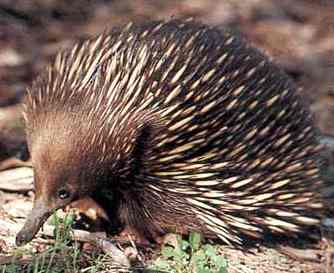
| ECHINDA (Tachyglossus aculeatus) |
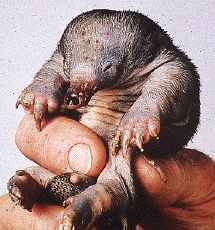
| Our other monotreme is the Echidna. Also called Porcupine and Spiny Ant Eater. There are two distinct types of Echidnas. One is the Short-beaked, which eats termites, ants and other comunal insects. Found only in Australia. The second is the Long-beaked, which is only found in Papua New Guinea, eats earthworms and other larger insects, however their primary diet is worms. |
| Echidna's do not have any particular habitat, they are equally at home in the bush or in towns. I have personally been delighted many times both in the city and in the country to suddenly come across an Echidna, lumbering across my yard. However nobody would disagree with the fact that they are much more at home in the bushland or open plains, than amongst houses. One of the funniest sights I have witnessed is my dog, 'discovering' what Echidna's are all about. When an Echidna feels threatened in any way, it assumes it's defensive position. That of rolling itself into a bristling ball of quills, quite a formidable one at that. LOL Goannas are known to take young Echidnas. Ferel cats, dingoes and wild dogs also have been known to take the odd Echidna. Unfortunately their biggest danger comes from man himself. Quite a lot of them meet a sticky end on roads. They are not the best thing for tyres if you are unfortunate enough not to be able to avoid running over one on the road. Both the tyre and the Echidna are very much the worse for wear after an encounter. The Echidna, like the Platypus lays eggs, normally one, but on the rare occasion, two. This she does by laying on her back until the egg emerges, then rolls it up |
| her body to the pouch, which is nothing more than a fold of skin. The egg takes 10 days to hatch. Babies are hairless and blind. They are suckled on milk that oozes from two mammary glands in the pouch. They do this by licking the milk rather than sucking. The baby is born with a single tooth, which it loses later. They remain suckling until they are 8 - 12 weeks old. |
| Once they begin to develop spines, they are evicted from the pouch, and remain in a burrow that the mother has prepared. Although normally they will return at regular intervals during each day, they have been known to only return every 5 days to feed the babies. This has led people to believe that the babies have been abandoned, which is not the case. They remain in the burrow until they are 6 months old. |
| Echidnas are covered with coarse hairs for warmth and the spines are also modified hairs. Much like the horn of a rhinoceros or our finger nails. The males have a spur on their hind legs as does the Platypus, however, they lack the venom of the Platypus. They dislike cold weather and are more active in the warmer months of the year. They do have the capability of going into topor (hibernation) during the colder months. They are seen both by day and night, so are not nocturnal. They grow to a size of 50 centimetres (20 inches) and weigh anything between 2 - 7 kilograms (4 - 14 lbs). In the animal world they are long livers. They have been known to live for over 40 years in captivity. Their habitat covers the whole of Australia, deserts, mountains cities and towns. They are equipped with a long sticky tongue, which it uses to collect ants and termites. They dig with their extremely powerful claws into an ants nest or termite |
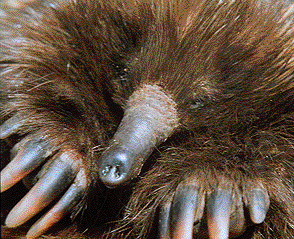 |
| mound, then insert their tongue to collect the ants. They crush the ants by chewing them between a horny pad on the back of their tongue and their palate. |
| Echidnas seem to have the perfect defense against dangers. They just simply disappear before your eyes, by burying themselves rapidly beneath the earth, resembling a subarine diving. They make no sounds apart from a snuffling snorting sound. |
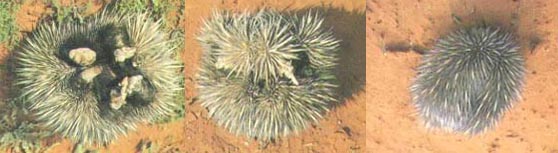 |
| I have never met an Australian who has failed to be enchanted by this loveable prickly ball of spines, on the odd occasion when they have been privileged to see it. |
| DREAMTIME Echidna was born with no spines. One day Echidna and Dingo were fighting, Echidna was losing, he rolled himself into a ball, and rolled into a prickly bush. The prickles stuck to him, and that's how the Echidna got his spines. The aborigines did however use the quills of the Echidna for the making of certain types of spears. |
|
| WOMBAT |
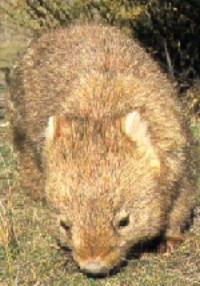
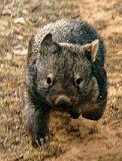
| There are three types of Wombat in Australia The Common Wombat (Vombatis ursinis) The Southern Hairy-nosed Wombat (Lasiorhinus latifrons) The Northern Hairy-nosed Wombat (Lasiorhinus krefftii) ** ** Also known as Queensland Hairy-nosed Wombat, and on the verge of extinction ! Wombats are a large masupial, extremely strong. They dig several burrows in their territory of up to 20 metres (22 yards) in length. Normally their burrows vary in length. Their territory can be as large as 25 hectares (62 acres) in size, but this is rare, depending on the terrain and availability of food. |
| They weigh as much as 40 kilograms (88 lbs) they have a large stocky head, with a broad nose. Short strong legs with extremely sharp strong claws and their rump contains cartlidge plates that have been compared to armour plating. Although their legs are short and they appear cumbersome when they walk, they are capable of reaching speeds of 40 kilometres (25 miles) per hour. |
| They have continually growing rootless teeth, much like those of a rodent, but they are strictly herbivorous. They eat native grasses, sedges, the roots of native shrubs and trees and matrushes. Which has led to their downfall in many areas when their natural food source has been interfered with by man. Because they are masupial, the females have the normal pouch, but it faces backwards to protect the young from dirt whilst digging. The pouch contains 2 nipples but they only normally have one baby. The mother nurtures the young one until the age of 12 months, at which time they are unceremoniously kicked out to fend for themselves. Although they usually stick pretty close to their mother but from a distance. Wombats reach sexual maturity at 2 years of age. Mating takes place in summer. |
| The Northern Hairy-nosed Wombat is in serious trouble, nearing extinction. In an area as small as 300 hectares (740 acres) there are between 65 and 75 wombats alive. This number has not increased since 1985 even though considerable precautions have been taken, such as fencing out cattle and sheep. They resist artificial feeding, refusing hand outs of their |
| natural food. Preferring to forage for themselves. They resist breeding when the droughts occur, which is often. They also resist breeding in captivity for release later on. It's imperative that a 2nd colony be established as soon as possible to aleviate the possibility of the entire colony being wiped out in case of bushfire, disease or some other disaster occurring. |
 |
| The Queensland Department of Environment and Heritage is currently working feverishly on research on Wombat ecology, genetics, reproduction, predators, competitors, habitat management, supplementary feeding strategies, translocation and captive management. So with a little bit of luck and good animal practices, these treasures will be saved. To have what appears to be such a strong animal in such a perilous position is disconcerting to say the least. To see one of these creatures in the bush, lumbering |
| along is a thrill that's difficult to explain. It's rare to see them in daylight hours, being mostly nocturnal, but they do occasionally sunbake or wander around near their burrow. You can usually tell when a burrow is currently being occupied, by the square shaped droppings at the entrance. |
| Wombats have very few predators, probably the dingo would account for the loss of lives in juveniles. However it's a very foolish dingo that would follow a Wombat down it's burrow, risking being crushed to death between the burrow wall and the excedingly tough, strong rump of the Wombat. It would be comparible to being crushed in a steel vice. The burrows are 'marked' by scent to advise other Wombats that the burrow is occupied. A strong aggressive display occurs when two male Wombats meet. Swinging it's head from side to side, baring and gnashing it's strong teeth, and issuing a growl, is usually enough to send the interloper on his way. However on the odd occasion that a dispute occurs there is normally some terrible damage done with those long sharp teeth on one or both rivals. |
|
| DREAMTIME Wombat originally had 6 legs and could run very quickly. When times were bad and the other animals were hungry, snake caught Wombat and took 2 of his legs. From that time on, Wombat ran more slowly and only had 4 legs. |
 |
|
|
|
|
|
|
|
|
|
| Australian_Birds |
| You are guest number |
| to visit this page |

|
 |
|
|
| Sign Guestbook |
| View Guestbook |
| View Archived Guestbooks |
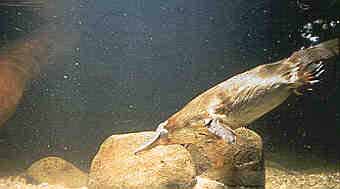 |
| Diving blind, eyes and ears firmly closed. |
|
 |
 |
 |
 |
 |
 |
 |
 |
 |
 |
 |
|
|
|
|
|
|
 |
|
|
|
 |
| (Poem) |
| (Poem) |
| (Poem) |
| (Poem) |
| (Poem) |
| (Poem) |
|
|
|
|