We have now come
to the final stage of the development of electric clocks. William Hamilton
Shortt coupled two Synchronome clocks so that one, the slave, would accomplish
the release of the gravity arm of the other, the master. Using his “hit and
miss” system he was able to have these pendulums “communicate” with each other.
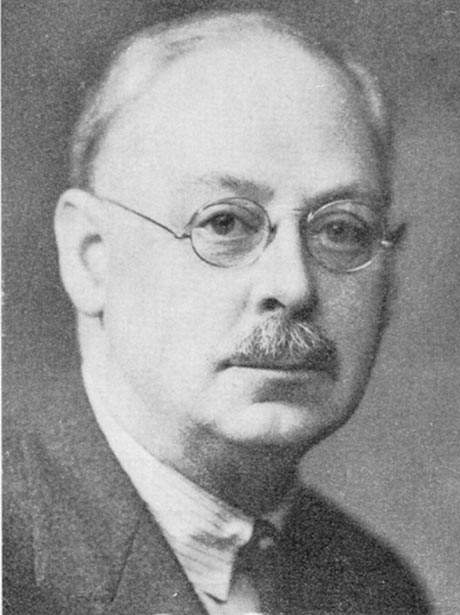
William
Hamilton Shortt (1881-1971)
In 1921 William Hamilton Shortt, a British railway engineer and director of
the Synchronome Co, succeeded in devising a system to keep two pendulums in
precise sympathy (patent no.187814).
A leaf spring is
fixed to the shaft of the slave pendulum and an armature is pulled down by
an electro-magnet receiving its synchronizing signal from the master clock.
The slave pendulum is given a small permanent losing rate so that, when its
spring is late in arriving at the tip of the armature, it is caught and deflected,
thereby quickening the semi-vibration of the pendulum, since the spring adds
to the force of gravity.
If the spring
is early in arriving at
the tip of the
armature it will miss catching the armature, hence the term “hit-and-miss”.
The tension of the spring is such that the advance
effected is twice the loss (due to the losing rate of the pendulum) during
the interval between two impulses, with the result that the engagement takes
place approximately at every other swing.
7.
Shortt's free pendulum
On the right-hand
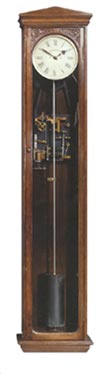
side we see an ordinary Synchronome clock (the slave) to which a leaf spring
is added and the "hit and miss" synchronizer.
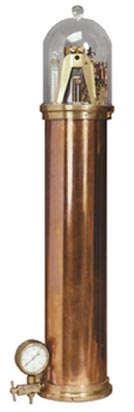
On the left-hand side we see the free pendulum (the master) placed in a vacuum
tank. There is no count wheel here and only an electro-magnet has been added
to operate the catch of its gravity arm.-------------
----- animation
Experiments
carried out by Shortt showed that if the vacuum of the tank is kept at 3 cm
of mercury the energy consumed by flexing the suspension spring equals the
energy consumed by deflecting the remaining air molecules; thus a higher vacuum
is not required.
When at half-minute
intervals vane a fitted to count wheel b
releases gravity arm c, the slave pendulum will receive its
impulse. After completing to give its impulse, the gravity arm touches contact
screw d of armature e. Electro-magnets
f are now energized and their armature resets the gravity arm. At
the same time electro-magnet g of the free pendulum is energized
and releases gravity arm h of the free pendulum that is on
its way to zero on its excursion to the left. Jewel j,fitted to the end of this gravity arm, now falls onto a little wheel
fitted to a bracket supported by the pendulum. And so the impulse begins when
jewel j runs down the periphery of the wheel and terminates
when it drops of the wheel.
The gravity arm then falls upon the wing of catch k and
releases switch arm m, which in falling replaces the gravity
arm onto its catch. At the end of its fall contact is made with armature p
and switch arm m is reset by electro-magnet r.
When magnet r is energized, magnets s
and t are also energized operating the hands of the dial
and pulling down armature v of the “hit and miss” synchronizer.
The considerable time that elapses between the release of the gravity arm
h and the operation of the remontoire replacing
switching arm m, can now be realized. It amounts to about
0.7 to 0.8 th of a second, during which period the slave pendulum, which was
a little beyond zero on its excursion to the right, completes its swing and
returns to zero in time for the act of comparison which determines
whether or not correction is required.
When the slave pendulum is late, leaf spring z will be
caught and deflected by armature v
and thus quickening the semi-vibration of the pendulum.
When the slave pendulum is early, the armature will miss catching the
leaf spring and nothing will happen.
Disregarding the energy
required to flex the suspension spring and deflecting the air molecules, the
free pendulum is swinging freely and has no work to do of any kind, none what
so ever! The only disturbance to its freedom is the acceptance of an impulse
from its gravity arm at
half-minute intervals.
The
introduction of the Synchronome-Shortt Free Pendulum was a great step forward
and about one hundred of these clocks were built. The first Synchronome-Shortt
Free Pendulum was installed in the Edinburgh Observatory. Suddenly the accuracy
of time measurements was increased to about one millisecond a day and it was
not long before astronomical observatories all over the world made use of
this system.
 synchronizer.