Before consideringelectrical horology, I would like to take a quick
glance at thehistory of electricity and magnetism.
Electricity
and Magnetism
Mankind has know
electric effects in the form of lightning from the earliest times but the
nature of these effects was of course unknown to him. Sailors were sometimes
startled to see a flickering luminous light at the tips of a ship's mast and
spars: the famous Saint Elmo's fire.
The first man-made electricity was discovered by the
rubbing of amber. Amber, a pale yellow translucent fossil, has the ability
to attract light objects such as paper and feathers when it is rubbed.
Some 3,000 years B.C. the Chinese were already aware
that lodestone, a magnetic oxide of iron, attracts small pieces of iron. The
Chinese were also aware of lodestone pointing to the North Pole and used it
for navigational purposes.
In 1600 William Gilbert (1540-1603), physician
to Queen Elisabeth and King James, was the first to explain the nature of
magnetism. In his book "De Magnete" he called the mysterious forces
involved: "electrics". This illustration shows how hot steel was
magnetized by hammering it while held in the magnetic meridian.
In 1660
Otto von Guericke (1602-1686) was the first to make a machine producing
electricity. Von Guericke is well known for his invention of the vacuum air
pump and his famous experiment with the Magdeburg hemispheres. By rotating a globe of sulphur it is electrically excited by the friction
of a hand held against it. The globe could be carried about to attract, and
repel, light objects such as paper and feathers.
This effect is now known to us as static electricity, meaning very
high voltage but of extreme low power.
In 1745
.Pieter van Musschenbroek
(1692-1761), a Dutch physicist, was engaged in a research to determine
the strength of electricity. In doing so, he probably was the first to experience,
quite accidentally, the discharge of a Leyden jar through the human body.
With the invention of the Leyden jar electricity could be stored in
large quantities, held sometimes for days, and discharged at will.
In 1678 Jan
Swammerdam (1637-1680), a Dutch microscopist
, demonstrated the contraction
of a dissected frog's leg when its nerve is touched by a metal wire.
It was not until 1786 that Luigi Galvani (1737-1798),
professor of anatomy at Bologna, explained this phenomenon by the production ofa "nerveo-electrical" fluid similar to that of frictional electricity.
Allessandro
Volta (1745-1827), an Italian physicist, disagreed with Galvani's
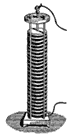
explanation. In 1796 Volta constructed a pile of a large number of alternate
silver and zinc disks and placed a piece of cloth,
moistened with a salty solution, between every other disk.
The first battery was invented:
the Volta pile.
However, this battery was not very practical
and had very little power.
Volta soon improved his invention by devising his "Crown of Cups",
a number of cups filled with sulphuric acid into which a number of metal strips
were dipped. Half of these strips were copper and the other half zinc.
The difference
between static electricity and electro-dynamic electricity was now fully understood.
Assuming that the tiny figures are electrons, one can better understand the
difference between a static electric charge and an electric current. In a
static charge all the electrons are on the surface and at rest, except here
and there an occasional electron that escapes. In the case of an electric
current the electrons rush along the inside of the conductor.
Inventions now followed in rapid succession:
1820 André Marie Ampère (1775-1836), a French physicist, discovered
the solenoid: a spiral coil of wire that behaves
like a magnet when an electric current flows through it.
1825 William Sturgeon, an English soldier, invented
the first electro-magnet bywinding
bare copper wire, insulated by silk thread, around a soft iron bar. When a
current flows through the copper wire the iron becomes a magnet. When the
current ceases the iron is no longer a magnet. 1827
George Simon Ohm (1789-1854),
a German physicist, formulated his famous law connecting voltage, resistance
and current in an electric circuit (V=I.R).
1828
Joseph
Henry, professor of Princeton N.J., created an electro-magnet of much
greater strength and efficiency by winding the ironcore with several
layers of wire and bending its shape:the horse-shoe magnet.
1831
M
ichael Faraday (1791-1867), professor of physics, devised a machine
to convert mechanical energy into electricity. A copper disk was mounted between
the poles of a big horse-shoe magnet and the rim and axle of the disk were
connected to a galvanometer. When the disk rotates the galvanometer needle
moves. The dynamo was invented,
for the first time a steady currentof electricity could
be produced without the use of a battery. 1836
John Frederic
Daniell (1790-1845), an English chemist, invented the first reliable
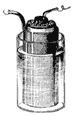
galvanic element: the Daniell battery.
Now reliable sources of energy are available, the scene is
set to consider electrical horology.
 explanation. In 1796 Volta constructed a pile of a large number of alternate
silver and zinc disks and placed a piece of cloth,
explanation. In 1796 Volta constructed a pile of a large number of alternate
silver and zinc disks and placed a piece of cloth,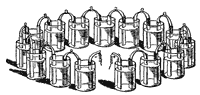 moistened with a salty solution, between every other disk.