The idea of a
free pendulum as Galileo Galilei (1564-1642) had in mind shortly before his
death fascinated many inventors but no one yet had succeeded. Only a free
pendulum, a pendulum having no work to do of any kind, can, in theory, be
used as a true timekeeper.
Robert James Rudd
In the illustration seen here (patent no.19337) the lower end of a free 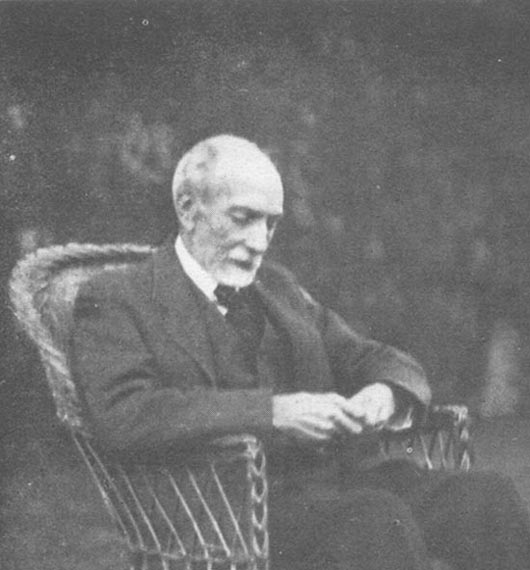 pendulum
is moving to the left just before receiving an impulse.
pendulum
is moving to the left just before receiving an impulse.
When the
electro-magnet is energized, triggered by a secondary clock, the armature
will turn a cam releasing a lever holding a roller. Rotated by a weight, this
lever will give the pendulum its impulse. When the lever has given its impulse
to the pendulum and has nearly completed its semi-revolution it breaks a contact.
Breaking this contact forms the synchronizing signal determined by the free
pendulum only.