The difficulties in devising consistent contact systems were well recognized
and the causes of failure known. Gold and silver contacts were used to avoid
failure but it only takes a speck of dust to make them inoperative with the
light pressure available from the pendulum.
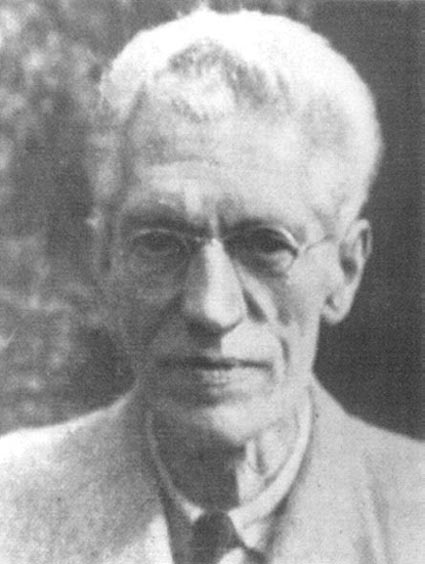
Charles Wheatstone
devised a solution to this problem!
Charles
Wheatstone Similar to Steinheil's
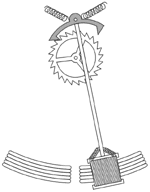
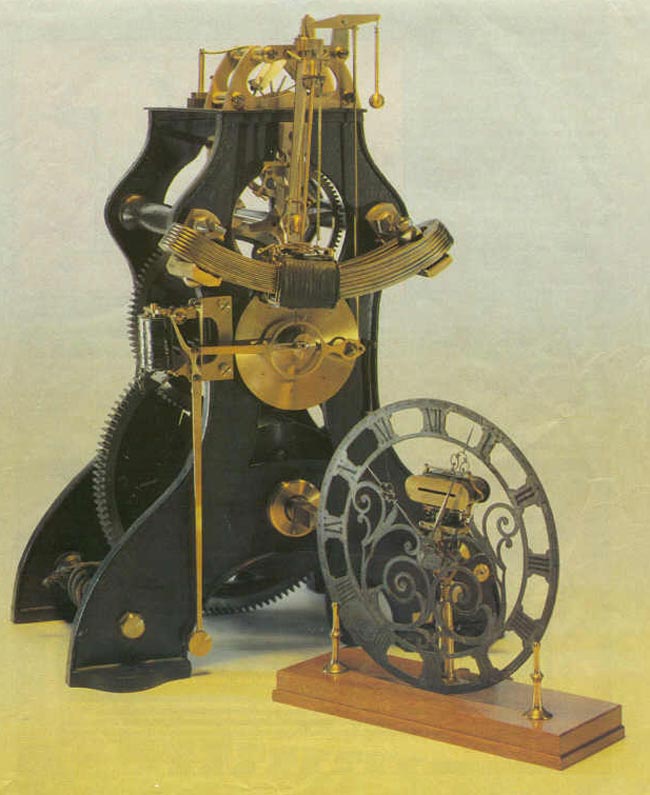
suggestion, Wheatstone used a large weight-driven
clock with a light pendulum carrying a coil passing over two permanent magnets
in 1870. The rapidly swinging coil induced electro-magnetic currents (Foucault
currents), reversing at each swing. The induced currents were used to drive
secondary clocks without the need for contacts of any kind.
Wheatstone outlined his proposal to use these electro-magnetic currents
as early as 1840 but it took until 1870 before that this clock was actually
built. However, the induced Foucault currents interfere ruthlessly with the
freedom of the pendulum making it necessary to synchronize his clock every
hour.His system was given a brief trial at the London University and the Royal-Society
but was soon abandoned. His clock is now exhibited at the Science Museum of
London.
The recoil escapement drawn here is not correct. In reality a more
complicated escapement was used.
3.
Reliability of contact making
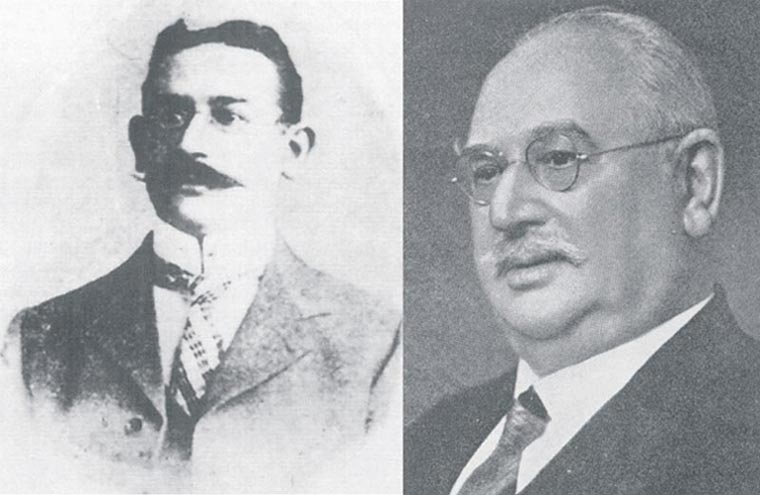
Martin Fischer
In 1900 Martin Fischer of Zurich used this principle successfully. In his
patent no. 19701 he used a master clock with a very high quality movement
releasing each minute a weight-driven train, which in its turn rocks an armature
of a generator within the poles of a powerful permanent magnet. The induced
Foucault currents are used to drive the secondary clocks.
His clocks are well known as Magneta clocks, later Inducta clocks.
Frank
Hope-Jones (1867-1950) and George Bennett Bowell (1875-1942)
Ten years later in 1895, Hope-Jones and Bowell adopted
the Van de Plancke system
for their version of a self-winding clock using a gravity arm as motive
power.
In their patent
no.1587 a weighted lever turns the wheelwork, descending until the
vertical arm touches a contact screw. The electro-magnet is energized and
its armature resets the weighted lever by throwing it up. The breaking is
caused by the inertia of the weighted lever.
This system disposed of the difficulties in obtaining a reliable
contact without interfering with the timekeeping properties of the clock.
Désiré and Gustave (1847-1915) van de Plancke
In 1885 the brothers Désiré and Gustave van
de Plancke of Courtrai, Belgium, devised a system (Belgium patent no.67750)
in which the contact making is not influenced by the wheelwork or its driving
power.
The horizontal arm of a two-armed lever rests on a tooth
of the wheel work of a spring-wound movement descending until it drops off
this tooth onto a contact pin. ---------animation
The electro-magnet is now energized and attracts an armature, shaped like
a hammer, adopted to hit a pin fixed to a weighted flywheel. The flywheel
is kicked and forced to make a full revolution thereby storing energy in
a spring.
At the same time a little finger attached to the flywheel makes contact
with the other arm of the two-armed lever thereby throwing it up. Contact
is broken by inertia and the lever will fall back on the next tooth of the
wheel work.
 a large weight-driven
clock with a light pendulum carrying a coil passing over two permanent magnets
in 1870. The rapidly swinging coil induced electro-magnetic currents (Foucault
currents), reversing at each swing. The induced currents were used to drive
secondary clocks without the need for contacts of any kind.
a large weight-driven
clock with a light pendulum carrying a coil passing over two permanent magnets
in 1870. The rapidly swinging coil induced electro-magnetic currents (Foucault
currents), reversing at each swing. The induced currents were used to drive
secondary clocks without the need for contacts of any kind.