The next
important step was the use of a count wheel driven by the pendulum to give
the pendulum an impulse at fixed intervals. The same count wheel as already
invented
by Hipp about 50 years before and used by De Jongin
1865.
Campiche
In 1893 Henri
Alfred and Moïse Alexandre Campiche of Geneva fitted a little finger
to the pendulum pushing a count wheel tooth by
tooth and impulsing the pendulum at fixed intervals (patent no.
8830).
In 1899 they greatly improved their system by making
the impulse less dependent on the condition of the battery (patent no.10393). ---------------------------animation At one-minute intervals,
a vane attached to the arbor of the count wheel slides between two contact
springs. The electro-magnet is energized attracting
its armature and the potential energy stored in a
spring is released to the pendulum.
William
Edgar Palmer (1864-1951)
In 1902 William Edgar Palmer of Tonbridge, Kent,
devised a similar system (patent no.10541) to that of the Campiche brothers.
At half-minute intervals
a pin fixed to the count-wheel unlatches a catch
holding the gravity arm. The pendulum is now impulsed by means of an impulse
pin fixed to the gravity arm. The last thing the gravity arm does at the end
of its fall is to unlatch a spring, which snaps into contact with a contact-plate
fitted to the gravity arm. The electro-magnet now resets the gravity arm by
means of its armature.------------------------------animation
Thus the energy for
contact making comes from the gravity arm and is not taken from the pendulum.
Palmer's impulse
system is open to the same objections as many other clocks. Shock and vibration
of the pendulum will result, unless the release of the gravity arm is accomplished
at exactly the right moment. In conditions of variable arc this is found to
be practically impossible.
Frank
Hope-Jones
In 1905 Hope-Jones took out patent no.6066 in which
he used a count wheel releasing a gravity arm to impulse the pendulum.
In this patent the impulse system used is still similar to that of the Campiche
brothers.
Three years later
in 1908, he devised a far better system (patent no.1945) in which the method
of impulsing was drastically improved.
A vane
fixed to the count wheel releases the gravity arm at half-minute intervals
and a roller fitted to the gravity arm then falls down on a bracket of the
pendulum and impulses the pendulum. When the gravity arm touches a contact
screw of the armature the electro-magnet is energized and its armature throws
the gravity arm back onto its catch.
The only work the
pendulum has to do is to turn the count wheel and unhook the gravity arm.
The energy lost in doing so is negligible.
The most significant
improvement to the impulsing devise is that it is done very gently and occurs
when the pendulum is passing through its zero position when its kinetic energy
is at its maximum and the interference to the freedom of the pendulum is kept
to a minimum. The form of the impulse
bracket accomplishes that the impulse always comes at the right moment when
the pendulum is going through its zero position. If the gravity arm is released
too early, the roller of the gravity arm will just ride on the horizontal
plane of the impulse bracket and will not disturb the freedom of the pendulum.
We now know
this system as “the Synchronome switch”.
Hope-Jones used
a pendulum rod made of invar. Invar is a nickel-steel alloy with an extremely
low coefficient of expansion invented in 1904 by Charles-Edouard Guillaume
(1861-1938), a French physicist. Using an invar pendulum rod, Hope-Jones'
clock of 1908 was capable of outperforming all but the most accurate astronomical
clocks at that time.
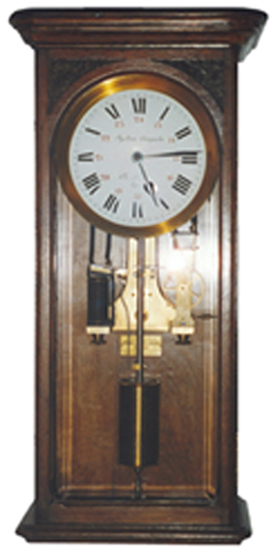 Henri
Alfred and Moïse Alexandre Campiche of Geneva fitted a little finger
to the pendulum pushing a count wheel tooth by
tooth
Henri
Alfred and Moïse Alexandre Campiche of Geneva fitted a little finger
to the pendulum pushing a count wheel tooth by
tooth 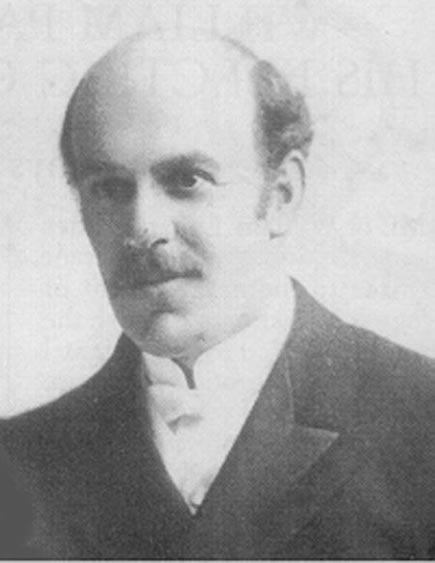
 ----------------------