PH
- That's what I was going to say. Ice
Shirt in Greenland, Fathers
and Crows about Québec…
WTV -Yeah, Fathers and Crows is mostly Canada,
The Rifles is mostly Canada.
PH - It's about the doomed Franklin Expedition.
People have done songs about it up here.
WTV - Yeah, that's right.
PH - It's a brilliant idea for a series.
Obviously I haven't got to read them all. It's a
septet, a seven book series. So far we've got the
Ice Shirt, released in 1990, Fathers and Crows in
1993, The Rifles in '94, and Argall, the new one.
You just finish them as they go. Whatever one comes
up next is released.
WTV - Exactly, and they can be read in any
order.
PH - The Vinland
Sagas were used as reference for the Ice Shirt.
I read them years ago, wonderful series, which included
the Grænlendinga
Saga and Eirik's
Saga.
WTV -Yeah, I love the Icelandic sagas so
much. I'm German, Swedish, Norwegian, so I figure
that's my ancestors they're talking about…
PH - I'm sort of the same way, but mine is
Scottish, so it's the Celts and the Orkneyinga
Saga.
WTV - That's right, yeah! There might have
been some Scots that settled on Iceland, it's unclear,
there was definitely some Irish.
PH - This is one thing I wanted to get to
the idea you've talked about; the barrier of myth
and history. These early books dealt with a lot
of that. You're at a place where it's not definitely
known and a lot of it is the myth, those wonderfully
rich stories, as opposed to the history and where
the actual fact lies. Did you find that same sort
of problem with Argyll, but in a different way,
say with the Disney-fication of history? The whole
Pocahontas story?
WTV - Well. With Pocahontas there is so much
to talk about. There's what really happened, and
then there's what everybody is pretending happened
for so long. And after a while both of those things
are equally important. Just like when you read the
Norse sagas or the Norse myths, you're looking back
at an outlook, and any outlook is truth in a sense.
These things that we desire to believe about Pocahontas,
because we desire to believe them, and try to convince
ourselves that they are this way for so long, they
reveal something about us, and therefore they are
true. Where they deviate from literal fact becomes
very interesting and if we find out how they deviate
from literal fact we're likely to learn even more
about ourselves. Why do we want to lie in this particular
way, why did we decide to make these particular
lies true. That's one of the things that I try to
do in each one of the Dreams. Not only to look at
the conflict between the two belief systems, in
this case European and Native American, but also
between, what, as far as we can tell, actually happened,
and what each side claims happened.
PH - The earlier books tend to have a more
dreamlike quality, maybe because they are closer
to myth than history, and you are able to create
a truth, but in this one, Argall you are more straightforward
in your narrative. Was that a conscious decision,
or do you even see that?
WTV -Yeah, I would say that that's true.
To me it's very important to me that these Seven
Dreams don't end up degenerating into seven copies
of one formula. I try to make each book very different
than the others. The interesting thing, in a way,
about the Pocahontas legend is that the legend is
kind of a dream but both sides; the Powhatan
Indians and the English colonists were exceedingly
practical and you can only get a hint of the weirdness
in the belief systems from the language itself.
Some of the conceptions of hierarchy and faithfulness,
and faith that are embedded in Elizabethan language
are fascinating, and it was kind of fun, for a change,
to bring those out more subtly through the language.
Also, there are very, very few Powhatan myths surviving,
in fact, the sources and the landscape and everything
else is so impoverished, compared to the sources
for, say, the Ice Shirt where you can go to Iceland
and see the ruins of Eirik
the Red's house. Out of respect for what's there,
I don't want to make anything up. I don't mind elaborating
on myths, but when so little is known about a whole
people it seems disrespectful to just make things
up. things. |
|
 |
 |
|
|
 |
|
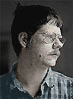 William
T. Vollmann defies classification. Attempts have been
made many times to neatly fold his accomplishments into one
sharp little article. The difficulty lies in meshing his personal
and journalistic travels and experiences with his wide and
varied written output. Beginning in 1982 when he traveled
to war torn Afghanistan, since then he has been to the Balkans,
done a solo trek to the magnetic north pole, experienced the
brothels of Bangkok, Cambodia, the poppy fields of Burma,
Bogotá's barrios, but nowhere has he more intimately
explored than the crack hotels and bars of San Francisco's
Tenderloin district. William
T. Vollmann defies classification. Attempts have been
made many times to neatly fold his accomplishments into one
sharp little article. The difficulty lies in meshing his personal
and journalistic travels and experiences with his wide and
varied written output. Beginning in 1982 when he traveled
to war torn Afghanistan, since then he has been to the Balkans,
done a solo trek to the magnetic north pole, experienced the
brothels of Bangkok, Cambodia, the poppy fields of Burma,
Bogotá's barrios, but nowhere has he more intimately
explored than the crack hotels and bars of San Francisco's
Tenderloin district.
He surged onto the letters scene in 1987 and has published
eight novels (most recently Argall), three collections of
stories, and one work of nonfiction. This equates to around
6000 pages of work. He also has found a publisher for his
Rising
Up Rising Down, a treatise on the morality of violence
which weighs in at around 4000 pages.
After the attacks on the U.S. on September 11, 2001, the Literary
Review of Canada asked if I would interview Vollmann for
the upcoming issue (Volume
9, No. 8, October 2001).
Of course, I agreed. This interview is the full version as
the LRC wanted me to cut down the draft by half.
Enjoy,
Paul
|
|