| "Most of this
continent's transformation is over with. What
remains can be extrapolated from forces that are
now already in place. I'm not trying to make an
Hegelian argument that history is coming to an
end, or suggesting that I know what's going to
happen in the future. Things will continue to
change in this country, and perhaps very radically
so. But my sense is that the other massive and
violent transformations which are going to impinge
on us (and they always will, because history is
like that) are probably going to come from some
outside source" |
- Larry
McCaffery, The Review of Contemporary Fiction,
Summer 1993
An Interview with William T. Vollmann
|
| "Americans worry
that Afghanistan has become a Petri dish in which
the germs of Islamic fanaticism are replicating-soon
Afghans will be hijacking planes and bombing embassies
everywhere. And their fears are not necessarily
unfounded." |
|
|
- William
T. Vollmann, The New Yorker, May 15, 2000
Letters from Afghanistan: Across the Divide. What
the Afghan people think of the Taliban?
|
 |
Paul Hunter -
Now, that's a lot of insight and you've gained a
lot of insight into the minds of those in and under
the Taliban as shown with your trips to Afghanistan
in 1982 [which you wrote about in An
Afghanistan Picture Show, or, How I Saved the World]
and again in January 2000 [which you wrote about
in Letters
from Afghanistan: Across the Divide for The
New Yorker]. Were you surprised by the attack that
took place September 11 in New York?
William T. Vollmann - No, I wasn't surprised.
I was very sad but I wasn't surprised.
PH - It's hard to relate to that kind of
fanaticism. But you talked about that before when
you said that when you wrote the An Afghanistan
Picture Show, or, How I Saved the World the whole
process of writing it ended up "being about
the unknowability of their experience," and
what they've been through.
WTV - They have been through a heck of a
lot and if we want to talk about unknowability;
so much of that derives from our distance; from
the people who are dropping bombs and kidnapping
heads of state and doing all kinds of things like
that around the world in our name. Americans, for
instance, periodically forget that we're still at
war with Iraq. That we still have blockaded them.
That thousands and thousands of kids have died there
from diarrhea and other causes. When I was there
it was really, really heartbreaking to see, and
so the Iraqis obviously know that we are at war
with them but we don't know. Most of us don't know.
And so it's very peculiar all these things are happening
that most people don't read about or don't see on
television, or if they do they immediately forget.
But all of a sudden somebody retaliates and people
are stunned. I don't think, of course, that this
attack is at all justified no matter what we might
have done. The only good thing I can see coming
out of it is that maybe people will pay a little
bit more attention to what's going on in rest of
the world. Fortunately your country, being a bit
less dominant than mine and therefore constantly
having to recognize that there's this other nation
just south of you who is trying to do things often
in an arrogant and bullying way. You guys have to
recognize the other, whether you want to or not.
So you are better equipped to deal with all this
stuff that's from the Americans.
PH - Well, it's true. But the thing that
gets me about it is that when it actually happened,
it was amazing how moved and really shaken everybody
was up here. We have such a connection to the States
and what happens there. And I don't think a lot
of people were aware of that connection until this
happened. I was amazed at the amount, still to this
day, of how many American flags Canadians are flying
now to show their support.
WTV - Oh, that makes me so happy to hear.
You know, I have many, many problems with my country's
domestic and foreign policies and when I'm abroad
it's always painful and sometimes exasperating when
I hear the country attacked and right now, you know,
we suffered a tremendous blow and we all appreciate
the signs of sympathy and friendship from everybody.
So, thank you.
PH -Why did you return to Afghanistan last
year?
WTV - Oh, because The New Yorker was
paying me and I love Afghanistan. I'm always happy
to go back there; I hope I can go again. I think
the people are terrific. There was an old Pakistani
General near the Northwest frontier province who
took very good care of me when I was there before,
he was still alive, and it was a big thrill to get
to see him again. It was a wonderful trip. I'm so
happy that I got to go back, and it was very interesting
for me to meet the Taliban as well.
PH - It must be really intense that in such
a short period of time a country changes so drastically
and I'm sure right now it's definitely not the same
place it was a year ago or twenty years ago. Something
that changes that often, the stress on the civilians,
the people that live there must be tremendous.
WTV - Some things have changed, the people
have not really changed. When I was there in '82
they told me they were fighting a jihad,
a holy war against the Soviets. So when the Taliban
came to power very many of them were happy because
they thought now we have accomplished our jihad
and have an Islamic government that is more perfect
than any other Islamic government on earth. We have
to remember about the Taliban, that they are really,
in my opinion, the best, and most practical of all
the various alternatives for Afghanistan. They have
protected women from being raped, men from being
murdered, property from getting plundered. It's
much, much better there than it was in the time
of the invasion. So they enjoy a great deal of support.
I don't say that I would want to live in Afghanistan
under the Taliban, but then they probably wouldn't
invite me.
PH - [laughter] That's true. Osama Bin Laden
is not part of the Taliban, is he?
WTV - He's not part of the Taliban government.
PH - Did he start as mujahideen?
WTV - Yeah, he's a war hero. They showed
me a big battlefield near Jalalabad where certain
hills were named after him because of some big defensive
action that he executed against the Soviets there.
I'm not sure exactly what. All the possible leaders
for Afghanistan, except the king, Zahir Shah, have
been mujahideen.
PH - I'm curious about your treatise on violence,
Rising
Up Rising Down; it's already been picked up
by a publisher, hasn't it? [ed. it has been picked
up by McSweeney's Books and, hopefully will be released
by the end of 2002 - P]
WTV - It was picked up then it was dropped.
Another small publisher is looking at it right now,
but who knows what will happen. It's about 4000
pages long and very expensive to produce. I hope
it will get published some day, but since I refuse
to cut any of my books maybe it will never happen,
who knows?
PH - The whole attack, as far as moral arguments
for and against violence, seems to be a unique example
of violence and how people react to it, and I wondered
if it was going to be written into Rising Up, Rising
Down?
WTV - It certainly is a pretty pure form
of violence.
PH - The ongoing theme of your books tends
to be Truth. You mentioned before the slogan painted
at the headquarters of Khun Sa, the Burmese-Shan
"Opium King" that said "The only
obligation is to tell the truth."
WTV - Yeah, I really admire him for having
that on his wall.
PH - and to me it seems to be the ongoing
theme of your books; it's always about getting to
the truth. To a certain degree it's a quixotic search
for something, for love in some cases, certainly
in the trilogy of the prostitute stories. You always
seem to be getting at the truth, searching for the
truth in some way, in the case of The
Royal Family, it's trying to find the truth
of himself….Henry Tyler and his brother John,
and you've said it's meant to be the last book of
the trilogy. I just love the idea of addiction as
a form of enlightenment. To me it seems like a true
statement, the whole idea of you get to that point
where you need something so bad you put a spiritual
attachment to it, and it happens so much with those
books, The
Whores for Gloria, the Butterfly
Stories, The Royal Family. Were you conscious
of that connection with the truth all the way through
these?
WTV - Yes, of course and for me I think that
almost anything can be redeemed in a sense, by love.
If you're engaged in some sort of behaviour or addiction
or what ever that other people might consider disgusting
or even reprehensible if you can be steadfast enough
then somehow or other you are purifying what you
do. You become more pure and you benefit no matter
how good or bad the activity is and no matter what
happens to you. I would say that I have had so many
deeply spiritual experiences involving sex with
prostitutes, and illicit street drugs. For that
matter I have learned so much from talking to terrorists
and often very, very creepy people. If you can understand
the extremes of the human continuum then you have
a shot at understanding the whole continuum which
would be terrific and so amazing. But as long as
we're here we might as well try to learn whatever
we can and we night as well be faithful to something.
Hopefully we can pick something good to be faithful
to. If we can't, we'll just have to do our best.
PH - It's true, the whole idea that if you're
afraid to experience something. Spiritual enlightenment,
or any sort of enlightenment, whether its satori
or whatever, it's an extreme state. And to experience
extreme states opens your mind that much more to
new things. That whole idea, as far as the love
aspect of it, with the Journalist for Vanna in the
Butterfly Stories; or Jimmy for Gloria [from Whores
for Gloria; or, Everything Was Beautiful Until the
Girls Got Anxious, December 1991]; or Henry for
the Queen of Whores, or for Irene [from The Royal
Family] it's all there, its wanting to attain that
thing just out of our reach, that's just not there.
But if you could, it would just open you up. It
would give you that burst of the unknown.
WTV - That's right, and it's actually so
wonderful that in life there are so many things
a person can do to go into darkness and discover
something new. I remember in my twenties I was really
depressed for a while. I thought well, the law of
gravity is not going to change, all the human beings
are going to look about the same and they'll have
the same respiratory functions. Really it's going
to be a very, very boring life. Fortunately, I was
so wrong. I think one of the great things about
reading literature or, for that matter, writing
it is that you can enter all kinds of new worlds.
The more you read and the more you write; the more
you discover and the more it becomes really possible
to appreciate a lot or things. |
|
 |
 |
|
|
|
|
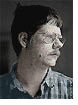 William
T. Vollmann defies classification. Attempts have been
made many times to neatly fold his accomplishments into one
sharp little article. The difficulty lies in meshing his personal
and journalistic travels and experiences with his wide and
varied written output. Beginning in 1982 when he traveled
to war torn Afghanistan, since then he has been to the Balkans,
done a solo trek to the magnetic north pole, experienced the
brothels of Bangkok, Cambodia, the poppy fields of Burma,
Bogotá's barrios, but nowhere has he more intimately
explored than the crack hotels and bars of San Francisco's
Tenderloin district. William
T. Vollmann defies classification. Attempts have been
made many times to neatly fold his accomplishments into one
sharp little article. The difficulty lies in meshing his personal
and journalistic travels and experiences with his wide and
varied written output. Beginning in 1982 when he traveled
to war torn Afghanistan, since then he has been to the Balkans,
done a solo trek to the magnetic north pole, experienced the
brothels of Bangkok, Cambodia, the poppy fields of Burma,
Bogotá's barrios, but nowhere has he more intimately
explored than the crack hotels and bars of San Francisco's
Tenderloin district.
He surged onto the letters scene in 1987 and has published
eight novels (most recently Argall), three collections of
stories, and one work of nonfiction. This equates to around
6000 pages of work. He also has found a publisher for his
Rising
Up Rising Down, a treatise on the morality of violence
which weighs in at around 4000 pages.
After the attacks on the U.S. on September 11, 2001, the Literary
Review of Canada asked if I would interview Vollmann for
the upcoming issue (Volume
9, No. 8, October 2001).
Of course, I agreed. This interview is the full version as
the LRC wanted me to cut down the draft by half.
Enjoy,
Paul
|
|