PH
- I know, you've mentioned in the past the Comte
de Lautréamont's Maldoror and I remember
being so blown away by that book when I read it.
WTV - Yeah, what a beautiful book.
PH - Which version did you read? The Penguin?
WTV - Yes I did.
PH - That's the Paul Knight [translator] version.
WTV - Yes.
PH - You should try finding the Exact
Change version by Alexis Lykiard
WTV - Oh really, why's that?
PH - his translation's considered the best. [ed.
- I wish to correct myself here. I sent a letter to
Bill after the interview explaining that once I went
back and read Lykiard's forward in the Exact Change
version it was Lykiard himself that claimed that his
version was the best I haven't found anyone to agree
with this so read either translation. -P]
WTV - Oh is that right?
PH - The translation is from 1970. It's just
as beautiful, I read the Penguin version first as well
and just loved it and when I found the Exact Change
version, the translator's note said that Knight's version
was just the worst. But, I didn't agree.
WTV - I'll have to check that out. I recently
read it in French and thoroughly enjoyed it.
PH - If I could I would love to read the original
version but I don't have the handle of French.
WTV - You know I have my own little publishing
company, it's called CoTangent
Press. I always wanted to do a new translation of
Maldoror and I thought it would be nice to have it on
titanium pages which were rainbow anodized. In other
words, you often see woman's earrings and they have
that pretty colour. And I would like the edges of the
pages to be razor sharp and dipped in some kind of poison.
PH - the "poison-filled pages." [Maldoror,
First Canto]
WTV - Yeah, exactly! So, you'd have to have a
special pair of steel gauntlets or something…
PH - like butcher's gloves. A lot of the stuff
you've done through CoTangent is just brilliant.
WTV - As a matter of fact I was working a little
bit on one of my CoTangent bindings when you called.
They're four platinum prints. They are fairly expensive.
PH - What are the platinum prints of?
WTV - They're nudes. The women involved are in
an overgrown backyard in Oregon, and they're holding
a papier-mâché mask that I made. It's got
bones for teeth, a bunch of crow feathers, and the hair
of a woman who is a good friend of mine. As well as
the platinum prints there are some watercolour drawings
of that mask and of some of the women. It's an attempt
to mix photography and fairly representational drawings.
PH - This will be in an edition of ten you'll
be doing?
WTV - Yes, this is the second one. I'm hoping
to finish it up by Friday; I probably can because the
weather is nice and warm. Probably close to 40º
c. today so the glue dries very quickly. What sort of
books do you bind?
PH - Right now it's all my own writing.
WTV - And how do you bind it?
PH - I've done a few different styles, it's more
traditional than yours. Basically sewn signatures bound
into davey board covers. Usually done letterpress, we
write illustrate and bind the books ourselves. Me and
my wife who's the co-proprietor. We do block prints,
wood engraving, or linocut. It's usually printed in
intertype, and we handset monotype title pages.
WTV - How long do the books tend to be?
PH - Around thirteen pages.
WTV - Uh huh, well that's doable then. That's
still a lot of work.
PH - It is. It's usually about six months beginning
to end.
WTV - I've been working on one, which I started
in '95 it's called The Book of Candles, and it's a folio
edition. It's seven poems with a lot of block prints
and magnesium cut text. There are probably about seventy
to seventy-five illustrations in all. It's a tremendous
amount of work but I really enjoy working on that, I'm
hoping to print another group of ten copies of one page
maybe Saturday or Sunday.
PH - I think it shows you do this sort of work
in your books themselves. I always thought about that
before I found out about CoTangent. The different type
use, you can see your hand through the whole thing,
even with Royal Family, one of your photographs is on
the cover and the font changes, where you'll see a bold
text or an outline text and it always seemed to me that
this is a writer who is used to doing his own text,
doing hands on of the product.
WTV - That's right and we are so fortunate nowadays
that it's very easy to do that.
PH - Yeah, it helps to have a printing press
in my basement.
WTV - Yeah, but even just for commercial work, I can
specify the type on the Macintosh. A hundred years ago
it would have been quite a chore to do it.
PH - But people like Benjamin Franklin and others
were able to do it. I remember an older printmaker who
said to have a printing press in your basement is the
ultimate power.
WTV - That's really true.
PH - How are you hands holding up, I know you
have had problems with carpel tunnel syndrome?
WTV - They're a little bit better. I have a little
daughter, she's going to be three tomorrow, I play with
her a lot, put in several hours a day with her, I carry
her around on my shoulders too, so I'm less productive,
which is probably good. How about you, do you have any
kids?
PH - No, no kids, no plans, we're too busy.
WTV - I understand.
PH - The Seven Dreams: A Book of North American
Landscapes, I've got to get onto that. I haven't had
a chance to read Argall yet, I just got it yesterday.
Is it going to be released in Canada?
WTV - I hope so.
PH - One of my favourite books of yours that
I've never been able to get or read is You
Bright and Risen Angels. It looks absolutely brilliant
but I can't seem to get my hands on it in Canada yet.
Give me some time and I'll get it.
WTV - I think Deutsche the English Publisher
did release a Canadian edition but there was only a
few hundred copies. I'm very frustrated that the other
Canadian Dreams are not available. It makes me very
depressed because Canada is one of my two or three favourite
countries and I just love it up there so much and I
really loved writing the Seven Dreams that were set
in your country.
|
 |
 |
|
|
 |
|
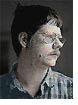 William
T. Vollmann defies classification. Attempts have been
made many times to neatly fold his accomplishments into one
sharp little article. The difficulty lies in meshing his personal
and journalistic travels and experiences with his wide and
varied written output. Beginning in 1982 when he traveled
to war torn Afghanistan, since then he has been to the Balkans,
done a solo trek to the magnetic north pole, experienced the
brothels of Bangkok, Cambodia, the poppy fields of Burma,
Bogotá's barrios, but nowhere has he more intimately
explored than the crack hotels and bars of San Francisco's
Tenderloin district. William
T. Vollmann defies classification. Attempts have been
made many times to neatly fold his accomplishments into one
sharp little article. The difficulty lies in meshing his personal
and journalistic travels and experiences with his wide and
varied written output. Beginning in 1982 when he traveled
to war torn Afghanistan, since then he has been to the Balkans,
done a solo trek to the magnetic north pole, experienced the
brothels of Bangkok, Cambodia, the poppy fields of Burma,
Bogotá's barrios, but nowhere has he more intimately
explored than the crack hotels and bars of San Francisco's
Tenderloin district.
He surged onto the letters scene in 1987 and has published
eight novels (most recently Argall), three collections of
stories, and one work of nonfiction. This equates to around
6000 pages of work. He also has found a publisher for his
Rising
Up Rising Down, a treatise on the morality of violence
which weighs in at around 4000 pages.
After the attacks on the U.S. on September 11, 2001, the Literary
Review of Canada asked if I would interview Vollmann for
the upcoming issue (Volume
9, No. 8, October 2001).
Of course, I agreed. This interview is the full version as
the LRC wanted me to cut down the draft by half.
Enjoy,
Paul
|
|