

| HOME |
| Little Red River |
| Norfork River |
| White River |
| River Reports |
| Fly Patterns |
| Seasonal Fly Choices |
| Local Entomology |
| About Generation |
| How-to Information |
| Fishing License |
| Local Forecast |
| About Me |

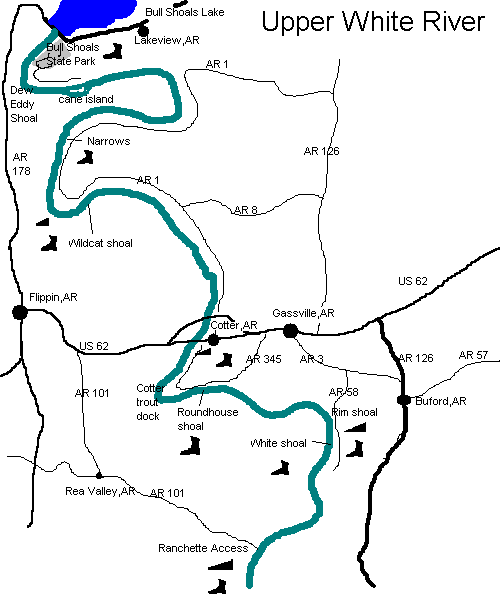
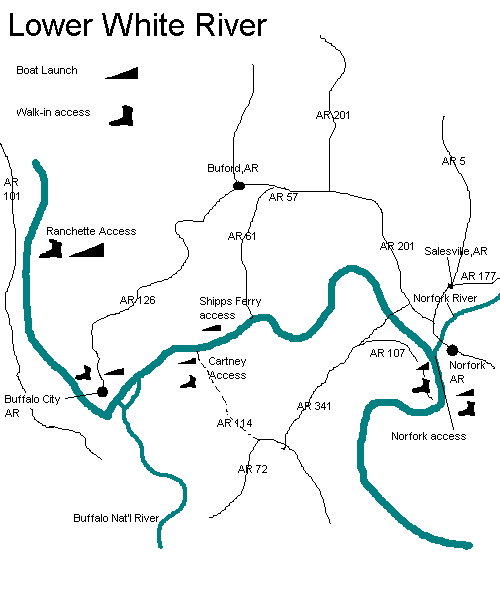
White River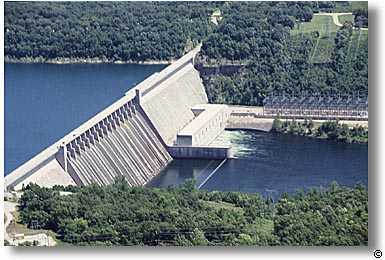 The White River in Northern Arkansas is, without a doubt, the best known trout river in the state and is recognized nationally as a premier flyfishing destination. Numerous resorts along her banks tout her "World Class" status. Originating in the foot hills of Northwest Arkansas, the river flows north into the impoundment known as Beaver Lake. The short tail water from Beaver lake has some quality flyfishing waters as it continues into Missouri where it is again impounded, forming Lake Taney Como. This water turns southward again into Arkansas largest lake, Bull Shoals. The Bull Shoals Dam, located a few miles north of mountain Home, AR is recognized as the world's fourth largest dam, and is quite awe inspiring upon first sight. The cold, crisp tail water below is what Arkansas flyrodders know as "The White". Spanning the entire state from northwest to southeast, the White River receives watershed from nearly all of northern and eastern Arkansas, eventually becoming big enough to support barge traffic before entering the Mississippi. Our concern here is however, the trout waters that extend approximately 44 miles from the base of Bull Shoals Dam. This far from the dam, the water slowly begins to warm beyond the likings of the trout. The White River in Northern Arkansas is, without a doubt, the best known trout river in the state and is recognized nationally as a premier flyfishing destination. Numerous resorts along her banks tout her "World Class" status. Originating in the foot hills of Northwest Arkansas, the river flows north into the impoundment known as Beaver Lake. The short tail water from Beaver lake has some quality flyfishing waters as it continues into Missouri where it is again impounded, forming Lake Taney Como. This water turns southward again into Arkansas largest lake, Bull Shoals. The Bull Shoals Dam, located a few miles north of mountain Home, AR is recognized as the world's fourth largest dam, and is quite awe inspiring upon first sight. The cold, crisp tail water below is what Arkansas flyrodders know as "The White". Spanning the entire state from northwest to southeast, the White River receives watershed from nearly all of northern and eastern Arkansas, eventually becoming big enough to support barge traffic before entering the Mississippi. Our concern here is however, the trout waters that extend approximately 44 miles from the base of Bull Shoals Dam. This far from the dam, the water slowly begins to warm beyond the likings of the trout.Be warned, this river fluctuates a great deal during generation. It is not a good idea to place yourself in an area with no escape route. Keep a sharp eye on the water level and get out immediately if the river begins to rise. Heavy generation also tends to change river's topology, so areas may be slightly different each time you visit. The descriptions that follow are assuming the water is low, and all directions are assuming we are looking downstream. Bull Shoals State ParkLocated within park boundaries are three main shoals. The first one, beginning immediately below the dam, is a short, shallow shoal with a small gravel bar in the center of the river, the deepest channel is on the left side. I have had my best luck here with gray or black midge pupas down to about size 22, or size 16 and smaller soft-hackles. If the midge hatch is heavy, you should consider using a dry midge in size 20-24. In the winter months, white woolly-buggers will catch some nice fish, especially after periods of heavy generation. The second shoal has a nice hole below it providing a good place to swing woolly-buggers, or fish a small nymph below a strike indicator. The water from here down is rather flat, but some good fish can be taken by stealthy anglers using long leaders and small flies. The last shoal accessible from here is called Dew Eddy Shoal. The water is a little faster here with some decent pocket water and a couple of drop-offs that usually hold some nice fish. Remember that this is a "Catch and Release" zone so make sure your hooks are barbless. This area is also closed to all fishing from November 1st through January 31st to protect the spawners.Cane Island ShoalThis is a long shallow shoal with deep water above below, with water fast enough to support heavy woolly-buggers and weighted nymphs. I usually make my best catches on nymphs near the lower end of the shoal as the water deepens and slows.Bruce Creek Shoal/Three ChutesAccessible from Denton Ferry road (CR 1), Bruce Creek Shoal has a nice mix of fast and slow, deep runs and shallow riffles. Some big fish are said to be caught here, but I haven't yet had the pleasure. There is a nice slow-water hole between here and Three Chutes, which is sort of plain looking at first sight, but when the bugs get to hatching, some really nice fish can be taken right up on top the shoal with small dries. Size 18-20 Parachute Adams and size 20 BWOs have done well for me. The Caddis flies can really get fired up here as well in the Spring months.The NarrowsA long narrow island divides the river, with perhaps the best water being on river right. The pool-riffle-run layout of this section gives anglers a nice variety of waters to choose from. Although this shoal gets a steady amount of pressure, it always seems to fish pretty good, with the occasional trophy fish making an appearance. The right side of the island is slow and not worth the effort to me.Wildcat Shoals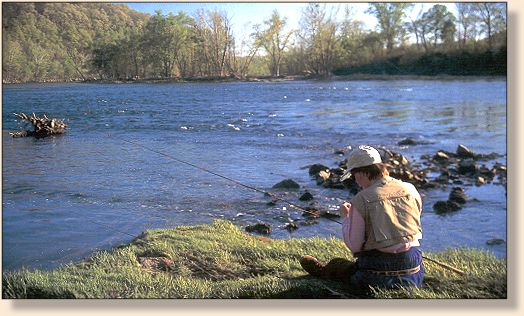 This is a long stretch of pocket water with lots of small boulders breaking the currents, and a nice deep pool in the middle. A very popular shoal with many anglers, this stretch of water is my favorite on the White, mostly because of the easy access and easy wading. Fish the drop-offs with scuds, pheasant-tails, or sowbugs and you should get some nice results. The dry-fly fishing here can get fun late in the day, so make sure you have a nice selection of adult imitations on hand. To wade in, you must take "Spearfish Trail", which is about 1/2 mile downstream from the boat ramp. Don't worry, if you can't find it just look for vehicles parked in the clearing just off Denton Ferry rd. This is a long stretch of pocket water with lots of small boulders breaking the currents, and a nice deep pool in the middle. A very popular shoal with many anglers, this stretch of water is my favorite on the White, mostly because of the easy access and easy wading. Fish the drop-offs with scuds, pheasant-tails, or sowbugs and you should get some nice results. The dry-fly fishing here can get fun late in the day, so make sure you have a nice selection of adult imitations on hand. To wade in, you must take "Spearfish Trail", which is about 1/2 mile downstream from the boat ramp. Don't worry, if you can't find it just look for vehicles parked in the clearing just off Denton Ferry rd.CotterThis is a busy area, with plenty of access both above and below the ramp. A goody area to bring new fly-fishers because of plentiful stocking and easy wading. During low water you must concentrate on the deeper holes between the gravel bars, but when the river is falling after a period of generation, you can catch fish just about anywhere. Approximately 1/2 mile downstream is Roundhouse Shoal. The fairly long shoal has deep channels along both banks that usually hold a fair number of fish. There is a small spring that enters the river just above the uppermost end, providing ideal conditions for the aquatic insects. Some hatches here are quite impressive, perhaps resembling those fabled in western rivers. The river is rather wide in this area, so caution should be used to avoid being stranded should the river rise.Rim ShoalRim Shoal is one of the better known, and more heavily fished stretches on the White. The area is in a "Catch and Release" area, so please observe regulations and help protect our resource. There is an island splitting the river, fast water and plenty of small boulders scattered about. Most of my best catches here are on small nymphs such as pheasant-tails, and hare's-ear nymphs. Another good choice is a size 18 squirrel nymph. I like to fish the far side of the island because of the deeper pockets that seem to hold better quality fish than the shallow gravel riffles on the near one. Be careful if you decide to wade across, it's a long hike to the nearest bridge. Downstream from Rim Shoal is another great area known as White Shoal. This area has mostly shallow gravel with some deeper bedrock runs along river right. Fish the channels and runs with small nymphs and streamers.Ranchette AccessThis is a popular access that offers a short gravel shoal with deep water above and below. Although the walk-in access offers little, it is a good place to launch the boat and travel up or down-river to "graze" in greener pastures. Buffalo ShoalLocated at Buffalo City, AR, Just about 200 yards upstream from the confluence with the Buffalo National River, this access (in my opinion) can boast the most beautiful backdrop on the White River. A boat ramp and picnic area with ample parking, lie in the shadow of a tall overhanging bluff and the river here is easily waded at low levels. There is very long shoal accessible here with many targets for your fly. The deepest and best water here is nearer the bottom of the shoal. Be warned however, easy access means crowds and lots of bait fishers.Cartney Access/Shipps Ferry AccessLocated about a mile apart and on opposite sides of the river, these accesses offer mainly boat launching and are typically crowded with boats and bait-fishers. None the less, the riffles and runs that exist here give the fly-fisher plenty of room to wade about and target the bedrock ledges and drop-offs. This area and areas downstream will also produce the occasional smallmouth, a nice surprise for any fly rodder! "Both above and below the gravel shoal at the Shipps Ferry access you will find slightly deeper water that tends to produce the better quality fish. Scuds, woolly-buggers, and sculpin patterns tend to do well bounced along the bottom in these deeper currents.Norfork AccessLocated within the city limits of Norfork,AR, this is probably the busiest access on the river. Withe ample parking, boat ramp, and access to two the Norfork as well as the White, this area can get really busy on a pretty weekend. If you find yourself here during a weekday, you will be treated to easy wading and plenty of action from the plentiful stocking. As you might imagine, the fish here tend to run small, but you can have a blast catching 12 to 14 inch fish on near-consecutive casts if you down-size to a three or even a two-weight rod. Be warned however, if you start catching lots of fish it won't be long until someone plops a treble hook loaded up with corn right next to you.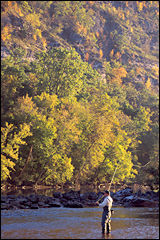 This purpose of this page is to give anglers some choices for a good place to start when visiting this river, perhaps for the first time. There are numerous shoal areas to fish on the White that are accessible by boat only, including many that exist below confluence of the Norfork. Since my fly fishing experience on the White has thus far been limited to those areas with walk-in access, it would be unwise for me to even attempt to talk about them all. Some good books are available that go great detail about not only this great fishery, but the other Arkansas trout fisheries as well. "Home Waters"(ISBN#1-882626-15-x) and "Ozark Trout Tales"(ISBN#0-9638832-9-1) are the two that I would recommend most. Each of these publications contain detailed river data, maps, and information on lodging and local guide service. Each are also available at most area fly shops. Unlike my home river, the Little Red, the White River fishes very good on high water (boat- only of course). The guides that work on this river regularly are very familiar with high-water fly fishing tactics and can put you on fish no matter what the generation schedule has been. I hope that you have found this page helpful and I strongly encourage everyone to visit the White River in Northern Arkansas. You will find great fishing and even greater hospitality, and I'm willing to bet you'll come back. Until then, good fishing! This purpose of this page is to give anglers some choices for a good place to start when visiting this river, perhaps for the first time. There are numerous shoal areas to fish on the White that are accessible by boat only, including many that exist below confluence of the Norfork. Since my fly fishing experience on the White has thus far been limited to those areas with walk-in access, it would be unwise for me to even attempt to talk about them all. Some good books are available that go great detail about not only this great fishery, but the other Arkansas trout fisheries as well. "Home Waters"(ISBN#1-882626-15-x) and "Ozark Trout Tales"(ISBN#0-9638832-9-1) are the two that I would recommend most. Each of these publications contain detailed river data, maps, and information on lodging and local guide service. Each are also available at most area fly shops. Unlike my home river, the Little Red, the White River fishes very good on high water (boat- only of course). The guides that work on this river regularly are very familiar with high-water fly fishing tactics and can put you on fish no matter what the generation schedule has been. I hope that you have found this page helpful and I strongly encourage everyone to visit the White River in Northern Arkansas. You will find great fishing and even greater hospitality, and I'm willing to bet you'll come back. Until then, good fishing! Web site created and maintained by:
|