

| HOME |
| Little Red River |
| Norfork River |
| White River |
| River Reports |
| Fly Patterns |
| Seasonal Fly choices |
| Local Entomology |
| About Generation |
| How-to Information |
| Fishing License |
| Local Forecast |
| About Me |

Your Virtual Guide for Flyfishing some of Arkansas' Blue-ribbon Trout waters
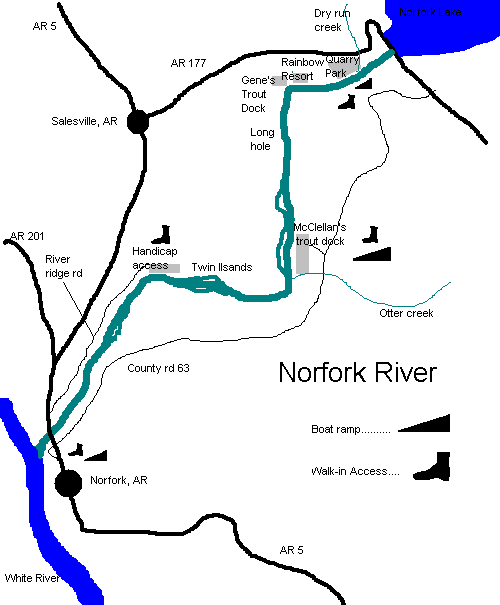
Norfork RiverPrintable Map  The Norfork River, a gem among tail-water fisheries, begins near Salesville Arkansas at the base of the Norfork dam. Originating from deep inside beautiful Lake Norfork, her cold clear waters flow only four and one half miles through majestic Ozark hill country before joining the White River at the nearby town of Norfork. Although somewhat small in size, this river is by no means short on fly-water. Classic riffles, runs and deep pools alternate along her path creating perhaps the most perfect flyfishing destination in the South. The Norfork has long been regarded as the top trout stream in the Arkansas, and one of the top ten in the nation. These waters produced a 38lb.9oz world record brown in 1989 (broken one year later on Arkansas' Little Red River), and observant anglers regularly spot fish of this calibre swimming freely in the river still today. The Norfork River, a gem among tail-water fisheries, begins near Salesville Arkansas at the base of the Norfork dam. Originating from deep inside beautiful Lake Norfork, her cold clear waters flow only four and one half miles through majestic Ozark hill country before joining the White River at the nearby town of Norfork. Although somewhat small in size, this river is by no means short on fly-water. Classic riffles, runs and deep pools alternate along her path creating perhaps the most perfect flyfishing destination in the South. The Norfork has long been regarded as the top trout stream in the Arkansas, and one of the top ten in the nation. These waters produced a 38lb.9oz world record brown in 1989 (broken one year later on Arkansas' Little Red River), and observant anglers regularly spot fish of this calibre swimming freely in the river still today.
Quarry State ParkQuarry State Park is the first of only four public accesses to the river. Located on highway 177 two miles from Salesville,Ar, this park provides walk-in access, boat launch, camping and restroom facilities. Dry Run Creek (a little jewel itself) enters the river within park boundaries, and the confluence of this creek is a great place to start. Fish the mouth of Dry Run with a size 16-20 bead-head pheasant-tail or a size 16 scud. On the opposite side of the Norfork, there is a deep, swift chute that is always loaded up with big rainbows. A heavily weighted nymph or woolly-bugger fished on a sink-tip line may get your arm ripped off. As the water flows through the campground, it slows down and is sometimes quite deep. Warm afternoons will often result in some great midge hatches. Try using a size 20-24 Adams or size 20 midge pupa in grey or olive on a six to seven "X" tippet. At the end of the campground there is a small island. Wade across to the island and fish the left bank with small nymphs and soft-hackles. Please note that this is spawning water so wade carefully in the fall and winter months to avoid damaging redds. One other important item is generation. This river rises dangerously fast when generation begins so one should waste NO time getting out when the warning sounds. I have seen this water rise six feet in ten minutes.McClellan's Trout Dock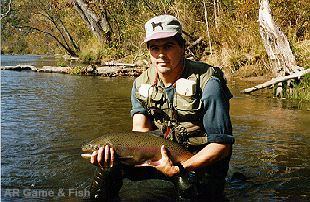 Located a few miles off the beaten path, in the middle of a cow pasture, lies a little slice of Heaven. To get to McClellan's, take county road 63 from either Norfork,Ar or highway 177 just south of Norfork Dam. This dusty road winds over the hills and through the woods to this angler's personal favorite place to flyfish in the entire world. Not that I have visited them all, but after fishing here who'd want to go anywhere else? Upon entering, drive through the pasture on the dirt road (cows have the right-of-way) to the office and pay the small access fee. There are camping and shower facilities here as well as a trout dock. You can park at the north end of the campground and take the trail to the upper riffles or go back across the pasture and park at the confluence of Otter Creek. Neither place will disappoint you, I promise. Located a few miles off the beaten path, in the middle of a cow pasture, lies a little slice of Heaven. To get to McClellan's, take county road 63 from either Norfork,Ar or highway 177 just south of Norfork Dam. This dusty road winds over the hills and through the woods to this angler's personal favorite place to flyfish in the entire world. Not that I have visited them all, but after fishing here who'd want to go anywhere else? Upon entering, drive through the pasture on the dirt road (cows have the right-of-way) to the office and pay the small access fee. There are camping and shower facilities here as well as a trout dock. You can park at the north end of the campground and take the trail to the upper riffles or go back across the pasture and park at the confluence of Otter Creek. Neither place will disappoint you, I promise. Starting upstream, walk the riverside trail up to the shoal and fish the pockets with small nymphs or scuds. Bead head pheasant-tails, hare's ears, as well as soft-hackles will take quality fish. The tail-out below the shoal is a great place to swing woolly-buggers or fish nymphs on a strike indicator. You can wade from here nearly all the way back to the trout dock before encountering any water over waist deep. I frequently will spend all day wading this stretch and have made some of my best catches here. Directly below the campground there is a long island. The right side of the island is choked with logs and down trees so don't waist your time unless you just feel like exploring. The left channel is a series of three or four(depending on generation) riffles that hold good numbers of fish. Look for rising fish, and show them tiny dry flies and emergers. Particularly good here are size 20-24 Adams and size 20-24 midge pupas in black, olive, grey or cream as well as soft-hackles (try every color you got till one works). If there are no risers (a rarity), fish a size 16-20 pheasant-tail, or size 16-18 scud in the deeper sections of the stretch. At times, a woolly-bugger swung over the deep holes will bring some big boys up to play, but more often it is midges and soft-hackles that'll have the other anglers wondering what you're throwing. From this point down to the Otter creek confluence, the water is deep and slow, offering little to the fly-fisher. From the parking area at the mouth of Otter Creek, walk straight down to the river and fish the deep narrow run with a nymph suspended three to five feet below a strike indicator. A "catch and release" area begins at the mouth of Otter Creek so make sure you use only barbless flies and NO droppers. Wade downstream on the left bank and out onto the rocky point extending into the river. Cast down and across with a nymph or soft-hackle, depending on whether or not you see any fish rising. This is a pretty good spot but chances are you won't be the first one here. A little farther downstream there is nice section of shallow, flat water called "Ace in the Hole". Usually there are fish rising to midges or whatever is hatching. Matching the hatch will pay off big. Down from that is a small pool called "Waterfall pool". This is deep water with a nice current tongue running into it. Lots of big fish are caught here by swinging woolly-buggers or sculpin patterns through the deeper sections, bouncing them along the bottom. Below this pool you will see a group of islands. If you feel like wading down to them(it's a pretty long way), fish the right side of the first island with nymphs or soft-hackles. The left side is very shallow and probably no worth the effort. Below this Island there is another long pool called "Mill Dam Eddy". The right bank is shallow enough to wade but you risking getting caught by rising water this far down from McClellan's, therefore it is better to access this part of the river from the "Handicap Access". Handicap AccessThis access, located on the river's north shore, can be reached by taking "River Ridge Road" off highway 5 at Norfork, AR. Here you will find a fishing pier with wheelchair accessibility and a nice place for a picnic lunch. Wade upstream to the islands(same islands mentioned above) to the bottom of "Mill Dam Eddy", and work your way upstream through this pool using nymphs or dries, depending on surface activity. This is flat water so the angler should use extra long, thin tippets and make long casts to reach the fish that haven't seen you and spooked away. The small rapid at the bottom of the pool is a good place to fish woolly-buggers or sculpins on a sink-tip, or use whatever nymph you find to be productive at the given time. You can fish both sides of the island but the river-left side seems to fish better most of the time. Fishing around the boulders and rocky ledges with nymphs or soft-hackles usually gets at least one fish worth a photograph. At the downstream end of the island the water gets shallow, but has a few little deep spots scattered about. Watch for fish holding in these depressions and if you spot one, show him a nymph or soft-hackle. I personally get lots of joy out of seeing a fish in the water and getting him to strike. Sometimes I will spend too long on one fish, but if I can catch him, that's the one I'll remember most. The "catch and release area" that began at Otter Creek ends just downstream from the lower island. From the second island back to the access, the water is mostly shallow and doesn't hold a great deal of fish during low water. I'll usually skip it and resume fishing at the access on downstream. The shoal directly in front of the access holds good fish but chances are you won't be the first one here. The pools below are great midge water. Look for solitary fish rising and present a size 20 Adams or midge pupa fished "on the swing". The next half mile or so is mostly deep water and hard to wade. I like to launch my kickboat at the handicap access and driftfish this area with a nymph. Fish the riffles along the right side with small nymphs and a strike indicator. Below this pool there is a small island with some nice fast water on the left side. This is a great place to fish a woolly-bugger or soft-hackle. Fish in this area are constantly looking up, so chances to take a fish are very plentiful. Below here, the river widens out and runs past the towering bluff on the left side. This is deep water and you are far from the access so if the water rises, you're going to hike out.Norfork Access Located just below the twin bridges that span the river, is a popular access known as Norfork Access. Here the Norfork River ends its short voyage and surrenders to the White, giving her a re-enforcing shot of cold water. This area provides boat launching and wade-in access to both rivers and tends to be a popular place with bait fishers and sightseer's, so if it's solitude you're after you'll have to look elsewhere. Having said that, the water fishes surprisingly well if you work your way back upstream towards the railroad bridge and fish the deep holes with a woolly-bugger or nymph under an indicator. Sometimes you'll encounter large fish here and if you can avoid alarming them, you just might catch one. Located just below the twin bridges that span the river, is a popular access known as Norfork Access. Here the Norfork River ends its short voyage and surrenders to the White, giving her a re-enforcing shot of cold water. This area provides boat launching and wade-in access to both rivers and tends to be a popular place with bait fishers and sightseer's, so if it's solitude you're after you'll have to look elsewhere. Having said that, the water fishes surprisingly well if you work your way back upstream towards the railroad bridge and fish the deep holes with a woolly-bugger or nymph under an indicator. Sometimes you'll encounter large fish here and if you can avoid alarming them, you just might catch one.The Norfork is, an many angler's minds, the premier flyfishing stream in the South. Good management by the Arkansas Game and Fish Commission has helped to make this river outstanding, but keeping her this way takes effort from state officials, guides, and anglers alike. Increased fishing pressure on this delicate fishery will take a heavy toll if care is not taken to release fish properly and help newcomers to the sport learn how to do the same. Always use barbless flies, regardless of area regulations and avoid directly touching the fish if possible. When wading, keep a sharp eye out for redds and avoid wading through them for they hold the next generation of fighters incubating in the gravel stream bed. Also, avoid the temptation to take spawners, opting to fish for opportunistic rainbows below and we can help protect this ever-so valuable resource for many years to come. Website created and maintained by:
|