|
Cultural
Study
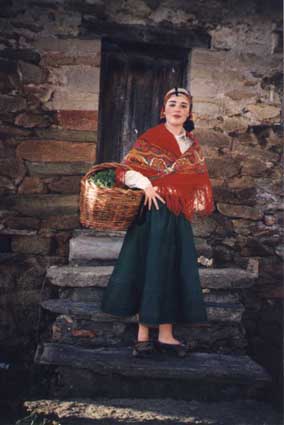
SUIT
POPULAR:
The
typical suit of the women of the town consists of black skirt,
red or green of cloth, apron with spangles, handkerchief of
"branch of silk" crossed and another handkerchief
tied at the top, white linen shirt. The suit of the men
consists of black layer and hat.
THE CHURCH:
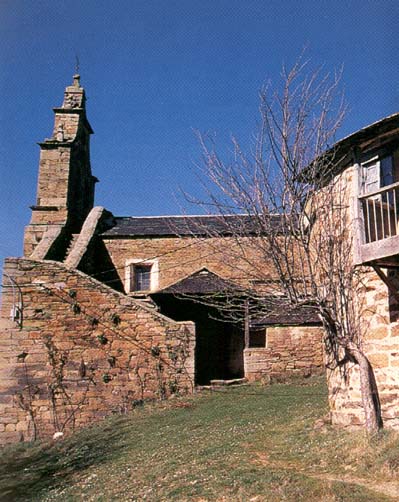
The
plant is of Latin cross. In a corner one is sacristía,
rectangular, doors and rectangular windows, framed in wrought
stone. In the interior of the center de la Cruz they take four
beautiful arcs of style Renaissance.
In
the central altarpiece, baroque, is the image of Our Lady of
the Asuncio'n, recovered recently and of a great value, above
Santo Christ, to the Virgin left of the Rosary and to the
right San Pedro; there is in the left wall of the head a hung
Christ of century XVI. In lateral of the left the de la Cruz,
the altarpiece of the Santísima Trinidad is located on the
wall, above San Cayetano, and to the right, watching, Santo
Tirso. In the same sense the altarpiece of the lateral one is
located straight, with San Antonio Abbot in the center, to his
right San Antonio de Padua and to the left San Sebastián.
HOUSES:
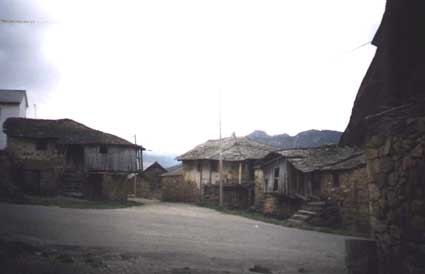
The
traditional house consisted of two plants. In the ground floor
they were the blocks for the cattle or the warehouses. In the
high plant one located the house, taking advantage of
therefore the heat the animals that were underneath. Its
facade is characterized by a typical element: the runner with
columns and wood balustrade. They
are of stone and with slate roof. the separation of the rooms
for of wicker and has been encalaban as a walls
In
the inner one the kitchens were typical the old kitchen or
home emphasize by their characteristic blackish color due to
the fire under made in the ground and fed with roots of urz.
In order to facilitate the exit of smoke a chimney exists,
underneath which it hangs beganceiro, wood of which hangs the
begancia that maintains the boiler to warm up the water. In
the kitchens the slaughter is cured, that is hung in barales
called horizontal woods, that were hung of the ceiling. Before
the incorporation of the electricity, the enclosures were
illuminated with the dry llumbreiros, woods of urces that were
hung of the bergancia; the intermediate step between the this
last and present one constituted the lucerinas or lamparas of
petroleum.
CELEBRATIONS:
The
local festividad is the Santísima trinidad that is celebrated
today during a single day, Sunday previous to the Corpus
Cristi; another day is Santo Tirso, 28 of January, of this
santo there was brotherhood and there was laws that to fulfill
by all cofrades:
1.
All the neighbors, heads of household of the town of the Hill
that are cofrades have obligation to attend when the judge
position of or Mayordomo corresponds to.
2.
When in a family cofrade is some and lacks the head of
household and has children of legal age, these compare to the
heads of household and will have to attend the position when
it corresponds to them.
3.
The one that does not fulfill the previous thing will have to
pay five hundred pesetas to the brotherhood and it will not be
left cofrade some of this family during a minimum term of 5
years.
4.
everything cofrade will pay to the brotherhood 3 grain rooms
in barracks in species and 5 pesetas in money.
5.
Each cofrade will receive as spiritual alms to participate in
honor to Santo Tirso and the day of the celebration is
celebrated, the day after funeral and another one by all
cofrades late.
6.
Everything cofrade will receive as material alms a ration of
920 grams of cooked bread and two wine rooms in barracks.
Another
celebration is the one of San Pedro, 29 and 30 of June, but
that at the present time has been transferred to the last
Sunday of July, being only whose celebration is boisterous
with dances and jolgorio that begins Saturday and continues
indicated Sunday.
|

 ·
·
 ·
·  ·
·  ·
·  ·
·  ·
·