|
Old
Economy
THE
BAKERY:
The
bakery in the town has disappeared with the entrance of more
modern techniques of bread manufacture, but still old furnaces
are conserved and the mill that allowed the manufacture of
this.
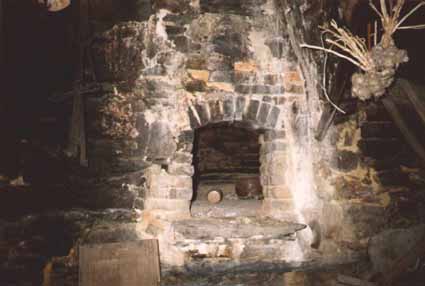
The
furnaces were constructed with marinates and had vaulted form.
The existing hollow between the vault and the outer cover
filled up with sand or salt, which facilitated the
conservation of the heat. The outer aspect is of semicylinder
and its use era of familiar character.
The
used mass to make the bread was prepared with flour of rye
mixed with a little wheat. This obtained thanks to the mill.
The mill consists of several parts: in 1º place, we were with
a container in pyramid form inverted and truncated by the
base, where the grain was deposited, call trimuella. Next this
canalexa falls by a denominated conduit that causes that the
grain falls slowly due to its oscillating movement.
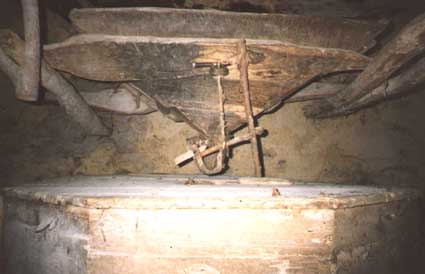
The
grain falls in the center of the stone, which moves by the
force of the grain and crushes the grain.
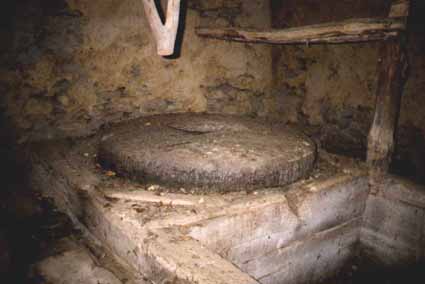
Once
ground it happens to the "farnal", wood coffer where
it is deposited, to come to its later storage. The
hammers to prick the stone and to repair some flaw by the use,
denominate tips and also they have rhomboid form.
Also,
another wheel underneath the subject mill with a wood axis
exists that transfers the base of the construction and it
breaks through from the interior with a screw, allowing of the
water and the revolving movement of the song that initiates
the milling. The water entrance from the prey to the cylinder
and the helix that the stone moves denominates the channel and
the exit towards the river the hot one.
Once
obtained the flour one keeps in a chaff of animal skin made
with the hair towards the external part. In a wood trough,
well-known with the name: masera, it was mixed with water,
leavening and salt and obtained the mass of the bread,
reserving a small part of this during eight days, passed which
became involved with flour, making the leavening functions; it
was what "fermiento" or mass was denominated mother.
Once
made the mass it is let rest, before grinding it in the
furnace, that was warmed up with firewood of oak, oak and
mainly furze being the one that more heat provided. Large
loafs introduced with the shovel, instrument made in wood and
with a handle of great length to be able to reach the bottom
of the furnace. In order to avoid that the bread with the live coal of the
fire was burned, this one with natural broom was swept,
diminishing simultaneously the temperature of the floor tile
that era of cooked mud.
In order to push the live coal towards the mouth the wood
roller, useful was used in form semicircular and provided with
long handle. The embers separated towards right or left to be
able to make flame and to see simultaneously if the bread were
cooked, that stayed constant the temperature. Once
conducted this operation, the furnace with the wet broom was
swept. When it was in his point was extracted with the shovel
giving by finalized the task.
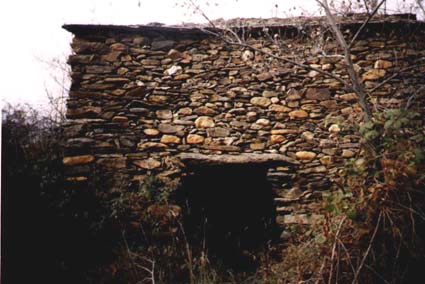
THE
BASKETWORK:
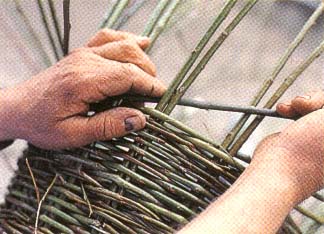
The wicker cane use in the elaboration of baskets is a work of
familiar character motivated by the necessity of containers
for product storage. Mainly wicker baskets are made of
"salguera". It is a work that is beginning to lose
although still there are people in the town interested in him.
THE BLACKSMITH SHOP:
Formerly also the blacksmith shop existed as essential
complement in the agricultural and cattle tasks but is an
office that is had lost in its totality.
|

 ·
·
 ·
·  ·
·  ·
·  ·
·  ·
·