|
Economy
AGRICULTURE:
Once
prepared the Earth and subscriber, using exclusively the
installment organic, scattered by hand and produced by its own
animals, is come to seedtime; although, of hanging of the
product that is it will seed at different time from the year. The
meadows, that do not require sowing, pay every ash-gray year
using domestic, very old custom in this town. The
parcels are small (minifundios) and his proprietor cultivates
them directly. The continuous familiar divisions have reduced
to much the surface arriving to be very small parcels. The
system of used culture is I leave fallow, that consists of
leaving without working the property a year. This method
prevents the harvesting during a year reason why it
impoverishes the economic system.
The
products more characteristic than are seeded are: potatoes ,
forrajera beet, habas, cabbage, pumpkin, cucumber, marrow,
onion, pepper, tomatos, lettuces, escarola, peas, puerro,
coliflor, chick-peas, nabo and beets. All these products are
seeded in little amount for their familiar consumption. For
plantations they use the seed plot system, (beet, lettuce and
other vegetables, transplanting them later), furrows (potatoes,
vegetables...). During
the growth process diverse tasks are made, among others: to
escadar, to select, to sulphate, to water...
Between
these works the one that has evolved more has been to sulphate,
due to the chemical agent use that ends the plagues easily.
Formerly the only existing plaguicida was to exterminate the
insects one by one.
APEROS
OF FARMING:
The
used aperos are traditional, since mechanization is
practically null, using in most of the cases animals, although
in the last years 2 tractors have been introduced. The
terrain preparation, previous to seedtime, is made with aid of
the cattle, that uncidos throws of the plow that is plowing
the Earth. The cows are united by xugo that protects them with
a dog skin that also covers the head with the animals. If it
is desired that some cow noncomma while it is working, is
placed a muzzle to him that it will prevent him to do it.
Seedtime
of the potato constitutes a very delicate task and of long
preparation; once Earth plowing, the following work is the one
of achanar, that consists of opening furrows so that the plant
when being born is not broken; instrument thrown by a pair of
cows is made with rancilla. Next it is watered and the mixed
potato pieces are thrown with the lime. These furrows are
covered with land of the following one until covering all the
surface. Once finished a nailed handful of dry grass in the
ground with a wood is placed, that serves to indicate what it
is seeded (receives the pachiza name).
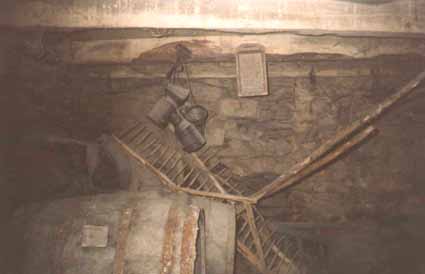
The
harvest takes control by hand of the sickle. It beats it is
made with the manales and the trillos thrown by the cows. Most
characteristic of all the aperos it is the car, with defined
peculiarities: massive wood wheels together with the wood axis
also, so that they turn simultaneously with which one obtains
to a greater stability considering the unevennesses of the
land. They are low and narrow and is necessary to unite two
pairs of cows to surpass the pending forts. Another
element also very used in agriculture is the plow made in oak
wood and negrillo.
IRRIGATED
LAND SYSTEM:
The
water arrives from a spring and is canalized by means of prey
done with branches and lumps until territories of work. In
the irrigation of the meadows a tolerant custom exists that
consists of the "robbery" of the water of an a other
neighbors. For example: A neighbor canalizes the water of the
prey towards his meadow, being able next, to go another one
behind and, without being seen, to cut it to it and to
canalize it towards his. This does not happen in summer
because through the council, all the neighbors fix the drip
and draw for the water to water all the cultures of the summer.
THE
CATTLE RANCH:
Like
agriculture the cattle ranch is practically of subsistence,
although in some cases sales to other towns become of the zone. The
main existing species in the town are:
1.
Cattle or Bovine:
In
the town eighteen heads of cattle exist pertaining to a same
neighbor. The most typical race is the one of the
"country" that lately is being replaced by the
"Brown Alpine one" and some dot. Formerly there was
a bull that was used for the reproduction and of their care
all the neighbors were in charge who had cows, being
proportional to the number of heads, and fining to which they
did not want to make this work. Also the "beceras",
that consisted of taking care of the communal land cattle
between all the propietary neighbors of cows, of rotating and
organized form, according to the number of heads existed. All
this no longer exists today, logically so that all the cows
belong to a single person. The milk and the obtained meat of
the cows are mainly for familiar consumption although once in
a while friends and people of the zone are sold between.
2.
Ovine and Goat cattle:
One
hundred fifteen ewes pertaining to the same neighbor also
exist who the cows. The ewe commonest is "churra",
small and resistant to the climate and the relief of the
terrain. The taken care of system of was "velia",
resemblance to the "becera". The goats are very few
and leave in the flock with the ewes. The goat and ewe young,
is the main source of wealth, as well as the sale of the wool
and also their car consumption for socks.
3.
Pig Cattle:
A
very important section within the cattle activity is the young
of the pig, animal that by its characteristics practically
takes advantage of in its totality, serves as nutritional diet
the neighbors of this town, to the time that contributes to
its self-supplying. The slaughter takes place, generally, in
the month of December, becoming garlic sausages, jamones,
backs, etc. The bacon is consumed in its totality, taking
advantage of part him in the soap elaboration. Also, the
butter is used like substitute of the oil, although every time
to a lesser extent. The slaughter is cured to the smoke, in
kitchens that emphasize by their characteristic blackish
color. Once finalized the same one, immediately a new young
buys itself, generally in the month of February, that will be
barley with culture products; therefore, at the same moment
that closes a cycle, new one begins another that will end at a
next slaughter.
4.
Birds:
The
poultries are abundant, whose meat and eggs are used for the
consumption of the family.
5.
Bees:
Also
the operation of the bee is very important. There is a
neighbor who dedicates itself to the beehives for the
obtaining of the honey. It has 56 beehives and these besides
to produce honey for the familiar consumption it is sold well-known
friends and.
OPERATION
OF THE SLATE:
A
very important element for the economy of the town is the
recent existence of a slate operation, Spain Slates, that an
amount of money pays to the town to the year. The existence of
this quarry seems to have importance for the town since it can
cause that it returns the people from the city to the town in
search of work opportunities, since the quarry has great
demand of jobs. The disadvantage is that it produces a great
environmental impact.
IT
HUNTS And IT FISHES:
In
spite of all the works made by the people to be able to
subsist with dignity always they are left short whiles free
that dedicate to their entertainment. There
is a boundary of greater hunting and smaller than it belongs
to the ocal meeting of the town and also there is fishing of
the trout in the Eria river. The hunting and the fishing
besides to provide diversion, also serve to improve the
nutritional conditions of people reason why it seems to be
necessary for many of the neighbors of the town.
|


 ·
·
 ·
·  ·
·  ·
·  ·
·  ·
·