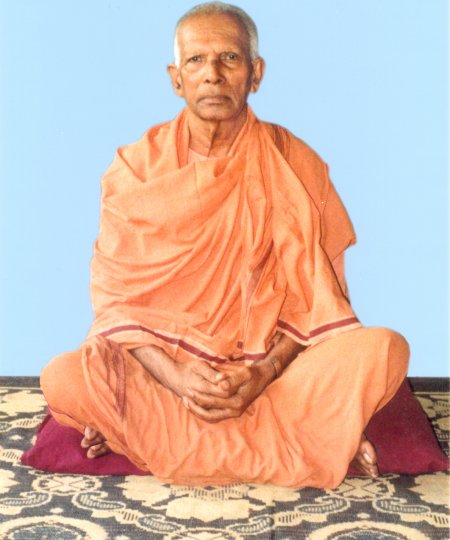
SWAMI RANGANATHANANDA
Swami Vivekananda and Swami Ranganathananda both belong to the same Ramakrishna Order. Swami Vivekananda's idea on education seems to have inspired Swami Ranganathananda to a great extent because at number of places in his works Swami Ranganathananda quoted ideas of Swami Vivekananda profusely. In his lectures our Revered Swamiji talked about Swami Vivekananda's ideas on several subjects including education.
Ancient Indian Education system has its foundation mainly in (1) Vedas (2) Upanisads and (3) The Gita.
Aims of Education of Ancient India according to Professor R. Ramanujachary, Professor in Education, S.V. University, Tirupati reflects in the aims of education mentioned by Swami Vivekananda and later by Swami Ranganathananda in a more comprehensive and lucid way.
We want that education by which character is formed. We have to discipline ourselves namely, our mind, sensory system, emotions and our energies. We have to discipline them and convert them into creative energy and employ that disciplined energy in various fields of work. That is we can develop character through education.
We want that education by which strength of mind is increased, the intellect is expanded and by which one can stand on one's own feet. Education must cultivate in our youth an openness of mind and largeness of heart, which would make them capable of entertaining and blending differences in ideas and behaviour into a harmonious pattern.
The ideal of all education, all training, should be man making, namely, the development of personality and by proper attention to those laws and methods, each one can grow and strengthen his personality. This is the secret of all education.
Education is for life-building, man-making, character-making and assimilation of ideas but not for stuffing the brain. The capacity for assimilation of ideas comes to man from self-discipline and self-discipline alone, which can be attained through education.
Education for religious quality in experience should build into the character of children, the power to mobilize and organize their life energies for the realization of the growing body of ideal value to which they become committed.
Without spiritual disciplines, no education will be effective. It includes meditation and prayers, control of the senses, practice of austerities and living a dedicated life.
Since body is the first instrument to perform the Dhrama, body has to be maintained. It should be pure, strong and healthy.
By way of food, clothing and shelter as the primary necessities of life, by way of medical and when he suffers from ailments,
by way of sports, games and physical exercises for the healthy growth of his body,
man leaves no stone unturned to see that he is adequately provided with all of them.
Education should cater to the needs of the body by providing 'satvic' nourishment, medical care and physical exercises.
Development of mind and intellect is tune with the accepted principles is the next step in education. Clear perception, observation and thinking are necessary for the development of mind. Concentration of mind on the work undertaken not only helps the skill in the work, but also enables him to understand the reality as well.
Education has to increase the skill of the individual in work, which is necessary for the sustenance of his body and the society. Education has to train the individuals for various professions in accordance with their natural aptitudes and also inculcate the spirit of dedication of their work to the benefit of the society.
Education should aim at providing a right training to a right individual so that he may not become a misfit in the society. The good of the society consists of under taking work in the spirit of sacrifice, which has to be inculcated through education.
Education should endeavor to develop a noble character in the individual. The cultivation of ethical and spiritual values is an important aspect of education; it is the education for the heart.
Since the goal of the life is the self-realization, education, which is a preparation of life, should reflect this ideal. This implies the preparation of the individual for every aspect of life, namely, for the satisfaction of material needs, for the growth of personal talents and the formation of good character.
Some of the Aims of Education mentioned by Swami Vivekananda reflect Ancient Indian Aims of Education mentioned above:
Education should help people to build up self-confidence and self-reliance, based on balanced human relationships.
We should aim in education for the development of spirituality in a social setting, by the people. The spirituality should lead to development of a spirit of fellow-feeling, sympathy and sharing and solution of common problems aiming people themselves. serving
Work is worship; Education should teach us to serve Humanity - the hungry, the ignorant and the suffering masses. To serve masses is to serve God. Education should lead us to recognize this and to fulfill it.
Education should lead to a feeling of brotherhood, and the unity of mankind - for the power of God exists in all, from the highest and most powerful, to the lowest and the weakest person.
Education should lead us to acquire the spirit of renunciation - the giving up of worldly pursuits as well as a life of pride, arrogance and ease. In place of them, we should be able to learn how to love knowledge, humanity, self-sacrifice and a desire to work for others.
One of the important aims of education in India, to aim at self-sufficiency. The individual should be given practical and vocabulary training along with the traditional and vocabulary training along with the traditional religious and cultural subjects. There should be workshops and laboratories for training in crafts and trades, so that pupil may be able to support him or herself. Students must be given education in Western Sciences, Technology, Engineering, Commerce and Economics.
The individual should develop adaptability and be able to meet the challenge of a changing society through his education and training he receives from his parents and teachers.
© Copy Right: M. Padma Lalitha Sharada Kumari, M.Ed. Osmania University, Hyderabad
E-mail: kpmiyapuram AT yahoo.com
Related Links:
For Details of Vedas Visit this small little site
http://www.geocities.com/kpmiyapuram/More Links to follow: Check for updates.