|
|
|
STORY BEHIND THE BOOK |
|
How it all began... While working for The Atlanta
Journal Sunday Magazine Margaret Mitchell was assigned a task of doing
historical stories. She enjoyed this job very much as she got a chance to
interview those who remembered the Old South, survived the hardships of war and
Reconstruction. She found listening to their stories fascinating, as she herself
was raised on the stories from that era. The inspiration... When Margaret Mitchell started on the book, she didn't have a preconceived idea of what the book was going to be about. She picked the subject she thought she knew best. Besides she was tired of Jazz Age Fiction and she said she "would try to write a book that didn't use the phrase 'son of a bitch' a single time". She never expected the book to sell because she didn't think there would be a publisher silly enough to buy a book, that was a "Victorian" type novel, long as "Anthony Adverse", about war and hard times in Georgia, with "precious little obscenity in it, no adultery and not a single degenerate...". In real
life Tara never existed, neither did the characters but practically all the
incidents in the book are true. Of course they didn't happen to the same person
and not all took place in Atlanta. Ms. Mitchell used to be very amused when her
book was called too melodramatic. She'd say that for that time period melodrama
is a word too mild to use! Even though the historical background of the book is as accurate as Ms. Mitchell could possibly make it, she often emphasized that the characters she created, their lives, names and places they lived in were all fictional. She didn't want to embarass or put anyone on the spot, therefore while writing the book she did a detailed research, going through records in Clayton County, Fayette County, Savannah, Charleston and Atlanta from the period between 1840 and 1873 to make sure that there hadn't been anyone bearing the same names as the ones she picked for her characters. Even though she explicitly said
that all the characters were fictional there have been rumors about what the
real prototypes were. It's believed that Margaret Mitchell was the prototype for
Scarlett herself: the same unsubordinate spirit...many of her experiences became
later Scarlett's doings. Her fellow reporter, Mr. Howland summed Peggy Mitchell
as a combination of Scarlett's fire and toughness and Melanie's understanding,
compassion and integrity. But if we go further we're led to believe that Ms.
Mitchell drew scenes from her personal experience. In 1918 while she was away in
college her mother died of flu; in the novel Scarlett comes home to find her
mother dead of typhoid. In 1919 she performed an exotic dance at a party
organized for charity by local debutantes and scandalized the Atlanta society.
In 1920 she worked all night at an emeregency center when a major fire broke out
in Atlanta; she was always the center of attention. A reporter H. S. Edwards
suggested that perhaps Ms. Mitchell had been the real Melanie. Ms. Mitchell was
shocked that someone would actually dare to make such a comparison. She said
that Melanie had been fitted to a number of people, but her last of all. She
reminded that she was the product of the Jazz Age and there were numbers of
occasions when she shocked her elders! Margaret Mitchell mentioned that
Melanie was really her heroine. In her own words: "I wanted to picture in
Melanie and Ellen the true ladies of the old South, gentle and dear, frail of
body perhaps, but never of courage, never swerving from what they believed the
right path, and no matter what were called upon to do, by rude circumstances,
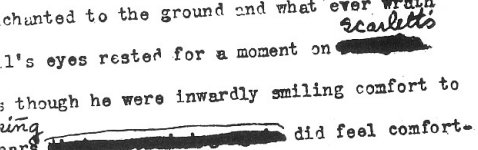
always remaining ladies". It is also believed that there had been real prototypes for Rhett and Ashley: a young lieutentant Henry who died of wounds in the war in Europe and who had been Peggy's love (he might have been a prototype for Charles Hamilton as well), and Red Upshaw, her first husband, which whom she had a very stormy relationship. To create the character of Rhett Butler Ms. Mitchell went through hundreds of ambro-types and daguerrotypes and questioned old ladies about their beaux and the men they remembered the longest. The type that stood out was a coastal, deep South type and face. Rhett Butler was typical of a certain mind and viewpoint of the sixties. While people in the North sometimes questioned Rhett's credibility, to the Southerners he seemed true to life. As for the name Rhett Butler...As Ms. Mitchell put it: "I wanted a two-syllable Georgia Coast last name and a one-syllable South Carolina Coast first name. Butler was a prominent name in our State in the 1840s. I made him a Charlestonian because I had to make him a blockade runner, and there was little or no blockading done from Savannah...". Scarlett had not gotten her name until 6 months before the publication of the book. In the manuscripts she existed as Pansy O'Hara (a character from one of her unpublished stories). The reasons Ms. Mitchell finally chose the name Katie Scarlett were that first of all, she had come across this name very often in Irish literature and second of all, she knew of the Scarlett family on the Georgia Coast but made sure that there was no one named like this in Clayton County in the years 1859-1873. As for Melanie...Ms. Mitchell wrote in a letter to a reader: "I cannot tell you how Melanie came to be named Melanie, because that has always been her name ever since I first thought of her". As a matter of fact there were two working names for this character: Permelia and Melisande but eventually she decided to go with Melanie which she thought was a very beautiful name, and should be pronounced with the accent on the first syllable and both e's should be short. She jokingly said she'd choke anyone who would dare to pronounce it MEE-laney...Wilkes should be pronounced as if it were Wilks. At some point the O'Haras' plantation was called Fontenoy Hall later to become Tara. It should be pronounced "TA-ruh" with the accent on the first syllable, the first a short and the second a modified broad a (the first a not as in 'arm'); it does not rhyme with either with Sara or Laura (nonetheless in the movies it's pronounced like Sara). The only character that was not completely made up by Ms. Mitchell was Prissy. |
WORKS CITED:
|