|
|
|
THE PRODUCER |
|
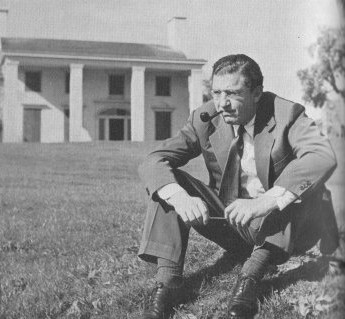
"Selznick was a giant
panda of a man, standing about six feet two and permanently struggling with a
weight problem. He wore thick glasses and had thick curly hair. He
chain-smoked incessantly, had a broken nose, a wild sense of humour, a great
deal of kindness, a weakness for dry martinis and terry-cloth bathrobes and a
completely non-existent sense of punctuality. Not even his friends, and he had
hundreds of them, could have called him handsome but such was his charm that
it never crossed one's mind that he was anything else..." - David
Niven. "I have no middle name...I had an uncle, whom I greatly disliked, who was also named David Selznick, so in order to avoid the growing confusion between the two of us, I decided to take a middle initial...". ~~~ "...Anything I ever learned in school, I learned in the public schools of New York City". ~~~ "I was trained by my
father in motion-picture distribution, finance and advertising, his idea being
that my older brother, Myron, would take care of the producing end and I would
take care of the other things". ~~~ "What had been my continuing dreams of going to Yale, which I had clung to for many years, were smashed when my father went broke in 1923". ~~~ "Myron had gone to California and urged me to go out...I went to California in the summer of 1926 with the hope of promoting some independent pictures for Associate Exhibitors, which was a distributing company in need of product". ~~~ "When I tried to get a job at MGM, Harry Rapf was one of the heads of the studio...When I arrived, Harry told me that he was sorry, but Louis B. Mayer had said that he would not have any Selznick in the studio". (as a result of an argument Mayer and L.J. Selznick had a little way back. Nonetheless, David worked for MGM in the years 1926-1928.) ~~~ "After leaving MGM, I was sent for in early 1928 by Paramount's Ben Shulberg, who hated MGM and was jealous of its success. He was anxious to tell me and the rest of Hollywood that Paramount had more respect for independent opinion that did MGM". (He worked for Paramount since 1928 till 1931; meanwhile in 1930 he became L.B.Mayer's son-in-law by marrying his daughter, Irene). ~~~ "After my resignation from Paramount in June of 1931, I decided to follow up on what I had long believed: that the whole system of assembly-line-production picture studios was absurd, and that the business had to be broken into small producing units". (with a man called L. Milestone, he formed the Selznick-Milestone unit and went East to promote it, but got nowhere.) ~~~ In October 1931 he was put in charge of production of RKO. He stayed at RKO until 1933, when his contract expired. During his stay there, he personally produced "A Bill of Divorcement", "The Animal Kingdom", " Bird of Paradise" and "Topaze" and he was the executive producer of "King Kong". ~~~ "After refusing the new conditions at RKO, I accepted an offer in early 1933 to become a vice-president of MGM, in charge of my own unit-the first departure from the traditional setup at MGM". (He worked on the productions of "David Copperfield", "A Tale of Two Cities" and "Anna Karenina".) ~~~ In 1935 with financial help from I. Thalberg (MGM's vice president) and his New York friend, John Hay Whitney, Selznick announced the formation of his own company, Selznick International (he also took over the operation of J. Whitney's company Pioneer Pictures). 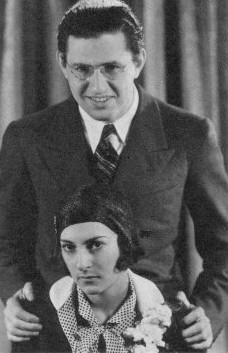
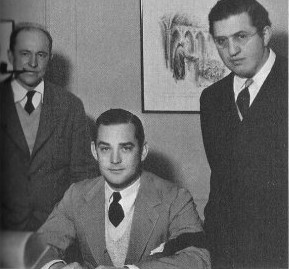
Left: David and Irene Selznick around 1930 Right: M. Cooper, John Hay Whitney and Selznick announcing the formation of Selznick International.
In 1935 Selznick International signed to distribute through United Artists. Among most notable picture made by Selznick International are
"The Garden of Allah", "A Star is Born", "The Prisoner of Zenda",
"Gone with the Wind", "Intermezzo" and "Rebecca".
David Selznick was notorious for his memo-writing habit. It had its beginning when he worked for his father who was a very impatient man; besides when at the age of seventeen David was supervising a large advertising and publicity department he was self-conscious about his age and hid it behind impressive memos. "To begin with, I find that I can think a thing through to its conclusion more clearly if I can express my views completely without interruptions and without argument. Two, I like to have my views a matter of record and reference. Three, I find that when a man receives written instructions he is much more likely to follow them, and certainly much more likely to follow them exactly, than if he receives them verbally...[...]
|
WORKS
CITED:
|
DISCLAIMER: This site is for educational purposes only.
"GONE WITH THE WIND" ©1939 Turner Entertainment Co.
All Rights Reserved.
"GONE WITH THE WIND", its characters
and elements are trademarks of Turner Entertainment Co. & The Stephens Mitchell
Trusts.