|
|
When
Katherine Brown brought "Gone With the Wind" to Selznick's attention
in the spring of 1936, Selznick was reluctant to buy the rights to be book.
From the very beginning, he realized how crucial the role of Scarlett was for
the future success of the movie, and how carefully this role should be cast.
In her first letter to Selznick, Katherine mentioned Miriam Hopkins, Bette
Davis and Margaret Sullavan as possible candidates, Selznick suggested
Tallulah Bankhead. This was all before the rights to be book were sold and
before the book was published. Once the book was published it became very
popular throughout the country. And when people learned that it was going to
be filmed they started voicing their opinions as to who should be in it.
Letter suggesting stars poured in, and opinions were so diverse, that it
became clear to Selznick and his co-workers that the best they could do was to
get a new personality to play the coveted role of Scarlett.
In the fall of 1936 Kay Brown toured South with a hope of finding a talented
girl that would fit the description of the heroine. The results were rather
dissapointing, although there was a group of girls that were sent to New York
City where they were auditioned by George Cukor (among them was Alicia Rhett,
who portrayed India in the picture). Later on in March of 1937 there was
another trip South, this time Kay Brown together with George Cukor.
By the end of 1937, with thousands of tests made, and with the Scarlett campaign
still going full blast in press, radio, theaters, schools and universities, it
became more and more clear that chances of finding an ideal girl were minimal.
Now Selznick began reconsidering established actresses.
The casting process back then was different from the way it's done today. In
the 1930s all stars were under contracts to studios, and each attempt to
borrow a star from another studio meant certain concessions (mostly financial)
on borrower's part. But by mid-1938 the decision of finding a new girl was
abandoned, and again the competition between Hollywood's biggest stars resumed.
|
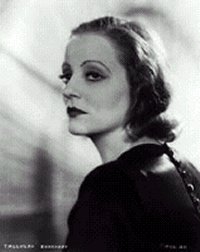
TALLULAH BANKHEAD
Tallulah was
among Selznick's and Cukor's first choices for Scarlett. In December 1936, she
came to Hollywood for a much-publicized screen test. Selznick received a
telegram from the governor of Alabama (Bankhead's native state) urging him to
cast her. The test did not go well but before leaving the set, Tallulah'd
managed to insult almost everyone in the studio.
The next day Louella Parson wrote in her column: "Tallulah Bankhead
breezed into town last night to make a test for Scarlett O'Hara in GWTW. Her
friend, George Cukor, is going to direct. Jock Whitney, another friend, is
backing it, so I'm afraid she'll get the part. If she does, I personally will go
home and weep, because she is not Scarlett O'Hara in any language and if
Selznick gives her the part he will have to answer to every man, woman and child
in America."
It was too much for Selznick: even if he still thought she was a possibility
he had to reckon with the opinion of the press. Knowing Bankhead's temperament,
he sent her a rejection as mild as he could come up with: "The tests are
very promising indeed. Am still worried about the first part of the story (the question if she would look youthful enough) and
frankly if I had to give you an answer now it would be no, but if we can leave
it open I can say to you very honestly that I think there is a strong
possibility. I should like to continue looking around and a little later on
consider the advisability of making further tests with you either in New York or
here using dialogue scenes from the script directed by George. These tests
should be beneficial to your chances, because certainly one you get a chance to
act, you should burn up the screen, and from our standpoint they would really
give us a clear idea as to how you would be as Scarlett and how much your
performance would offset other possible drawbacks. In short, I should like to
say to you very sincerely that I think you are a definite possibility, but I
cannot give you an answer for some time."
|
|
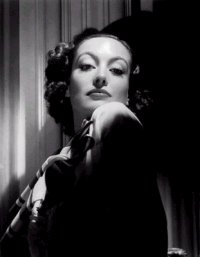
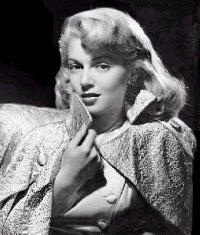
JOAN
CRAWFORD Joan
was one of MGM's top stars and appeared with Clark Gable in movies such
as
Possessed and Love on the Run which were big hits and
established the duet Gable-Crawford as screen favorites. But when it
came to Scarlett, she was rejected as being "too hard-looking"
|
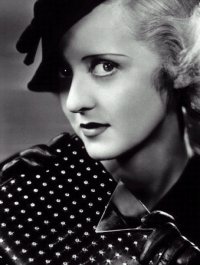
BETTE DAVIS
Bette Davis was public's number one choice for
Scarlett but she turned down the role twice.
For the first time even before the book was published.
Warners wanted Bette to do a movie called God's Country and a Woman. They
promised her that if she did this movie, she would get a great role in return -
in Gone With the Wind- a role that she was born to play. She angrily left the
office replying: "I bet it's a pip!" It was only months later
when she realized what she had walked out on!
After Selznick bought the rights to the book, she turned the role down for the
second time. In her own words: "David Selznick wanted Errol Flynn and me
on a loan-out from Warner Bros. Thrilled as I was, I knew Flynn was not good
casting as Rhett Butler, and therefore my performance would be hampered. Oh if
only I could have played it with Gable!"
But Bette got a chance to play a Southern Belle in Warners' epic Jezebel which
was released a year before GWTW.
|
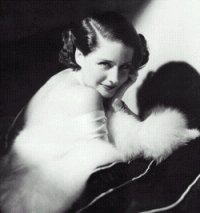
NORMA SHEARER
In the 30s Norma Shearer was a
MGM star and public's favorite for playing sophisticated roles. When it was
announced in 1938 that she and Clark Gable were to be cast as leads, Norma
received enormous fan mail, asking her not to portray "a scheming
little b*tch".
Then the press spread a rumor about the role of Scarlett and the script
being changed so that they would fit Norma.
In August 1938, Noma announced her withdrawal: "I have decided that
I should not play Scarlett. I am convinced that the majority of fans who
think I should not play this kind of character on the screen are right..."
That was the public story. But it was probably the letter from Margaret
Mitchell to Kay Brown, from July 13, 1938 that sealed Norma's fate: "I
haven't heard a word against Norma Shearer as an actress or a woman. She is,
of course, enormously popular and everyone prefaces their statements with
the remark that they think she is a wonderful actress. However, everyone
thinks she is sadly miscast in the part of Scarlett. They think she has too
much dignity and not enough fire for the part."
|
LANA TURNER
Lana had her screen test on
November 18th, 1938. Three days later David Selznick wrote to D.
O'Shea: "I saw Lana Turner and Melvyn Douglas test. I think
that Turner is completely inadequate, too young to have a grasp of the
part apparently...I'm afraid we'll have to forget her." |
Go to Page
--> 1 2
3
|