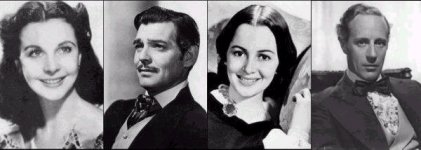
|
|
Vivien Leigh
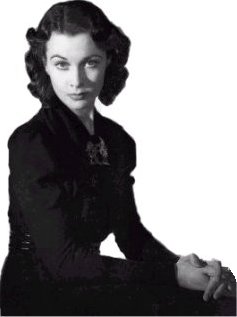 |
"I've cast myself as Scarlett O'Hara, what do you think?"
- Vivien Leigh in 1937
" Hi genius! I want you to meet Scarlett
O'Hara..."-
Myron Selznick to his brother David O. Selznick on December 10, 1938
" I guess we're stuck with
you!" - G. Cukor to Vivien, on Christmas day 1938, telling her she got the part
" Mr. Selznick was two years deciding on his Scarlett and out of millions of American women couldn't find one to suit him [...] I'm sure millions of Americans will stay away from the picture in a gesture of protest"
- Columnist Hedda Hopper on January 15,
1939 |
It seems that Vivien got the part by sheer coincidence - unexpectedly David Selznick saw his Scarlett in her.
This might be Hollywood's side of the story, but not Vivien's. If she later said that
it came as an utter surprise for her, it to was to keep up with Hollywood's publicity. Vivien longed to play Scarlett ever since she read the book in 1936.
While chatting on the set of '21 days' in England in 1937, someone suggested that Larry Olivier would be good as Rhett
Butler.
Vivien announced "Larry
won't play Rhett, but I shall play Scarlett
O'Hara, wait and see!". She never quite seemed to realize what a fat chance that was.
She was quite popular in England, having been in such great films as 'Fire over England' and 'A Yank at Oxford', and a hit play 'The Mask of Virtue', but she was practically unknown in America. Actually at one point she was considered by the Selznick people, having been suggested in a letter by a man from New Zealand,
but David Selznick, who saw her in 'Fire over England', had no enthusiasm for
her.
In 1938 Vivien's boyfriend, Laurence Olivier went to Hollywood to star in 'the Wuthering Heights' directed by W. Wyler. His agent was no other than Myron Selznick, David's brother.
Vivien, never one to miss an opportunity, decided to join Larry in Hollywood. In the fall of 1938 with passages from the book memorized and with a clear idea of what Scarlett should be like in mind, she boarded Queen Mary. She was in New York City by December 1st, and took a plane to Hollywood.
The story of her meeting David has been told hundreds of times, and has been wonderfully embellished along the way. It was not as fairy-tale like as legend has it.
Vivien met Myron Selznick already on Dec 3rd. He introduced her to Daniel O'Shea. They both figured that she could be another possibility and they arranged tests for her. But they waited for the right moment to introduce her to David...the shooting of the burning of Atlanta, which was inaugurating the filming of GWTW seemed to be a perfect moment.(see
Scarlett Search)
When on the night of December 10th, Vivien arrived to see
the Atlanta fire, she already had a professional "Scarlett O'Hara
make-up" done by one of MGM's stylists. David climbed down the
platform, Myron introduced him to Scarlett O'Hara, David looked and the
question was asked: "Would you like to test for Scarlett?"
On December 11th, David O. Selznick wrote to his wife, Irene "Shh...she's the Scarlett dark horse and looks damn good."
It
was now narrowed down to Paulette Goddard, Joan Bennett, Jean Arthur and
Vivien.
After a series of screen tests, at a Christmas party in George Cukor's
home, George took Vivien aside and told her that the choice had been
made. As Vivien later recalled, her heart sank to the bottom of George's
pool...and the outcome didn't matter anymore. George brought the news
rather plainly:
"We're stuck with you..."
|
"I hope I've
one thing that Scarlett never had. A sense of humor. I want some
joy out of life...And she had one thing I hope I never have.
Selfish egoism...Scarlett was a fascinating person whatever she
did, but she was never a good person. She was too petty, too
self-centered...but one thing about her was admirable. Her courage.
She had more than I'll ever have."
- Vivien Leigh |
|
Until the official press release the choice had been kept secret. Susan Myrick wrote to
M. Mitchell that the matter was so secretive that she referred to Viv as 'That woman' or 'Miss x'. After the annoucement reactions of the audience varied. Some Southern organizations, such as The Oscala Daughters, protested against Scarlett being played by a non-southerner, although generally
the southern audience tended to agree that an English girl was better than a Yankee. The choice had also been criticized by some of the well known Hollywood columnist, including Hedda Hopper.
Vivien signed her contract on January 13th 1939. It was a standard 7-year Hollywood contract and she was paid $30,000. She was concerned with the length of the
contract, but as her agent assured her, if the movie was a hit, it could be easily
renegotiated.
Vivien telegraphed Margaret Mitchell on January 13th IF I CAN BUT FEEL THAT YOU ARE WITH ME ON THIS, THE MOST IMPORTANT AND TRYING TASK OF MY LIFE, I PLEDGE WITH ALL MY HEART I SHALL TRY TO MAKE SCARLETT O'HARA LIVE AS YOU DESCRIBED HER IN YOUR BRILLIANT BOOK". This wire was printed in one of Atlanta newspapers even before Ms. Mitchell got a chance to read it.
In a wire from January 30, M. Mitchell reassured Vivien that even though she'd heard that some people protested her selection, she
"encountered none of that sentiment in Atlanta", and that she was pleased that the part had fallen into "the hands of a girl whose photographs show her to be so charming".
Nevertheless, since M. Mitchell often said she that had nothing to do with the production, until the premiere she never publicly okayed Vivien. But March on 24th, 1939 she wrote in a letter to D.
Selznick: "For your private ear and not for repetition, I am impressed by the remarkable number of different faces she has".
Clark Gable
| "I don't want this part for money, marbles or chalk" - Clark Gable
"I must regretfully inform you that chances of getting Gable are practically nil"
- D. Selznick in a telegram to Kay Brown, 1937
"...Clark Gable...he has never been a choice for Rhett down here..." - Margaret Mitchell in a wire to Kay Brown, July 7, 1938
"Hiya Rhett!" - Spencer Tracy when passing Clark on the Metro lot.
|
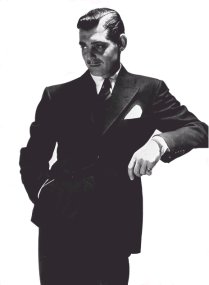 |
As soon as the public learned that the novel was to be filmed its choice had been unanimous. But even though movie audiences clamored for Clark Gable getting him was not that easy. Most of Hollywood's leading men were considered for the part of Rhett Butler before the final choice was
made.
First there was of course Clark - "The King" but as Margaret Mitchell noted in her wire to Kay Brown in 1938:
"Clark Gable...was not as popular here in the South as in the other sections of the country...
He has never been a choice for Rhett down here".
The idea of having Basil Rathbone was dismissed quite early on by Selznick. He tried to get Gary Cooper, but Sam Goldwyn, to which Cooper was under contract, refused to loan the actor
out.
The next possibility was Errol Flynn - but he was Warners' superior stock. Jack Warner would have Flynn play Rhett only if Scarlett was played by his number one actress: Bette Davis. The idea was quashed by Davis herself, who refused to act opposite
Flynn.
Ronald Colman was a strong candidate, especially looks-wise. Once Kay Brown telephoned Colman to discuss the project with him and she read some passages to him. His reaction was very enthusiastic; he thought it 'ripping' and 'absolutely topping'. Implacably British, he was already pretty much out of question.
"I present to you the man who, by national acclaim, from start to finish, is and always will be Rhett Butler, who now owns Atlanta Mr. Clark Gable"
- Mr. Hartsfield, Atlanta Mayor at gwtw premiere
|
|
Selznick had no choice but to try to get Gable. Especially since the public believed that Margaret Mitchell wrote the book with
Clark Gable in mind. This rumor was discounted by Clark himself, who pointed out:
"when the book was being written I was
a four-dollar-a-day laborer in Oklahoma" (which was not exactly the case, but he got his point across).
|
Clark was very reluctant about playing Rhett. He'd been in a costume picture before, which was a box-office flop and he was afraid that people had so many ideas as to what Rhett should be like, that it would be impossible to satisfy them
all.
"...Here is a novel that is the top seller of all time.
Now people form opinions about characters and they form an opinion about who's going to play it. They already had a preconceived idea about what they were
going to see. Now, that's why I didn't want to play it. I said too many people know this character, but my God with Rhett Butler if they saw one thing
that they didn't like they would've remembered back to the book. I had to be on my toes and I knew that".
Selznick avoided asking his father-in-law, Louis B. Mayer for anything so far, but he was still determined to get Gable. The first time he
made an offer, Clark turned it down, saying he didn't want this part "for money, marbles or chalk" and pointed to
the contract that he had with Metro-Goldwyn-Mayer. He was MGM's superstar and the studio was not in habit of lending their stars.
The offer that MGM was making was not profitable to Selznick: it was making Mayer richer, and depriving United Artists of the right to distribute Selznick's picture. But Gable was worth it. Early in 1938 D.O.S struck a deal with MGM: The studio would loan Gable and provide up to $1,250,000, half of the
estimated budget of the production in return for half of the film's profits. Also MGM's parent company, Loew's Inc. would distribute the picture in return for 15% of the gross.
(For more on the casting process click here)
Now the only problem was to persuade Clark. Clark wanted to divorce his wife, Ria Langham, to marry actress, Carole Lombard. Ria asked for a compensation which was to be a share of the money MGM had been
putting in trust for Clark since 1934, just about the most complicated thing she could've demanded. But L.B. Mayer agreed to pay Ria's divorce settlement.
Clark signed his contract on August 24th, 1938. He was to receive a record sum of $100,000 which sweetened the deal for him
considerably.
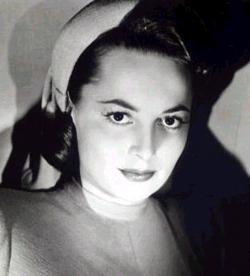
Olivia
de Havilland
 |
"May I thank you for insisting to me that Melanie was beautiful?
Of course, I had pictured her as a very plain little person but in my heart I
thought her beautiful too" -
Margaret Mitchell to Robert W. Bingham on February 23, 1937
"I would give
anything if we had Olivia de Havilland..." - D. Selznick in a letter to Daniel T. O'Shea, Selznick
International Vice President, from November 8,
1938 |
The casting of Melanie was not any less
problematical: it was crucial to find an actress who would be able to portray
all aspects of the character of Melanie: her kindness, her inner strength, her
simplicity and her maturity.
The scene that Cukor used for testing was a dialogue
between Melanie and Scarlett which eventually didn't make it into the film.
There were many actresses that tested for the role: (Click here for
details) Dorothy
Jordan, Frances Fuller, Andrea Leeds, Anne Shirley, Marsha Hunt, Elizabeth
Allan, Geraldine Fitzgerald and Priscilla Lane. Louis B. Mayer's choice was
Maureen O'Sullivan. There was another possiblity, Janet Gaynor, but she decided
to give up her film career. Finally at one point Selznick decided on Marsha
Hunt, even said to her that he found his Melanie, but told her to keep the
decision secret until he called in a few days. She never got a call from him
however because in the meantime Olivia de Havilland showed up.
One day Joan Fontaine appeared in Cukor's office,
thinking he wanted her to read for Scarlett. When she heard that it was the
character of Melanie that she was considered for, she declined, but recommended
her older sister, Olivia.
Olivia was thrilled at the prospect of playing Melly and
she came down to George Cukor's house to read for him. He took the part of
Scarlett and as Olivia said she was sure that: "it was his performance that got
her the part". Both Cukor and Selznick were enthusiastic: they found what they
were looking for.
There was only one problem. Olivia was under contract to
Warners. And Jack Warner was adamant: Davis as Scarlett, Flynn as Rhett and THEN
Selznick could have de Havilland.
Olivia was determined to get the part and she went to
plead with Jack Warner. She didn't get far- he tried to discourage her and told
her that the movie was going to be "the biggest bust of all time".
Not at all discouraged she then decided to use the fact
that she was a personal friend of Warner's wife, Ann. She invited her for tea
and explained the situation. Ann managed to persuade her husband to let Olivia
go. (But as Olivia later pointed out, it was not at all that altruistic: she was
traded for Jimmy Stewart and a certain sum of money).
She signed her contract on January 13th and telegraphed
Margaret Mitchell: "THE NEWS THAT I AM TO PLAY MELANIE MEANS A LONG CHERISHED
DREAM REALIZED. NOW I HOPE FOR ONE THING MORE IMPORTANT, THAT IS TO PLAY THE
ROLE TO YOUR SATIFACTION".Ms. Mitchell send Olivia her sincere good wishes. She
also wrote: "I know better than anyone
else how difficult a part Melanie's will be. She is one of my favorite
characters in the book and I am looking forward to
the day when I will see you portray her on the screen".
Leslie Howard
| "Mr. Howard has always been the almost unanimous choice of Southerners for the role of Ashley..." - Margaret Mitchell to David O. Selznick, January
14th, 1939
"Money is the mission here and who am I to refuse it?" - Leslie Howard in a letter to his daughter
|
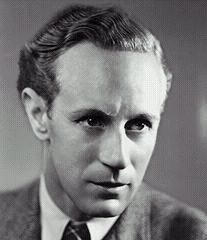 |
Leslie Howard was even more reluctant to play Ashley than Clark Gable was to play Rhett. He never read the book, but he didn't want to play another ineffectual character, he didn't want to be a costume picture, and he knew that being forty-five years old he was to old for the part of a twenty year old beau.
But Leslie Howard seemed to be the only possibility. There were dozens of actors considered and also Cukor used the paddock scene, a dialogue between Ashley and Scarlett, for tests. Among the candidates suggested were: Ray Milland, Richard Carlson, Shepperd Strudwich, John Howard, Robert Young. Douglass Montgomery tested with Vivien Leigh as Scarlett; Selznick was totally unimpressed with Jeffrey Lynn's performance, who tested with Paulette Goddard. Melvyn Douglas test (with Lana Turner as Scarlett), Selznick thought, was the first intelligent reading of Ashley he had seen, but he considered Douglas completely wrong in type and "too beefy" physically.
(casting of Ashley in Selznick's words)
Selznick kept coming back to Leslie Howard. He learned that Leslie had already started his own company and purchased several literary works and had one life-long ambition, namely to be a producer. So to get Leslie to play Ashley, Selznick offered him the position of associate producer of Intermezzo, in which he would star opposite Ingrid Bergman. Also a six-figure payment was added for both films. The contract was signed on January 13, 1939.
Also on January 13th, Leslie sent Margaret Mitchell a humorous wire: "I AM NOT AT ALL ENVIOUS OF RHETT BECAUSE THANKS TO YOU, IT WAS MELANIE, MA'AM, THAT I WANTED. BUT SERIOUSLY, I FEEL IT A GREAT HONOR TO HAVE BEEN SELECTED TO ENACT ONE OF THE ROLES OF YOUR BOOK, THE TITLE OF WHICH ESCAPES ME AT THE MOMENT".
Margaret Mitchell replied that she was looking forward to seeing him on screen and wished him all the best.
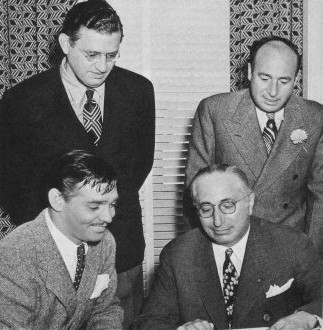
August 25th, 1938: Clark Gable, Louis B. Mayer, David Selznick and MGM executive A. Lichtman sign a contract for the loan of Gable to Selznick International.
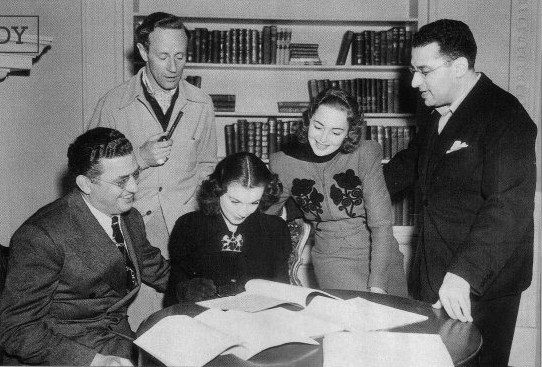
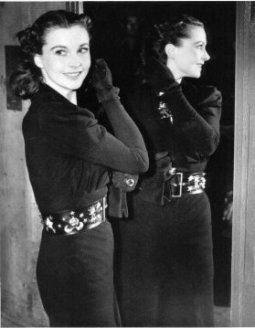
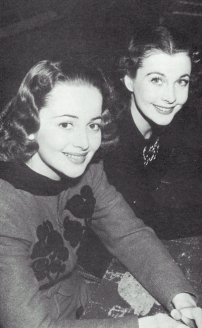
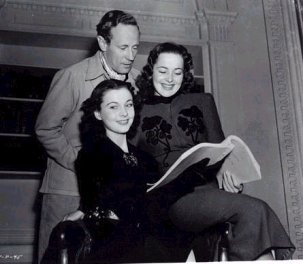
January 13th, 1939: contracts are signed by Vivien Leigh, Leslie Howard and Olivia de Havilland.
|