|
|
"...the usual method of
scoring pictures is for the arranger and scorer not to come near the picture
until the editing is completed. The producer then turns the picture over to the
music people, usually with the injunction to do a great job cheaply in a couple
of weeks..."
Thus David Selznick wrote to Katherine Brown in the summer of 1937, explaining
her why he tried to avoid working this way with the score. This issue was behind
his longstanding argument with Max Steiner; Selznick preferred to have his
composer read the script first, Steiner would rather wait until the picture was
finished.
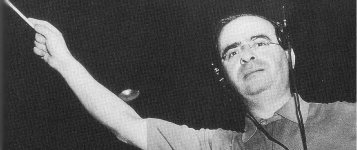
Max Steiner had first worked for Selznick International back in 1935. Selznick
considered him the best composer in the field. Then came the misunderstanding
between the composer and the producer and in 1937 Steiner signed a long-term
contract with Warner Bros.
But when the filming of GWTW was underway and Selznick began thinking about the
score - he knew that the best for this job would be Steiner. As he wrote to H.
Ginsberg in March 1939: "I think that whoever is going to do the score
on Gone With the Wind ought to know about it now so that he can be spending
whatever time he has free in study of the music of the period and generally
doing preparatory work...My first choice for the job is Max Steiner, and I am
sure that Max would give anything in the world to do it..."
Steiner was borrowed from Warner Bros. While working on GWTW he also wrote
scores for Warners' We Are Not Alone and Four Wives, and some
parts for Selznick's Intermezzo.
Selznick became increasingly concerned about the deadline, because he planned to
hold the world premiere in December. In November Max told Selznick a couple of
times that he would not be able to meet the deadline but as David wrote to Jock
Whitney: "...Steiner is notorious for such statements and works well
under pressure, and I am inclined to take the chance that we can drive him
through...".
At the same time composer and conductor, Franz Waxman was writing the so-called
insurance score against the possibility that Stainer would not be ready by the
deadline.
Meanwhile, another composer Herbert Stothart had always been very anxious to do
a GWTW score, and was Selznick's second choice for the job. In November Selznick
considered a possible switch or a collaboration of two composers. The idea of
having Stothart was soon quashed, first because MGM was reluctant to loan him,
and second because he blurted out about how he was going to fix the score and it
got back to Max. (As Selznick noted: "...in case you didn't know, the
musicans out here are even more jealous of each other, and there are even more
cliques among them than is true about producers, directors, actors etc...").
From then on the writing went much faster and the score was recorded in November
and December 1939 in United Artists Studios.
Hugo Friedhofer, Steiner's primary orchestrator recalled: "The whole
thing had a nightmare quality, because we were really under pressure. We never
started recording until after dinner, and we'd record until two, sometimes three
in the morning...".
Hugo Friedhofer, Adolph
Deutsch, and Heinz Roemheld wrote some sequences based on Steiner's material,
among these the siege of Atlanta.
Steiner composed 11 principal themes; all the main characters had their own
motifs, Scarlett, Rhett, Melanie, (Melanie's comes from 1934 RKO movie The Fountain),
Ashley, Mammy, Gerald, Bonnie, Belle Watling and there
were two principal love themes. But Steiner considered Tara's Theme as most
important: "I can grasp that feeling for Tara, which moved Scarlett's
father and whichi is one of the finest instincts in her, that love for the soil
where she had been born, love of the life before her own which had been founded
so strongly. That is why the Tara theme begins and ends the picture and
permeates the entire score".
There are two cues, "The Prayer" and "Charley's Death," by
Franz Waxman, and a cue, "The Locked Door," by William Axt, all listed
as the property of Loew's, Inc., the parent company of Metro-Goldwyn-Mayer.
These bits were selected from the M-G-M library and had been written for and
used in earlier M-G-M films. The Waxman cues were composed for His Brother's
Wife (1936); the Axt cue for David Copperfield (1935).
There
is also a cue written by Steiner and called "Prayer In Despair," which
had been used earlier in Selznick's The Adventures Of Tom Sawyer (1938).
In a memo Selznick noted: "...crazy about the
Melanie theme, the Mammy theme, and the Tara theme, but Max has failed terribly
with the Scarlett theme and the Rhett theme..."
The score included some melodies of Stephen Foster:
"Katie Belle"
"Under The Willow"
"Louisiana Belle"
"Dolly Day"
"Ring De Banjo"
"Massa's In De Cold, Cold Ground"
"Old folks at home"
(Swanee River)
"My Old Kentucky Home"
"Camptown Races"
Patriotic tunes, Southern songs and military pieces that are interspersed
thoughout the movie:
"Dixie"
(D. Emmet)
"Taps"
(unknown)
"Marching Through
Georgia" (H.C. Work)
"Battle Hymn Of The
Republic" (unknown)
"Yankee Doodle"
(unknown)
"Sweet and Low"
(Jay Barnby)
"Cavaliers of Dixie"
(unknown)
"Maryland, My
Maryland" (unknown)
"Irish Washerwoman"
(unknown)
"Gary Owen"
(unknown)
"When Johnny comes
marching home" (L.
Lambert)
"When this cruel war is
over" (H. Tucker)
"Bonnie Blue Flag"
(unknown)
"Hark, the Herald angels
sing" (
F. Menderssohn)
"Tramp, tramp,
tramp" (G.F.Root)
"Stars of the Summer
Night" (I.B. Woodbury)
"Can Can"
(Offenbach)
"Bridal Chorus"
(R. Wagner)
"Deep River"
(unknown)
"For He's a Jolly Good
Fellow" (unknown)
"London Bridge is
Falling Down" (Unknown)
The song that Scarlett sings one day in the morning in the film ("Oh she
wept with delight when he gave her smile and trembled with fear at his frown")
is called "Ben Bolt".
Soundtrack recording were not available on commercial recordings until 1940s
mainly because the public didn't seem to be interested in buying them. But in
December 1939, Selznick wrote to the Chairman of the Board of Columbia
Broadcasting System about a possible selling of the musical score of GWTW. "I
know that under ordinary circumstances the musical score of a picture couldn't
be expected to sell records, but everything in connection with GWTW is
apparently attracting such unprecedented attention that this may be the
exception. And incidentally, the score is quite beautiful."
Various renditions of the Tara theme were available in the 1940s, but GWTW
soundtrack was first issued in 1954. Also in 1954 Mack David wrote lyrics
to the Tara theme, called "My Own True Love".
The complete GWTW 2-CD soundtrack is available at
www.amazon.com
|