The maelstrom behind the morning calm
The most important thing in understanding any society is not knowing its surface laws, the things written by judges and politicians, but the unwritten rules that govern individual behaviour. These rules go back hundreds or sometimes thousands of years. No matter how hard a society tries to change itself or its appearance to outsiders, people are resistant to change and will maintain the unwritten rules. If you as the outsider can discern what those unwritten rules are, you can understand the whole society.
Some will scoff at the notion that there is a simple explanation for every behaviour and action in a society, but there is. For example, whether a thief who steals for himself, a christian who does charity to gain brownie points with "god", or a man who is courteous and polite so that others around him will be courteous and polite to him, we are all motivated by selfishness, what we get out of our chosen behaviour. Whether the benefits of our actions are immediately obvious or not, at our basest level we do everything for our own benefit. We cooperate or we capitulate because we gain something, not because we are deferring to the needs of others.
Similarly, despite their western-style "democracy" and economy, pop culture, and contact with us, Koreans are still driven by the unwritten rules of their society. Everything Koreans do follows these rules, or principles, written by Confucius two and a half millennia ago.
Confucius, or K'ung-fu-tzu, lived from 551-479 BCE and worked as a teacher, administrator, and as a writer and collector of others' knowledge as well as his own. Confucius' most well known book was known as the Analects. In the book he describes the five basic principles for a harmonious society:
- husband and wife (or more accurately, male and female)
- parent and child
- elder and younger
- ruler and subject (similarly, employer and employee)
- friend and friend
A sixth unwritten but equally held principle also exists:
- Koreans and foreigners
Quoting Confucius own words, "There was Tao (a way or road of righteousness) only when fathers were fathers, when sons were sons, when Rulers were Rulers and when ministers were ministers." At first this seems to encourage respect for one's social superiors. But whether they are misinterpreted or misused, in reality the "principles" are used by the first group to dominate and subjugate the second. In reality, is it not "husband and wife", but "husband over wife", "elder over younger", "Korean over foreigner", etc.
Korea is really a class system of privilege and power based on position. Those who are higher in the social structure are not accountable to those beneath them. Koreans will speak of theirs being a "collective culture", of concern for those around them, but in fact the "socially superior" are only concerned with collectivism when it suits them.
There is a sense of "entitlement" by those higher in the structure, an expectation that those below them are meant to serve or even gratify them. In different situations, the "entitlement" changes but is still based on one principle: the lower castes submit themselves to their "superiors".
What sort of effect does this have on interpersonal relationships?
- In marriages and dating
Several western women and Korean women I know or have met who are married to Korean men tell the same story about their relationship with their husbands. Picture A below is how western men see themselves and their wives. Picture B is how Korean men see it.
A 
B 
Westerners see men and women as partners, people who share but still have independent lives in some ways, hence the two intersecting rings. Korean men, on the other hand, see the roles differently. A Canadian woman told me what her husband said, and I quote verbatim:
"He drew a circle and said, 'This is you'. Then he drew a bigger circle around it and said, 'This is me'. I want you to make your life about me."
To put it simply, he (and Korean men in general) expect their wives to make their husband the purpose of their lives, to live for him which is anathema to (most) western thinking.
Witness this little girl's shirt I saw on a laundry line. Subservience to males is instilled from birth.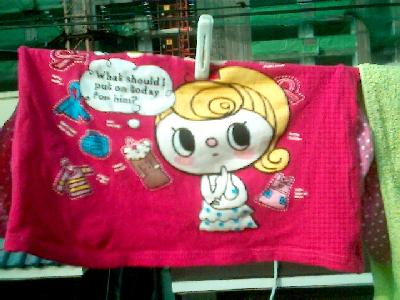

For him?
- In the home
In Korean families, the eldest generation dictates the lives of those living in the home, and even in the extended family. Grandparents dictate to children and grandchildren how to behave, where to live, who to marry, what to study, what career path to follow. Korean families travel regularly across the country or cities, sometimes weekly, expected to visit their grandparents home constantly, not just regularly.
Not to spend every free weekend or holiday in the elder generations' home is seen as a slight, that the children "don't love or respect them". It is a culture of guilt games, of control.
Another woman I know is married to a Korean man and has lived here for several years. She tells me that every Chusok (Korean thanksgiving), every xmas, and every national holiday that she and her husband must travel cross country to his mother's house. There all the family members must do what the grandparents dictate every minute of the day: when to eat, when to sit, when to spend time in the living room, when to go to bed. They exhibit many other controlling behaviours as well.
- In business dealings
Ever heard the saying "A verbal contract isn't worth the paper it's written on"?
You can say the same thing about written contracts in Korea.
Despite their insistence that Koreans are nothing like the Japanese, they readily adopt the Japanese business philosophy of "one strong, the others weak" and change terms of contracts already signed without agreement from the smaller party. Because the smaller company or less powerful person is more concerned with maintaining "face" than in addressing a wrong, they accept without complaint what no westerner would ever tolerate.
While you and I would be calling our lawyers, a Korean small businessman would be calling for the ajumma and buy more soju for a person who just cheated him on a deal.
- In the workplace
The influence of age is not limited to the home. In Korean business, promotion within a company is determined by seniority and age, not by talent or ability. The notion that someone, no matter how skilled, should be a superior to a chronologically elder person is unfathomable to Koreans.
Connections, or "friend and friend" are as much a part of one's climb as is age. As the adage goes, it's not what you know but who you know, and moreso in Korea. Friendships within a company, sometimes going back to college or high school days, are considered more important than skill, company loyalty or even tenure within a firm. It is a true "old boys' network", which makes it doubly difficult for women to succeed when you factor in the confucianist "ideal" of the submissive and pliant woman.
Westerners are used to speaking their minds and are often shocked when attending meetings with Koreans. If only one Korean is meeting with foreigners, he or she might adopt a western stance for discussion, but in a solely Korean group or westerners and Koreans mixed, a Korean manager expects everyone to adopt the Korean way: the manager speaks, everyone else listens and does not ask questions. To Koreans, consensus means everyone accepts without questioning, it does not mean everyone agrees.
My experience: I attended several meetings at different school which were mixes of westerners and Koreans. The directors would ask the group if people had any questions. The westerners would speak, and the directors would become angry because we asked questions. Korean teachers, even when they concerns they raised in private, would not speak at all during meetings.
- In the public square
Amongst strangers, whether on the street or other public places, the same rules apply even though there is no individual verbal or emotional contact involved. Those with higher stature expect those of lower standing to defer to them. Walking on the sidewalk, the "higher" groups expect the "lower" to step aside, to hold doors open for them, to stand so they may sit, to wait while they go. "Disturbing" the hierarchy (in essence, not following it) is considered rude.
At the top level, this means men in business suits will act as though everyone is there to serve their needs. Watch any street in downtown Seoul: middle aged men will regularly bump into others expecting the "lower" person to step aside, sometimes turning and giving dirty looks at those who refused to move. Watch on buses and subways: if a couple boards and there is one seat, the man will sit and expect the woman to stand. Chivalry isn't dead in Korea, it never existed to begin with.
This is not just limited to the wealthiest and most privileged people. Most older Korean women expect foreigners to immediately move out of their way, sometimes pushing people out of the way. Or a person who walks around you because you are facing him will only seconds later walk into and push another stranger whose back is toward him out of the way because the agressor cannot see the person's face.
Because the Confucianist "principles" are dictated from the top down, rather than obeyed from the bottom up, some people in korean society feel the rules give them special privileges, that they are not accountable for their actions and can abuse others. In some cases, this abuse of those below is driven by abuse received from above.
Some people use the anonymity of crowds to push and shove people they would normally never dare because of the hierarchy. The men with carts who collect recyclables (the Korean equivalent of the British "rag and bone" men) have a very low status in society often use their push carts to block traffic and sidewalks. Many women will push shopping carts into strangers "by accident". Drivers will honk and threaten pedestrians with their vehicles. Strangers will throw garbage into people's yards or vehicles if they are not seen.
People with social power use it to dictate and get their way in many things. People with no social power to affect those "above" them use what little they have to overpower those below. The only Koreans I have seen or met who are civil and courteous to all other people in all situations are those at the very lowest rung of society: the homeless, the poor, the retarded, and the disabled. They are not courteous because they are hoping politeness will win a handout (although that is part of it), they are polite because they have no social status.
How can one describe Korean society in a sentence?
One could liken Koreans and Korea to chickens with a pecking order. Or a more damning indictment of Korean behaviour would be to call it an entrenched culture of passive-aggressive behaviour, of bullying by (mostly) those who are themselves bullied.
This certainly explains many of the everyday actions of Koreans that westerners would consider to be abuse. "Domestic violence" is commonplace, parents tease their children to the point of tears and then hug them, and physical violence by officers against recruits in the Korean military are just a few examples. Some Koreans I have discussed this with think it makes them "tougher", "hardier", "stronger people". They accept this as normal behaviour.
The few Koreans who don't agree are invariably those who have lived overseas, and most are women who studied abroad in countries like Canada or the USA. Many of them are the willing and even seeking to marry foreign men because they want to leave Korea, to live in a culture where they are seen as equals instead of being subservient to men. (I would not say western men are much better. I have seen many Canadians and Americans, especially the GIs, dating Korean women and treating them the worse than how they would dare treat a woman from home. The Korean women stay because they are treated better than they are used to.)
So how does this relate to me working as a teacher?
In the workplace, the need to control and to demonstrate power from the top, especially to the foreigner who has knowledge of the structure will begin from day one. You will be taken out with the group, all members of the school participating in your welcoming party, no exceptions.
Attempts to control employees happens both inside and outside of work: the monitoring of teacher's private lives, discouraging westerners from socializing with people outside the school, and even dictating when teachers socialize within the school.
Last minute assignment of work is also commonplace as a means of control. "It's Friday! Write all your report cards for Monday!" happens every two or three months without warning. When you have 100 students and must cancel your weekend plans, this is infuriating.
(Report cards take about one hour per class, and teachers have ten to twelve classes at a time. That's ten to twelve hours of work. Do you want to do that on a two day weekend, or an hour per day over a ten day span? The worst part is that no matter how often you explain this to them, many Korean directors believe - or claim - that westerners are lazy and don't want to do their job. It's not the work we object to, it's the lack of respect for our personal time by the directors and owners.)
To a manager, this is a way of demonstrating control. People I met from other schools reported and they agree that keeping people uncertain is a common Korean management technique. Only those in control are allowed to know what is going on.
(I personally have a strict rule and stick by it: I tell my directors that for every hour of work required outside of class, I expect at least one day's notice. It sometimes leads to arguments, but saying up front and in writing that I expect reasonable notification makes them less willing to assign unannounced work. I have backed it up by doing it, finishing in the number of days I estimated to do the job. Be sure you discuss this with the recruiter and the director before you sign the contract. Remember what I said above on this page about business and contracts when dealing with Koreans?)
Koreans use fear in the workplace is not to gain control, but to show that they are in control. In the west, we say "A good manager makes himself redundant", but to the Korean, good management means making the employees constantly aware of their presence, as though workers are mice waiting for the cats to leave.
In closing
Understanding why Koreans do certain things can help you get along better. You do not have to be fearful of them, but at the same time do not be insubordinate. Get everything in writing, insist on it, and don't be afraid to say, "This is not what you said before". You will only be used and stepped on if you let someone do that.
On that note, it's time to move on to Part 9b: Anonymity and Unanimity, where I discuss how Koreans interact with each other - or don't interact, as the case may be.
Back to the front page