Getting ready to go
|
Choose your air carrier carefully!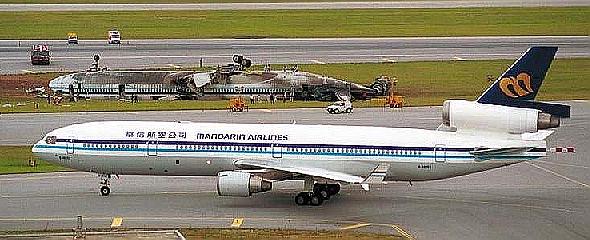
|
|
Just be glad you aren't flying on Scare Air (the nickname for Canada's military air service).

|
I and many other people who pack to come over make the same mistake when choosing what to bring. We pack things that we think are necessary when in fact they are dead weight. You would be surprised and what you can do without. Here are my rules (suggestions?) for packing.
- If it's replaceable, dump it. If it's irreplaceable, bring it.
Just because you are teaching English does not mean you need to bring a dictionary. Think about it: tens of thousands of Koreans are trying to learn English. Don't you think there might be some dictionaries in the bookstores? This is not just about dictionaries or even books. Anything you can buy again, be it clothes, shoes, books, or a stereo, is expendable.
At the same time, if something is truly unique, it might be worth bringing. Bring your video tapes of the Trailer Park Boys. Bring some cans of Tim Horton's coffee. Pick up some cheap souvenirs and symbols of Canada or your town like free bank calendars or t-shirts with your city's name. You would be amazed how much these things are appreciated.
One thing I wish I had brought was my road hockey gear: a mask, blocker, leg pads, plastic goalie blade and a half dozen stick blades. I packed them but later changed my mind thinking they were dead weight and only brought my baseball glove. After I arrived I found groups of Canadians and Americans playing on university campuses and that replacement stick shafts were readily available. ("He wouldn't write 'argh', he'd just say it." - Monty Python)
If you haven't already done so, go back to Part 1: Pack Up All Those Phantoms
- "I hate it when I can't trust my own technology!" - Geordie LaForge, ST:TNG
Bringing electric and electronic devices from Canada is a bad idea. Anything but portable devices (CD players, laptops) are a burden and are easily replaced.
Canada uses 110 volts, and Korea runs on 220. Unless your gadget has a voltage converter (some computers do), anything from Canada will die after five minutes use. The brand new hair trimmer I brought literally exploded in my hand the first time I used it.
Korean wall sockets are incompatible with North American power cords. You need a power adaptor to use them, and any adaptors for North American plugs sold here are two-pronged, not three-pronged. If you bring a computer or a laptop, you can buy power cables that have the computer's power supply head and one end and the Korean wall socket end at the other, but for anything else, forget it.
Small electronic devices that use batteries are fine since you can buy adaptors for them. But don't bring rechargeable batteries, NiCad systems that run on 220V are readily available in Korea. Big electronic devices are a waste of time and are just plain dead weight. North American VCRs are incompatible with Asian cable systems, and you can buy used TVs for less than the cost of shipping one from Canada.
Can't live without a stereo system? If you have a CD walkman, buy some high quality computer speakers when you arrive and use that as your stereo. My 600 watt computer speakers with a subwoofer can pound sound and cost me only 30,000 won (C$35). You're only here for a year, it's more than good enough as a makeshift system.
- Impress the locals
I said above to bring cheap souvenirs. Koreans like to receive gifts (some would call it expecting bribery) and will appreciate getting them. Other things such as pamplets and information about your community are worth bringing too because you can teach with them. It's much easier to deal with your neighbors when you can give them something, and it's much easier to talk in class when you have something to talk about.
- Don't bring anything illegal
I shouldn't have to say that, but there are some stupid people out there.
I have met several Canadians who think because marijuana is legal in Canada that they can bring it with them or use it in any country. If you are that dumb, do the world a favour and kill yourself. Don't give other Canadians a bad reputation just because you are an idiot.
Korea has very strict laws on marijuana. Possession and use are criminal offense with jail sentence and expulsion for foreigners. (Do you think the Canadian government would embrace you when you return?) If you attempt to bring any amount of illegal drugs in, even a single seed, you are an complete moron and deserve whatever punishment you receive.
(Despite claims to the contrary, Korea is not a wholly free or democratic country. If you are punished for a crime, think Abu Ghraib, not Club Fed. Corporal punishment is common in Asian prisons. In Japan, prisoners are forced to sit still for up to ten hours straight or are beaten with wooden sticks. If you don't believe me, search the internet for accounts of American GIs who spent time in Japanese prisons.)
- Packing list suggestions
Because people come to Korea for a year, most think they need to pack everything and anything to prepare for anything. Don't do that, it's a waste of space and weight. Here are two reasons why:
- You can buy pretty well anything in Korea that you might use back in Canada.
- Thing you will be using 6 months from now, you won't be using today.
Think about that. You're going to Korea to work, which means paycheques. Unless you are a complete moron and wastrel, you will have plenty of money to buy new things. If you don't want to buy things or decide to save weight, have them shipped to you later.
Choosing your airline carefully
Some employers may give you a blank cheque when it comes to booking your
airline ticket, letting you choose which airline you fly on. If you are
fortunate enough to have that choice, then I would advise checking different
airlines to see which one you like best.
Some airlines are better than others for travelling, and for a variety of
reasons: comfort, safety records, and service among others. If you have
particular needs or likes and dislikes, find out and make arrangements
weeks before you travel, not when you get to the airport.
For example, I prefer dietetic meals (intended for diabetics)
on flights. They have less fat and salt and are healthier than most airline
food. Some airlines even offer kosher or vegetarian meals. Ask for special
meals when you are booking your flight, you won't get them if you don't.
Some airlines don't provide special meals, and if you need one, you
should try to change carriers. Korean and Japanese air carriers serve
only one meal (following the philosophy/mentality in both countries
that there is only one way to do things). I also find the Korean and
Japanese air carriers do not enforce the no smoking ban if men
smoke in the toilets.
Baggage limits
A few years ago, there seemed to be a standardization of baggage and what
passengers could bring on board. When I first came to Korea, almost all
had the same limits: two checked bags (bags that go underneath
the plane) up to 70kg each and one carry on bag up to 30kg,
with a maximum dimensions of 7"x14"x21" (17cm x 34cm x 51 cm).
Since that time (2001), the only thing that remains the same is the size
of your carry on bag.
Be it the rising costs of fuel, the cost of security and maintenance, or
just plain greed for profit margins, air carriers had to choose: the
prices go up or the weight limits come down. Given that people were
travelling less, especially after 9/11 and SARS, higher prices would have
killed off even more airlines. So they chose to cheapen the value of
your ticket.
Because of this, you cannot be sure what you can take on board. Once
you know what airline you will be flying on, call them. Find out the
weight and size limits long before you ever plan to travel.
If your bags are overweight, it would be better to know when you are
packing than to find out at the airport check-in booth and end up leaving
things behind or paying extra to ship it. If you have repacked and are
still overweight, ask how much extra you will have to pay. If worst
comes to worst, have your family or friends ship a bag, like sending
your winter clothes later if you are travelling in July.
Carrying on about luggage
Since we have already discussed the size and weight of your carry-on
bag, here I intend to talk about the contents. There are some things
I have found indespensible when travelling. Some people may disagree
but that doesn't mean I am wrong, it means my choices work only for
me. They are condiments, not commandments. You only
have to use the ones you like.
Water may seem a strange first item to those who have never travelled,
but for anyone who knows what sterile and dry airplane ventilation is
like, extra water can be a lifesaver.
I usually take a 500ml bottle for every 3-4 hours of flight time.
Going from Canada to Korea, that's three or four bottles. It sounds
like a lot, but it's better to have and not need it than to need it
and not have it.
Do not take a large 2 litre bottle! It's hard to drink from
and easy to spill. If you are kind enough to share with another
dehydrated passenger, a 500ml bottle is easier to give.
Just because you get two meals on a flight to Korea doesn't mean
you won't need extra food. They serve the meals on a schedule, not
when you are hungry, and the food might be inedible. Having an extra
sandwich, fruit, or muffins can tide you over until you land.
But remember: meats and mayonnaise go bad after about two hours at
room temperature. I would recommend a submarine sandwich made
with only vegetables and cheese. It will satisfy you when hungry
and remain edible and be safe to eat for the duration of the flight.
Most people think all their clothing should go in their checked bags,
but having a few items could save the day. I change my socks and
underwear during long flights and I feel a lot fresher, especially
on humid days. An extra t-shirt, and even a pair of shorts or pants
would be a good idea. (What would you do if you spilt coffee on yourself?)
And think about this: what if your luggage is lost, stolen, or put
on the wrong plane? How long will you be without a change of clothes?
Having a few items could keep you going for a few days until your bags
arrive or until you can buy some more.
You don't have to buy one of those travel kits, just put your toothbrush
and toothpaste in a ziploc bag. (Ziplocs are so handy for travelling!)
And don't forget to pack deodorant.
Carry a few foil wrapped "moist wipes" in case you are stuck without
washing facilities. As well, carry a small towel. Not a fluffy bathroom
towel, I mean a "quick-dry" swimming towel that weighs nothing and folds
into the size of your hand. They are absorbent enough to shower with.
(See "Clothing" above about the possibility of losing your luggage!)
I said it before: you will be on a twelve hour flight. Can anyone sit
for twelve hours and do nothing or limit themselves to reading in-flight
magazines? I know I couldn't. Having a few creature comforts with you
can save your sanity. Take a gameboy, a PDA, a novel, a puzzle magazine,
but take something or you will quickly learn what stir crazy means.
(I take several e-books and games on my PDA.)
Taking a walkman or an MP3 player is also a good idea, but check with the
airport. (See below about what you cannot take on board.) If you
do take one, put in fresh batteries immediately before passing through the
security gate. You might only be allowed enough batteries to operate the
item and have to throw away the rest.
More and more airlines (all, to my knowledge) now provide in-flight
entertainment systems, though some are better than others. They range
from simple radio channels up to individual TV screens and video game
controllers. I came over on Singapore Airlines and they had
Nintendo available in every seat.
Now I am going to talk about things you must not have in your carry-on.
These are not my rules, they are the airports', airlines', and governments'
rules. Ignore them at your peril. You can be denied entry to the boarding
area or arrested if you try to hide them in your bag or on your body.
There are a great many things no longer permitted on any flights, domestic
or international. Check with Transport Canada, the airport, or
your air carrier before packing. In fact, most plane tickets nowadays
contain a list of banned items, so check that first.
Because the hijackers on September 11th 2001 used box cutters to
take over the planes, they ruined the fun for everybody else. All
sharp objects, no matter how small, are absolutely verb�ten
from entry to the cabin. That includes even the smallest pair of
scissors in a sewing kit. No forks, no knives, no spoons, and no
glasses except on your face.
I said bring deodorant, but that means a stick or roll-on, and
forget about shaving foam either. Containers can explode when the
air pressure goes down after takeoff. (Shaving foam is sold
in Korea, but I would recommend bringing extra deodorant sticks.)
This means no camping fuel containers, although you should be
able to bring the stove sans fuel. For you drug addicts
(read: cigarette smokers), that means no lighters.
Why would you try to bring a lighter on a plane anyway? Smoking is illegal
on all international flights.
Saying "no explosives" on a flight seems mind numbingly
obvious, but most people don't realize that alkaline batteries
(disposables) can explode if exposed to flame.
As an act of civil disobedience to show how overzealous the
fascists in the Shrub regime are since 2001, some Americans
have started carrying things like bare wires and disassembled
clocks and radios or Play-Doh in their suitcases. Under an x-ray
machine, they look like bombs and explosives, and people are
deliberately being arrested to protest Stalinist laws.
While I can empathize with their argument, you and I are not
boarding planes to protest, we are boarding to travel. If
anything in your suitcases could be mistaken for something
lethal, take it out of your bag.
Heading for the airport
The day that you are flying out is one of the most hectic of your
life, and the worst thing you can do is not to have a plan ready
for that day. Do yourself a favour and write out your itinerary
for the day of your flight at least one week in advance.
Remove all last minute planning from your schedule. "I'll do
that in the morning before I go" is stupidity. There should
be nothing on your agenda that day except getting on the flight.
Here are some suggestions for the day before your flight if
you want to save time next day:
If you live with your parents, it will save time and clean up.
Your last face to face conversation with them for a year
should not be an argument about dirty dishes.
If you live alone, this will avoid wasting an hour scavenging
for breakfast. It may not be haute cuisine, but it's
better than being ornery because you are hungry.
Tracking down and calling people the day of your flight is time
consuming and to be avoided. In fact, don't finish this the day
before your flight, finish it a week before. You aren't going
to see these people for a year, so what's another week?
People don't like the sound of that, but do you really have
any time to wash the night before you leave? And do you really
want to be boarding a plane in smelly, dirty clothes? If your
answer to both questions is no, then do it. You can
always wash the dirty clothes once you arrive in Korea (they
do have washing machines, you know).
Going to the airport feeling funky is bad enough, but when you
consider that the flight is twelve hours long, and then add in
the time zone change, it means you will be in those clothes for
approximately 36 hours straight, including the time you are
sleeping in them on the flight. In the cramped, sweaty conditions
of a plane the only chance you might get to freshen up or change
clothes is in the airplane's toilet. Take a shower while you can.
If your town or city has an airport taxi service (many do),
call them and arrange a pickup time for the next day. If there
are only buses that pick up from specific locations, know at least
a day ahead of time where they are. The day you fly out is not
the time to be researching this. If neither is available, ask a
taxi company about their airport service.
Eat, shower if necessary, and relax for 20 minutes. Start slow
and don't get excited, but don't waste time either. Do a final
"once over" and make sure everything is ready.
If you are changing clothes or getting ready when the airport taxi
arrives, you will either panic and forget something, or you will
miss your ride. This is avoidable if you plan ahead.
If you have never flown overseas before, then you have no idea
what is involved. Don't say this is too much time in advance if
you have no experience of this sort.
Check in immediately after you arrive. Find your airline booth,
check your bags, and get rid of the dead weight. You should have
only your carry on bag in hand as soon as possible. Less weight
to carry means less sweat now and more comfort later.
Checking in early also means you can find out if something in your
carry on or checked bags is not permitted. It's better to find out
now that you put something in the wrong place and not have to throw
it away. I once accidentally left a pair of scissors in my carry
on bag. The x-ray found it and I was able to put it in my checked bags,
solving the problem.
Another good reason to get rid of the bags is in case you want to
shop in the airport. Yes, everything is overpriced at the airport,
but you might find something you want to take (a newspaper, a book)
or something you need on the flight (bottled water).
Because of American foreign policy and their FBI's incompetence making
9/11 possible, the rest of the world has suffered the consequences and
had to change to make them happy. The line-ups are long, slow,
and sometimes infuriating. Arrive early. Be patient. And cooperate
at every turn.
Security now in almost all airports involves serious scrutiny. Everyone
must now take off their shoes and put everything except their
clothes through x-ray machines and metal detectors, and sometimes
they will do a pat-down and body search.
(Once I was nearly detained by security at an airport. I had a
neck-pouch under my shirt holding my passport and plane ticket.)
Going through security early also gives you time to visit the duty free
shops and pick up a cheap bottle. ("I'll take that bottle of
sake with the gold leaf in it, thank you.")
You have an assigned seat on a plane, so this is not about being first
in line. By arriving early, you will have time to relax and hear any
notices such as flight delays, weather, or have a chance to board early
if you have special needs (eg. you are disabled).
For the drug addicts who need that final nicotine fix, the "smogging
lounge" near the gate is your last chance to pollute the air for
twelve hours.
How (not) to act at the airport
Having a plane ticket and passport is not enough to get on a
flight anymore. In this era of paranoia about terrorism and
with the rise in "air rage" caused by lousy service, airlines
are scrutinizing passengers more closely than ever.
Airport operate under martial law, not democracy. The little
Hitlers running them decide who gets through, and if you don't
follow the rules, you will follow the nice man in the uniform
while wearing the fancy bracelets.
If you have locks on your suitcases, have the keys ready to
open them if instructed to.
To airport security, nervous people look suspicious, as do
impatient people. Angry people. Sad people. Hell, overly
happy people can arouse suspicion.
Arrive early, be calm, be patient, answer their questions
straight (don't make jokes or be sarcastic) and speak
naturally. Maybe this sounds uptight and paranoid, but aside
from the neck-pouch incident, I have never been stopped by any
airport security.
Does anyone reading this remember what happened a few years
ago when Ziggy Palffy was with the New York Islanders?
While boarding a flight for a road trip, he made a joke about
having a bomb in his suitcase. Because of his broken English
and east European accent (this happened at the time of the
Kosovo conflict), the airport employees assumed the worst
and held him in custody for hours, holding up the flight and
all the passengers. Needless to say, people were not amused.
One last check before the gate
If you arrived early enough, check your bag one more time. Do you
have water? Snacks? Reading material? An inflatable neck pillow?
A bottle of Napoleon Brandy for half the street price?
Have any of your possessions been stolen by a thief?
How to have a relaxing flight
For those who never took high school science, at higher elevations
air pressure decreases, and this makes things expand. (In the
vacuum of space, they can explode.)
This includes your body. When the plane takes off and rises to a
cruising altitude of 9000 meters, your body will expand slightly
and your blood pressure will decrease. If you are wearing tight
clothes, this can be very uncomfortable.
See part 1 above. It is not just your head that expands, your
feet do too. Untie your shoes before takeoff so you can
remove them with just your feet if you need to.
Because of fluid and skin in your mouth and throat, your ear canal
is closed off. Swallow regularly to equalize the air pressure.
If you have an ear infection, don't fly until it is treated or
it will be twelve hours of unbearable agony.
In the next section I discuss what to do about unruly passengers
so that you don't become one yourself by getting angry. Solve
problems early in the flight when you are polite and in a good
mood and the flight attendants will be more willing to help you.
In flight, make fruit juices and water your drinks of choice. Sugar,
alcohol and caffeine can both dehydrate you and increase urination.
Walking back and forth to the toilet is no way to get comfortable and
it annoys other people.
And avoid alcohol altogether or at least minimize its use. ("Free
genuine champagne from France? Sure!" I said....) Airlines and
governments take air rage seriously. Passengers who cause disturbances
won't just be arrested, they might be fined for the cost if an
unscheduled landing in another country was necessary.
On the day of your flight, most of your time will be spent sitting
and waiting. Relax and don't be agitated because the waiting is
not for you to decide. Just as important, adjust your schedule
depending on your flight. If the plane leaves early in the morning,
you might be better off staying in a hotel near the airport (now
you can take a shower and not have to clean up).

|
Most airlines offer two choices for meals, and unless you are the last passengers served, you will usually get it. Korean and Japanese airlines usually only offer only one meal.
Elsewhere, I mentioned that I specify dietetic meals when I book my flights. They are low in fat, usually vegetables and rice or potatoes with either chicken or fish. Some airlines even offer vegetarian meals, meals for people with allergies, and meals for religious or ethnic needs. Don't hesitate to ask, and don't hesitate to take your business to another airline if they don't. The earlier you book your meal and flight, the more likely you are to get it.
Airline dining usually starts with a drink about an hour after takeoff (fruit juice, soda and some alcohol are usually offered). Depending on the length of the flight, at the two or three hour mark they will serve a meal corresponding to that time of day. Meals usually have a container of water and no other drink, and coffee is served soon after.
Thanks to 9/11, all eating utensils now are plastic except for the short disposable chopsticks on some flights. You can keep the plastic packets of utensils, but the eating containers are reused. The meal also contains a moist towellette so you don't have to go to the toilet and wash your hands.
The trays the meals are served on are plastic and the "table" in front of you is made of metal. If you think about it, maybe bring a very thin cloth-topped mouse pad to put between the two and it will keep your tray from sliding. Turbulence is an unpleasant thing.
You can get more juice at any time, but getting the flight attendants' attention can range from 10 seconds to never, depending on the airline and their quality of service. Of those I have flown on, Singapore Airlines, Thai Airways, and Philippine Airways have great service and the staff are always courteous and polite. Korean Air, Asiana, Japan Air Lines and Air Canada act like customer service is an inconvenience and an interruption of their job by the cattle (you and me).
(On an overnight Korean Airlines airline flight I was forced to take, the breakfast they served was either rice and tofu which I cannot eat, or instant noodles. I paid hundreds of dollars for this flight and you expect me to eat instant noodles? When I later wrote a polite letter to them saying the quality of their meal was inadequate, their response was - I am not lying about this - "People who complain are mentally disturbed". I still have the letter. See Part 9: Stick It Out for more on the Korean mentality.)
Boss, Boss! Deplane, deplane!
When the plane is preparing to land, you will have to sit and
be buckled in just as you were during takeoff. To prevent loose things
from flying around, put away everything you don't need into your carry
on case and store it in the overhead container at least 30 minutes
before landing (but keep out a book or something).
Once the plane lands, don't act like the people around you.
On every flight I have been on, I see the same stupid behaviour
from every single passenger of every single country and every ethnicity.
They unbuckle, stand up, and start grabbing their luggage while
the plane is taxiing back to the gate.
WHY?!?! You can't get out. I have lost count of how many
idiots dropped their luggage onto their own heads or onto other
people's when the plane jumped on the bumpy runways.
Sit down, it's not a race. You can't get out of the plane until they
open the doors, so don't bother reaching for your bag. Wait until
the plane stops and the doors open. And while you are waiting, look
around and in the seat pockets in front of you. Did you leave anything
in there?
When the doors do finally open, it's still not a race
to get out of the plane. Let other passengers push and shove their
way out, then take your carry on out of the compartment. It
won't kill you to wait five minutes, even after being on a plane for
twelve hours. The flight attendants won't chase you out with
broomsticks if you don't run.
"Last one out is a rotten egg!" is for schoolchildren. Try
acting like an adult instead.
Clearing customs
Finally, you are out of the plane and into the airport. If you feel
like it or need to, head for the toilet and freshen up. Changing
your shirt or other clothes can make a difference after 12 hours.
How you look is important. People who don't look scruffy have an
easier time with customs and immigration. Also, once you do get
through customs, you will meet your employer for the first time.
What do you want to be his first impression, the scruffy "tree
planter" type or someone who can look good in any situation?
Pick up your checked bags at the carousel and be sure to use a
trolley, even if your bags have wheels. It will make toting them
through the airport that much easier.
Once you arrive, you will head for the immigration desk. Pick up
an immigration card if you didn't keep the one given to you on the
plane, and fill it in. Because this is your first time in Korea,
you will need only a 30 day visa which is given automatically. You
will obtain the E-2 visa at a later date by travelling to Japan
(usually) or Beijing.
Have your passport and keys ready to open your baggage if necessary
and wait in line for the next available officer. People with empty
passports are usually waved through with little difficulty.
Next is the customs officer. If you try to walk past without
stopping, you will most certainly be stopped. Approach and be ready
to declare anything you have if it is on the list of items.
(The most I have ever been asked by a customs officer is what I
had in a suitcase. I started opening it instead of answering and
he waved me through without looking.)
If by chance the customs office does stop you (eg. random
checks), cooperate fully. Declare anything they ask you about.
Keep it brief and truthful. Long answers make you look devious.
In Closing
Free at last! Free at last! Thank...well, maybe not. But
you are in Korea now and the fun starts, or at least, the work.
If there is something you have experienced and want to share
(bad airplane food, good service from a company, or other things
I didn't talk about) feel free to contact me through my
Feedback page.
Back to the front page