Life in the big city can be awe inspiring but can also be intimidating
|
| What to do first | What to get first |

|
Seoul is one of the world's largest cities, its metropolitan area over 15 million people, nearly one third of the Korea's population. Only a handful of cities - Mexico City, Tokyo, one or two in China and perhaps London - have larger populations or physical size.
Feeling lost in Seoul is easy. Not knowing where to get even the most
basic necessities or how to get around can make you feel dwarfed by
your surroundings. For those without a more adventurous spirit, it
can be intimidating and can quickly push all the wrong buttons.

Back in Canada, did you go to the tourist attractions or tourist offices near where you lived? Probably not. Most people are jaded and ignore special sights and events where they live. "I can go see those things anytime," is their thinking. But when you are new to a place, the reverse is often true - you are interested in the unusual, and you don't have a jaded sense of normalcy.
Upon your arrival, you and your host will probably be working at cross-purposes. The host wants to be friendly and show you the unusual immediately after you moved, the time when you are most vulnerable and want some sense of normalcy. (Conversely, the tourist-y things you want to see, like old temples, special sites, and attractions, the local residents often don't care about.)
Also, the tendency of those already here is to make you come out and socialize, to make you feel welcome, or in some cases, to indoctrinate you and make sure you follow the group. (See Part 9: Stick it out for more on Korean groupthink.) Some employers are trying to be friendly, some are trying to enforce conformity from the get-go, and in some (many?) cases, both.
Try to see things their way when you arrive. Perhaps they are trying to be friendly, but don't be afraid to say what you really feel or to protect your own well being. If you are tired after a 12 hour or longer flight and need to sleep, say so. Don't allow yourself to be dragged off for an all-night drinking session (very common in Korea) or anywhere because it's what the group wants to do. My advice is to be polite but not afraid to say no if you really don't want to do something. If the choice is them feeling offended by you saying "no" or you becoming angry and upset because you feel violated and your well being is not respected, protect your health first.
The first thing to do in any new place, whether in Canada, Korea, or Timbuktu, is to become familiar with your surroundings. When you feel lost, it doesn't just make it hard to get things or to do things, it can wear you down mentally. Gaining a sense of normalcy, of belonging, of things becoming everyday will go a long way to making life in Korea more bearable.
You will do yourself a big favour if you do and obtain the following
things early in your time in Korea. Many of them will give you that
sense of normalcy. Feeling normal and comfortable is a crucial part of
living - not just surviving - in a foreign country.

 |
Get On The Bus
Take the time to ride some of the buses in your area. Don't be afraid of getting lost if you exit the bus somewhere. Remember: it is a bus route. Where you got on and where you got off are part of that route. The bus will eventually pass again both places again.
The buses in Seoul follow major routes through the city. This is not like Japan's Shinkansen train, built in the countryside to win votes. The Seoul bus system is actually useful.
Although the buses are generally slower than the subway because of the traffic around them, there is one big advantage of riding them: you can see things out the window. You can find stores, attractions, movie theaters, parks, recreation areas, and many other things you would never see from an underground subway.
There was one person I knew who was into rock climbing and asked
if I knew where he could go. I told him to take a certain bus south
from Jong-no (the city center) and he would see the rock climbing
park. He thought he was "too cool" for buses and balked at the idea
of riding one. He asked me which subway went to the climbing park
and when I told him that none do, he wouldn't believe me. (If
you don't want help, don't ask for it!)

Check Out the Stores
Most supermarkets and convenience stores are like those you are familiar with back home. They sell food, candy, soft drinks, milk, and various and sundry things. But a lot of the things we take for granted being there often aren't sold in the same stores in Korea.
For example, basic health needs like aspirin, bandages, or throat lozenges ("Halls") are not sold anywhere but in pharmacies. If it is late at night and you have a headache, you will have to live with it until morning. If you need a comb or nailclippers, you won't find them for sale outside of a "beauty shop", and men's underwear is sold in lingerie shops. (I'm talking boxers and briefs, not thongs and g-strings.)
Westerners expect things in certain places and so do Koreans, but the
two cultures' ideas of what is appropriate are not the same. Neither
country is wrong because there is no "right place" for anything, but
if you need something, you need know where to get it. It's up to you
to adapt because Korea will not change for you.

I can't provide a list of where to get everything, especially since I don't live in your neighborhood and don't know what you need. The best thing you can do is get stuck in and locate the things you use and need before you stuck without them.
Visit the Canadian Embassy
You can tell a lot about a country by how it builds its embassies. The American, British, Chinese, Brazilian and many other countries' embassies are buildings enclosed by a brick or concrete wall several metres away in all directions, separated to keep car bombs away. The Belgian, Thai and a few other countries have roadside buildings without inordinate amounts of security.
Canada's embassy is a few floors in an office building.
Any terrorist with a bomb wired up his ass could walk in and blow up the place. Canada's international reputation is why they don't, and why we don't get attacked when we are overseas. (It's also why that fascist idiot Steven Harper scares me, he wants to throw away our hard-earned reputation and hitch our wagon to the US. It makes me want to permanently give up Canadian citizenship.)
You can register at the embassy while living in Korea. In case of an emergency (eg. a death in your family) the embassy will contact you if your family can't. They can also provide help in leaving Korea if worst comes to worst and the North invades. (Yeah, right.)
Here are the addresses (physical and mailing) of the embassy in Seoul:
|
Canadian Embassy Consular section Kolon Bldg. 9th floor 45 Moogyo-dong Jung-gu Seoul Tel: (82-2-3455-6000 ext. 3262, 3263 or 3330) Fax:(82-2-3455-6123 or 82-2- 3455-6013) |
Canadian Embassy Consular section C.P.O. Box 6299 Seoul, Korea 100-662 |
Here is the address of the consulate in Busan:
|
Consulate of Canada in Busan c/o Dongsung Chemical Co., Ltd. 472 Shin Pyung-dong, Saha-gu Busan 604-721 Korea Tel.: 051-204-5581 Fax: 051-204-5580 |
To visit the Canadian embassy in Seoul, take subway Line 2 to City Hall station (201) and use Exit 5. Walk east to the next street and turn north around City Hall. You will find the Kolon building 200 metres ahead on your left, a fire-brick red building with a Starbucks in the lobby. (Just past City Hall, you will find the Seoul Help Centre, home of the Hi Seoul website.)
Seoul City and Subway Maps
Throughout metropolitan Seoul these free maps and information are
readily available. The Korean National Tourist Offices also has a
large amount of information and some free translation services. If
you need help at any time of day, just dial 1330 for help
from KNTO. See also the links page for more
sources of information on the city and transportation system.
Just as important, carry a pocket compass when walking. Some people
think it is a silly thing to buy or bring, but you would be amazed
how much you will use it. Many buildings in Seoul are tall and you
often can't see anything. With a map, a point of reference and a
compass, you can quickly figure out where you are and which way to go.
If you find yourself without a compass or map, look for a subway
station. At the bottom of the steps entering every station is a
map of the area with the cardinal directions and key landmarks.
Unless your name is Ryouga (an anime reference)
it is easy to find your way around.
A Bank Account

What to get first

|
Some people tell you it is difficult to get one, and that is nonsense. Ask your school's director or owner to help, they should be willing. In fact, most will expect you to have an account so they can deposit your salary directly so they are obliged to help you. (Some employers still pay in cash, which is a frightening prospect. What if you are robbed on the way to the bank or home? What if your employer is robbed and has no money to pay the teachers' salaries?)
Even if your employer won't help you get an account, most banks have one or two employees who speak some English. Get the forms, take them home if necessary or ask a co-worker to help you fill them out. To obtain an account, you will need your work visa card and your passport, so have them with you when you go to apply.
Korean banks offer other services too. Some have Western Union money transfers, some have branch offices in North America and can process overseas payments, and all banks offer American Express or Visa travellers cheques in US currency. But be aware: you must present your passport for all international transaction. The government has strict rules on taking large amounts of money out of the country. Even if it is money earned and taxes were already paid, taking out large amounts of cash (over US$10,000) could be subject to fines or seizure.
Once you have your account, be sure to get a debit card as well. Before you say "Debit card? The transaction fees are ridiculous!" let's make a comparison. To Koreans, the fees are exorbitant, but compared to North American banks, they are nothing. Most banks charge 500-1000 won (approximately C$0.60-1.20) for transactions made at other banks' ATMs, and there is usually no charge for getting cash at your own bank.
There is also no minimum or maximum number of transactions and extra charges per month, a sweetheart deal compared to most North American banks. This means you can withdraw smaller amounts and end up spending less than if you have large amounts of cash in your pocket (something westerners often do to cut down on service charges).
The only thing to be leery of with ATMs is their hours. Most banks automatically close their ATMs at 10:00PM. Some westerners report being trapped inside ATMs until help arrived. If it is later in the evening (after 9:00PM) you can obtain cash at ATMs in many convenience stores. In the busier nightlife areas (Itaewon and Shinchon) and where shopping is sometimes open past midnight (Dongdaemun) bank ATMs are also available after hours.
A Cash Card may also be an option. It functions like a credit card, but does not use credit. Instead, you transfer money onto the card and can use the card for internet purchases (very useful when buying things from overseas) but without the interest rates.
Note: If you do purchase things from overseas while in Korea, you will have to pay customs duties on all items, even if the things you are buying are not sold in Korea. On some items, the duty charge can be as much as 40% of the item's value. Korea is as two-faced about "free trade" and protectionism as the USA is.
A Bus and Subway Transit Card
Riders can pay to use the transit system in one of four ways: bills and coins (but only on buses), prepaid tickets, with a credit card (which is automatically debited) or with a transit card.
Transit cards can be purchased at many news stands or certain banks. They cost 12,000 won and have 10,000 won in credit on them. (They cannot, for some idiotic reason, be purchased in subway stations.) At any subway station, you can "recharge" the card with more money. If a card is damaged and unreadable, you will lose any credit remaining on the card but take it back to a bank and the card will be replaced for free.
There are two great benefits to having the card. One is obvious as I tell you about them: you don't have to fumble for change or subway tokens. Whether on the bus or subway, just pull out the card and swipe it across the sensor and your fare is automatically deducted.
The other benefit is that users of the cards receive a discount. On most buses and subway rides, it's about 10% cheaper than the regular fare. On the intercity buses (whose routes go 20-30km and charge 1,400 won) you save about 100 won. But even if there were no discounts, the convenience alone makes it worth getting one.
A New Bed or Sleeping Surface
If the apartment supplied by your employer is maintained long term by the school, then chances are it is furnished. For things like tables, chairs, a sofa and other things that are easily washed or covered with a dropcloth, cleanliness is easy to start with and maintain.
What you sleep on is a wholly different matter. If there is a bed in the apartment, is it brand new and wrapped in plastic? If not, how long has it been there? Is it comfortable, or lumpy and backbreaking? Is it filled with bedbugs and other people's filth after years of use?
If you have any sense of personal hygiene, you would do yourself a favour by buying something better. There are two inexpensive and temporary options you can take, and a more permanent one if you intend to stay longer than a year.
- Yo!
Many Asian countries often use the same room for sleeping and for living in. This means they need to be able to put the bed out of sight for the day and easily take it out at night. In Korea, there are soft floor matresses called yo that can be rolled up and stored in a closet.
A yo is inexpensive (20,000-40,000 won, or C$23-46), you can run it through the washing machine yourself, and it will last you a year. But if you live on the second floor or below in buildings, you may find bugs crawling on the floor and not want to sleep that way. Apartments above the second floor don't seem to have as many. For that reason, I offer this second temporary option:
- Camping cots
Mountain climbing is popular in Korea (why, I don't know - Korea has hills, Canada has mountains) and you can find camping gear in many stores, especially in Myeong-dong and Dongdaemun. In many camping shops you will find folding cots.
These cots have aluminum frames with a canvas sheet stitched strongly around the frame. They are easy to assemble and should last a year for anyone weighing less than 90kg. You can buy them for 30,000-40,000 won in most places.
If you toss and turn a lot in your sleep, they are not advisable. The legs are thin and they can tip over easily. Restless sleepers or people who want a bed big enough for other nighttime activities (if you know what I mean) need another option:
- Folding beds on wheels
Remember the old folding beds you saw in hotels, the ones that get wheeled in for the kids when parents are too cheap to pay for an extra room? In late 2002 such beds were heavily advertised in Korea: a strong metal frame, a fairly thick mattress and it folds vertically for storage in closets or behind furniture. Some even let you raise one end, like a futon.
If you have the money to spare (150,000-200,000 won), the commitment to stay long term, or you suffer severe back pain, this could be an option. How much money is your comfort and a good night's sleep worth to you?
A Mountain Bike
If you are an aggressive off-road rider (hand raised) a mountain bike can be a great investment for getting around on the streets of Seoul. In most places, you can outpace the traffic. Even if you aren't psycho on a cycle, there is a concrete paved park system that links most parts of Seoul. A person can travel from Kimpo airport to Walker Hill Casino and down to Seocho and Gangnam without ever using the surface streets.
Bicycles are remarkably cheap (my 18 speed was 130,000 won, or C$150) and of good quality. (More basic models can be had for 70,000 won.) The man I bought mine from gave me several free tune ups despite my attempts to pay him (whether others will, I don't know). You can also buy a rack and folding baskets to put on the bike and carry your groceries home.
Also, Seoul's weather is fairly mild in comparison to most Canadian cites, much like a Vancouver winter but with very little snow or ice. Riding year round is quite possible, but DON'T ride in Korea without a helmet! Koreans have less respect for the safety of cyclists than Alberta drivers do. Unless you are willing to defend yourself by deliberately damaging cars that drive too close and try to run you off the road, I would advise staying off the streets.
(I am soooo glad my cow horns are the same height as the side
mirrors on all the cars. You wouldn't believe how many cars deliberately
drove too close to me and broke their own mirrors or their paint jobs
were scratched the full length of their cars. And then if you add
in the damage that I actively did to their cars for driving too
close....)

Roller blades might seem a good idea, but I would advise against them. Outside of Canada and the United States, "defensive driving" is an unknown concept. Drivers in most countries, especially Korea, have no concern for the safety of those around them. Except on the paved trails (and even then, it's treacherous) using rollerblades in Seoul is a risky proposition.
|
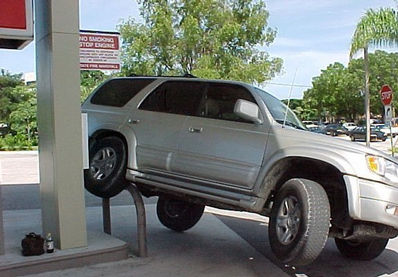
Most traffic fatalities in North America are caused by cars colliding with other cars or fixed objects. Most traffic fatalities in Korea are caused by cars hitting pedestrians at intersections.
These idiots don't stop behind the stop line, they stop on the crosswalks and end up hitting pedestrians crossing the street. Despite a new law fining drivers 60,000 won for failing to stop behind the line (stiffer penalties can also be assessed), so far drivers have not changed their habits and people are still getting hurt. Korean drivers expect pedestrians to get off the crosswalk, even when you have a walk signal and they have a red light.
It is even less safe where there is only a crosswalk, not an intersection. Most Korean drivers will speed through, honking and expecting pedestrians to run out of their way, sometimes committing a hit and run without concern for the person they injured.
In 2002, two US soldiers accidentally killed two teenage girls who ran into the street against a red light and it's a national tragedy. Koreans drive like maniacs and kill 500 people in Seoul alone annually and it's just a statistic. Maybe Josef Stalin was right.
A Treadmill For Jogging
If you are serious about jogging, you can purchase a new low-end treadmill for about C$700, or pick one up in used stores for even less. Some people might think this unnecessary, but given the lack of concern for safety Korean drivers have (and that they park on the sidewalks) finding places in Seoul that are safe to jog is difficult.
The public trails I mentioned for mountain biking are good for some people, but if concrete causes you shin splints like it does to me, running on them can be very painful. Even if you can run on the trails, pollution in Seoul is a serious problem and not advisable for two reasons.
First is the seasonal problem of the "yellow wind", an arsenic tainted dust from China's mining industry that blows over in spring and a few other times of the year. Regular warnings are given by the government for children, the elderly and asthmatics to avoid going outside. I myself have suffered two throat infections because the yellow wind. Second, the massive number of cars on the road and the "heat island" effect of large cities combined intensifies the effects of of carbon dioxide in the air, and health warnings are issued when the CO2 content is high.
 Smokers are buttheads |
 Buying yourself a treadmill may be the only way to stay healthy in Seoul.
There's one good point: since Lee Bong Ju won the Boston Marathon a few years ago, the bandwagon effect has made jogging popular and lowered the price for various jogging goods (clothes, treadmills, etc.). Check the newspapers and magazines regularly for any deals or people leaving the country who want to sell one.
Medical Plan Card
Employers sponsoring teachers on E-2 visas are required to provide a medical card to employees. The card gives you a reduced rate for a regular doctor's office visit and a fixed deductible if you should need to use a hospital. Because employers are required to pay for the card themselves, many stall and waste time in getting the cards in attempts to save money. This is illegal and should not be tolerated.
Your employer has an obligation to provide you with one, so DO NOT let him or her get away with it. Make sure you have full medical coverage as soon as possible. Hospital bills in Korea can run into thousands of dollars without it, and even a visit to a GP can be overpriced without a card. You cannot know ahead of time when you will be sick.
Cellphone
Living in Korea without a cellphone is like buying a car without wheels. Soon after you get here, you will need to buy one, no matter what kind of person you are. In fact, buying one may not be a choice: employers provide apartments as part of the contract, but that does not necessarily mean there is a phone included in the apartment.
If you really want all the bells, whistles and toys of the latest model of phones you can get it, but why bother? Are you really going to take a phone with Korean text back to Canada when you leave? At the same time, bringing a phone from overseas may not be a good idea either. Depending on the Korean telephone company (they are sometimes more restrictive than Bell Canada or Telus) you may not be able to use the CDMA or GSM phone you bring.
Realistically, it's best to buy a used phone because making calls and taking calls is what you really need. There are many available for sale, and once you have your E-2 work visa card, you can obtain a phone number in your name for very little money. The cost of setting up a usable phone that you can throw away at the end makes this a good option. If you do shop for a used phone, check the battery life and weight of a phone, those are the most important factors, not taking pictures or having the latest model.
There are two benefits to getting a cellphone, even if your apartment has a land line. First, you can reach anyone at anytime from anywhere in the city, and even make international calls. Second and more important, a cellphone gives you privacy. Not privacy from your roommates, but from your employer. He can see the phone bill for the land line in your apartment but not for your cellphone, and many employers try to protect their investment by watching and stalking their employees. Do you always want your employer to know who you are calling? (See also below about having a mailbox, it is just as important.)
Home Internet Service
Several companies in Korea provide internet service at home. If you have a PC or a laptop, it is worth it at 40,000 won per month for unlimited use. The set up fees are low and the installation can be done very quickly. Korea, along with Canada, the US, and Finland, is amongst the most "wired" countries in the world. (So much so it is a hotbed of "professional" computer game players. There is even a TV channel where you watch people playing online games.)
PC Bang (PC rooms) are can be found everywhere and they charge only 1000 won per hour to use, but if you object to smoking from the buttheads sitting around you, you are SOL without a home DSL. Koreans are probably the world's most inconsiderate smokers and you will find the PC Bangs are full of them. (See Part 9: "Stick It Out" on Korean attitudes toward smoking.) In my time here, I have seen a grand total of one PC Bang that had a non-smoking area, and even then the assholes still expect to smoke in the cleaner section.
I asked an English speaking Korean why he smoked in the non-smoking section. His answer: "I don't like breathing other people's smoke." His stupidity was astounding.
|
Renting a PO Box for a year costs very little money. The only trouble with having one is that the office recently (Spring 2004) moved from an inconvenient location to an even worse one. If it's so inconvenient, why am I suggesting you rent one? I said before that having a cellphone gives you privacy from your employer. A PO Box provides the same privacy.
You can receive your mail through your employer, and it is very convenient. But is it worth it? Employers, mine and other people's, may not open big packages but they will open letter mail, even if it is marked private or confidential. Do you really want letters from your family opened by them? Or letters from your boyfriend or girlfriend? (Especially worrisome for gays and lesbians because most Koreans believe the myth of the gay paedophile.)
How about your credit card bills, both for reasons of security and privacy? (Do you really want people knowing what you buy? Or one bad apple taking your credit card number using your it illicitly?) If you receive mail at your place of employment, this can and does happen. A PO Box may be inconvenient to get to, but it guarantees your employer can't read your mail.
Speed is another good reason to get a mailbox. Street addresses as we know them in North America don't exist in Korea and receiving mail at any building or house (including your workplace) is ridiculous, taking upwards of two weeks for regular mail. Letters coming to Korea will usually be in English or other European languages. Addresses must be translated into Korean by hand, and then delivered through Seoul's ludicrous street system.
Receiving mail at a PO Box, however, takes only a week on average. Letters addressed to PO Boxes usually do not need translation and are sent quickly to a central location. You have to do the footwork, but the delivery will always be faster. Trust my experience, it's worth the effort.
Letters and packages should be addressed like this. The image was taken
directly from the Korea Post website.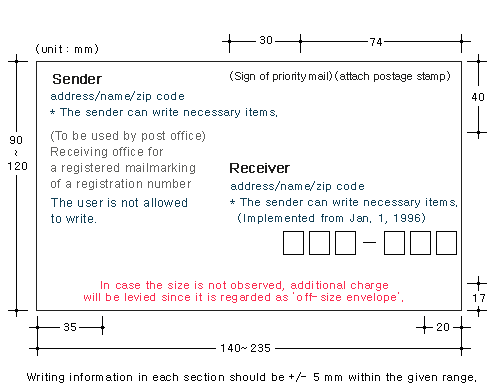
|
If you need to get mail right way or aren't inclined to get a mailbox, you can receive mail by "General Delivery" while in Korea. Just have the person sending the mail use this address:
|
Your name Poste Restante Seoul Central Post Office Seoul 100-011 Korea |
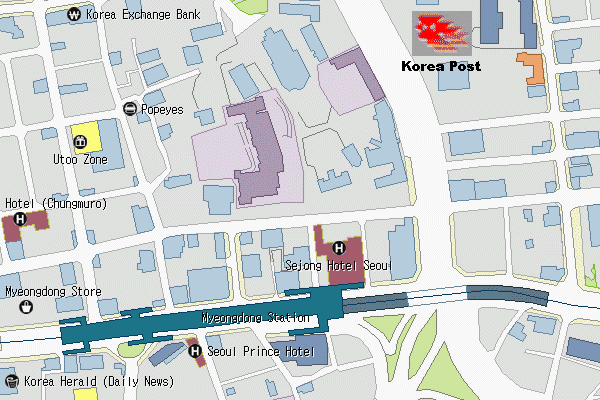
 Korea Post |
|
Click here for the map if you block pop-up windows |
In closing
These are all the things I can think of that helped myself and others. If you have been here and have any suggestions to add, feel free to submit them by visiting the Feedback page.
Back to the front page