Dr Elham AlBassam
Anglo-Arab Literary and Cultural Relations
290 and
272
Contact Me : [email protected]
|
|
|
|
|
Exam 10 (Fiction) |
Drama and Poetry |
|
Handouts and oline Texts:
1.click Here (for Tawfiq Sayigh,Muhammad al-Maghut and Jabra Ibrahim Jabra{Click
Here to read a
clearer copy of Jabra's}) and Here ( for Khalil Hawi,
Badar Shakir al-Sayyab and Riyyad Najib Al-Rayyis) ,Here ( for Adunis and Albayyati)
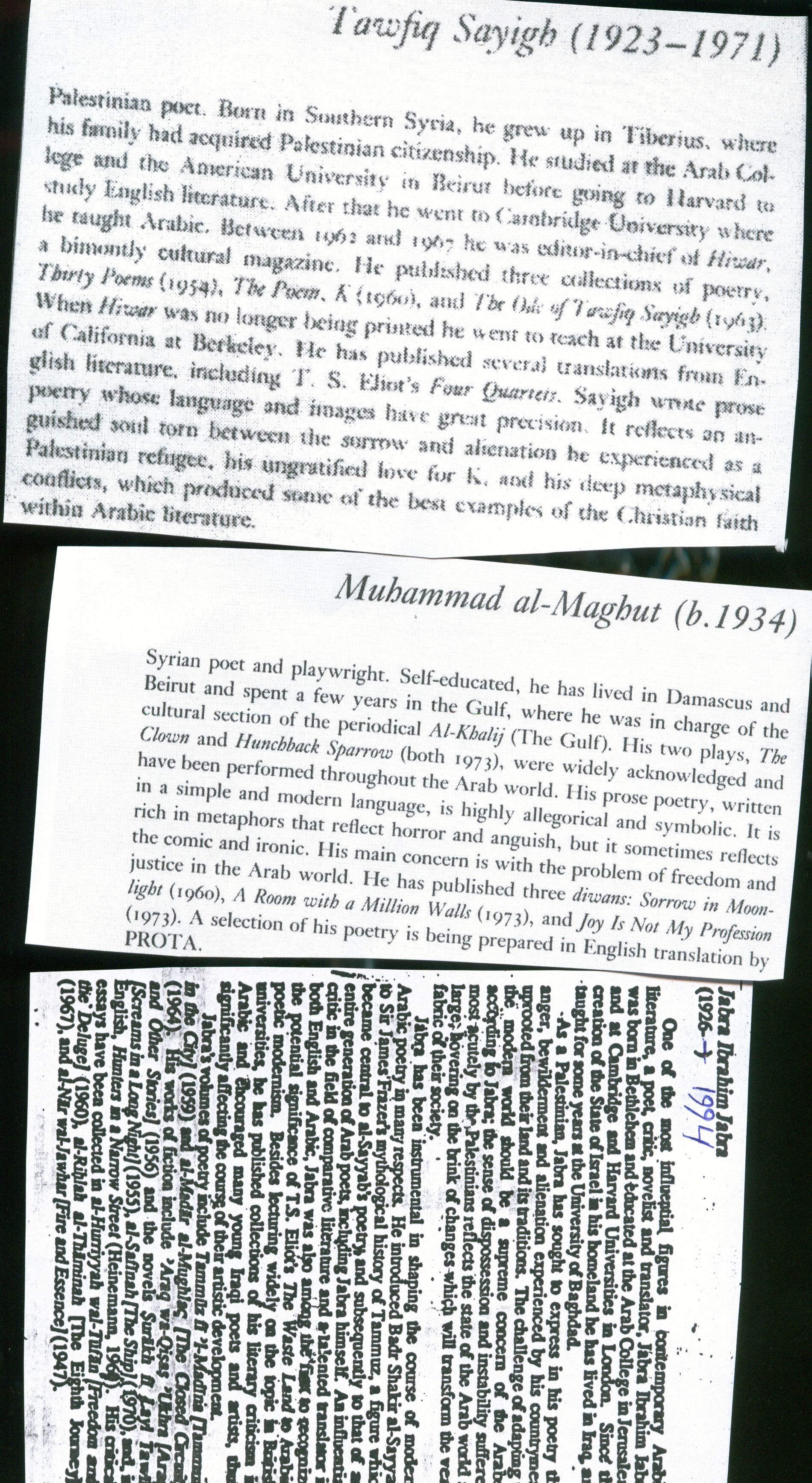
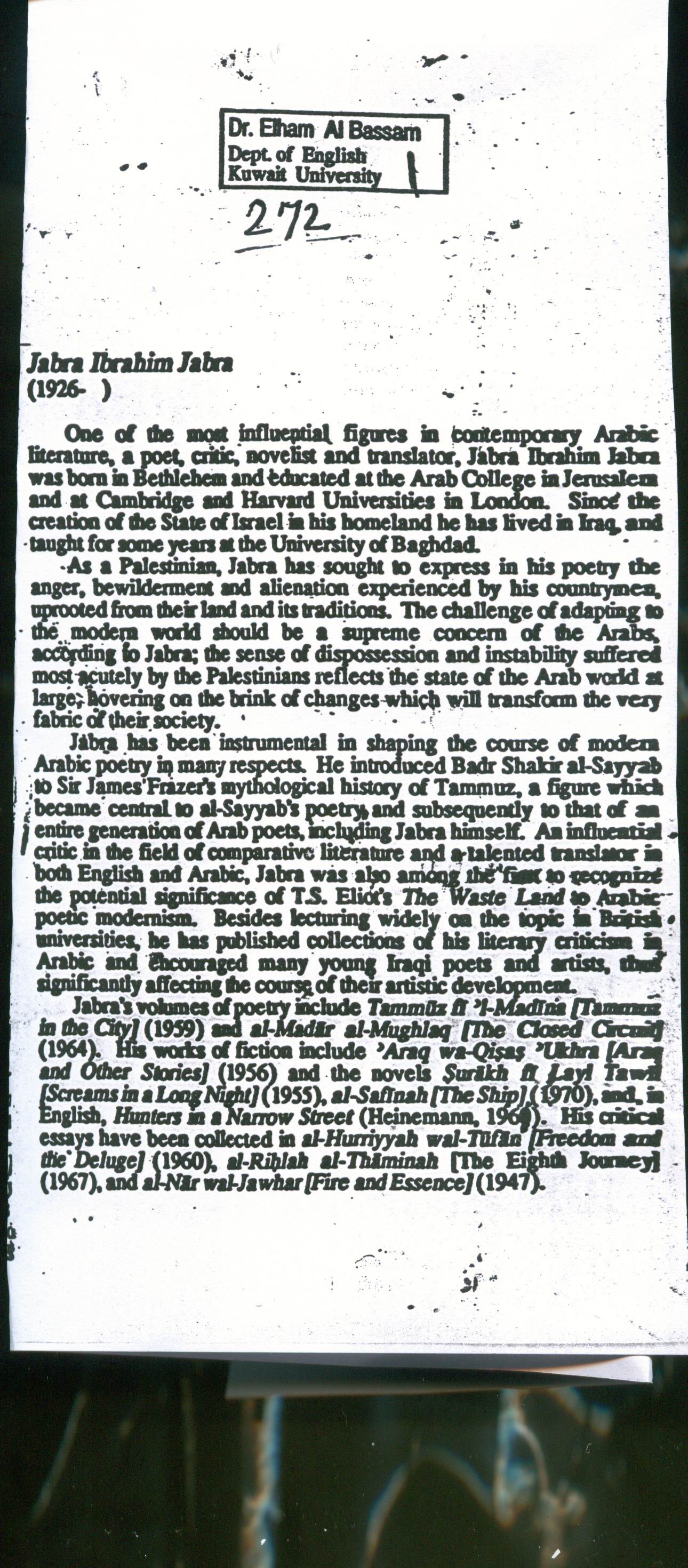
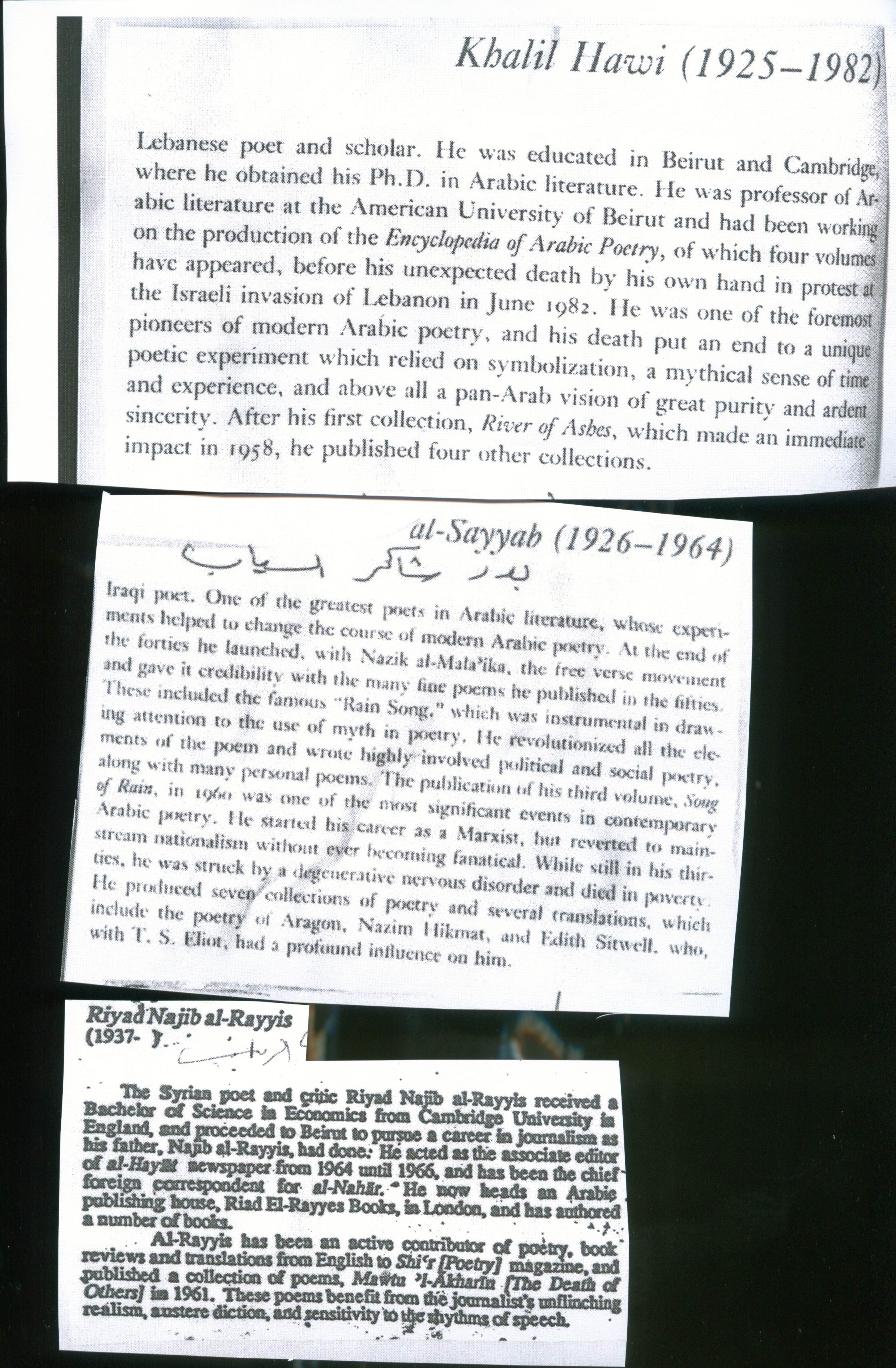
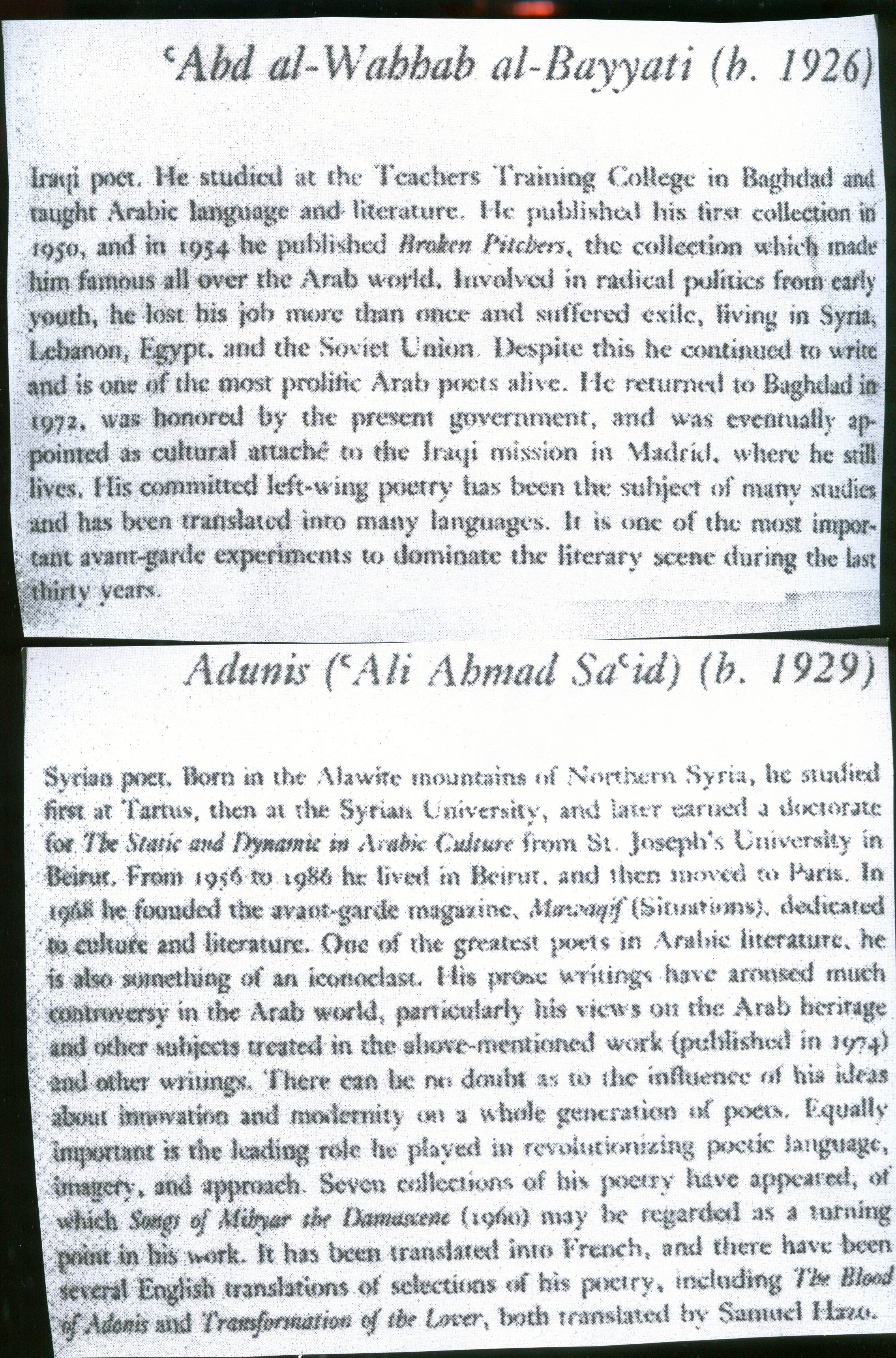
Click Here for the nine poets mentioned above in 1.
Click Here to read Jabra's
article on 'The Rebels, the Committed, and the Others'
2.Here for Arab woman as poets
in Arabic: Here for
Saad Al-Sabah , a Kuwaiti
Poet
(Click Here for Nazik al-Malaka in Arabic :
الكوليرا
والافعوان
and Here for Nazil Al-Malaka a brief bio in English, two essays in Arabic,
poems in English and a short story in Arabic).
3.Click Here to read an
article on" Modern Arabic Poetry: Vision and Reality"
4. Gayatri Chakravorty Spivak , Death of
a Discipline: click Here1, Here2,and Here3
for brief bio of Spivak, click Here for summary
of Death of a Discipline, click Here
for review of Death of a Discipline,
click Here
for another review, and click Here
for review of Spivak's The Intervention
4.Click Here
for Susan Bassnett's ' Reflections on Comparative Literature in the Twenty-First Century' in which
its author refers to G.C.Spivak's Death of a
Discipline ( click Here for a pdf copy)
5. 6. Click Here
for the image of the Arab woman in Frankenstein by Mary Shelley and the
influence of The Arabian Nights , Alph lala
Click Here
to read the
novel , Frankenstein
7. Click Here to read to read Candide
Ch 27: 'Candide's
Voyage to
8. Click Here
to read Vathek An Arabian Tale
by William Beckford
( 1760-1844)
9. Arabic Poetry in English Translation :click Here
for Al-Sayyab's Poetry , Here
for Adonis's Mihyar Songs, and click Here for
Al-Bayati's 'Love and Death' and 'Secret of
fire'( or click Here
to watch Al-Bayati's in power point)
Students' Presentations :
1. Click Here for 'Nazik Al-Mala'ka as a Rebel'(a Power point Presentation ,each time click to read new information till you reach 'End')
2. Click Here
for 'Gayatri Chakravorty Spivak , Death of a Discipline : The
first chapter of the book 'Crossing
Borders' (a Power point Presentation ,each time click to read new information till you reach 'End')
See the following Links:
Postcolonial
Literature: Problems
with the Term
How to prepare your
presentation
See Below Eliot’s Poetry
See the following :
Golgotha(k l´v
l´v r) (KEY)
[Lat.,=a skull] or Golgotha (gl´gth) (KEY)
[Heb.,=a skull], in the Gospels, place where Jesus was crucified, outside what
was then the wall of
r) (KEY)
[Lat.,=a skull] or Golgotha (gl´gth) (KEY)
[Heb.,=a skull], in the Gospels, place where Jesus was crucified, outside what
was then the wall of
Free Verse :Free verse, term loosely used for rhymed or
unrhymed verse made free of
conventional and traditional limitations and restrictions in regard to
metrical structure. Cadence,
especially that of common speech, is often substituted for regular metrical pattern. Free verse
is a literal translation of the French
vers
libre, which originated in late 19th-century France
among poets, such as Arthur Rimbaud
and Jules Laforgue, who sought to free poetry from
the metrical regularity of the
alexandrine. The term has also been applied by modern literary critics to the
King James translation of the Bible, particularly the Song of Solomon and the Psalms, to
certain poems of Matthew Arnold, and
to the irregular poetry of Walt Whitman's Leaves of Grass. The form is probably most closely associated with such
English and American poets as Ezra
Pound, Amy Lowell, and T. S. Eliot who sought greater liberty in verse structure. Other poets who used the free
verse form were William Carlos
Williams, Carl Sandburg, and Marianne Moore. (The
.
|
1988, Oct. 13 |
|
|
|
The Nobel Prize for literature was awarded to NAGUIB MAHFUZ (b. 1911-2006), the most
famous novelist in modern Arabic literature and the author primarily
responsible for developing the novel as a literary form in Arabic. He was the
first Arab author to win the prize. |
|
|
|
1991 |
|
|
|
Death of Yusuf Idris, one of the
great Arab literary figures of the 20th century. Educated as a doctor, he
achieved distinction for his novels, short stories, plays, and journalism. |
Objective Correlative
(http://www.geocities.com/elmbsm272/objecivecorrelative.html
)
T.S.Eliot’s File ( From 1-4)
1. Eliots : Life And Poetry:( From a –c)
Table of Contents :
a.T. S. Eliot : Life :
b. The Love Song of
J. Alfred Prufrock
c . The
a.a.T.S. Eliot (1888 - 1965)
T(homas) S(tearns)
Eliot was born in St. Louis in 1888 to a family with prominent New England
roots. Eliot largely abandoned his Midwestern roots and chose to ally himself with
both New and old England throughout his life. He attended Harvard as an
undergraduate in 1906, was accepted into the literary circles, and had a
predilection for 16th- and 17th-century poetry, the Italian Renaissance
(particularly Dante), Eastern religion, and philosophy. Perhaps the greatest
influence on him, however, were the 19th-century French Symbolists such as
Charles Baudelaire, Arthur Rimbaud, Stephene Mallarme, and Eliot's favorite, Jules Laforgue.
Eliot took from them their sensual yet precise attention to symbolic images, a
feature that would be the hallmark of his brand of Modernism.
Eliot also earned a master's degree from Harvard in 1910 before studying
in Paris and Germany. He settled in England in 1914 at the outbreak of World
War I, studying at Oxford, teaching, and working at a bank. In 1915 he married
British writer Vivienne Haigh-Wood (they would
divorce in 1933), a woman prone to poor physical and mental health, and in
November of 1921, Eliot had a nervous breakdown.
By this time Eliot had already achieved great success in 1917 with his
first book of poems, Prufrock and Other Observations
(which included "The Love Song of J. Alfred Prufrock,"
a work begun in his days at Harvard). Eliot's reputation was bolstered by the
admiration and aid of esteemed contemporary poet Ezra Pound, the other tower of
Modernist poetry. During Eliot's recuperation from his breakdown in a Swiss
sanitarium, he wrote "The Waste Land." A couple of months later he
gave Pound the manuscript in Paris. Thanks to Pound's heavy editing, as well as
suggestions (specifically about scenes relevant to their stormy, hostile
marriage) from Haigh-Wood, "The Waste
Land," published in 1922, defined Modernist poetry and became possibly the
most influential poem of the century. Devoid of a single speaker's voice, the
poem ceaselessly shifts its tone and form, instead grafting together numerous
allusive voices from Eliot's substantial poetic repertoire; Dante shares the
stage with nonsense sounds (a technique that also showcases Eliot's dry wit).
Believing this style best represented the fragmentation of the modern world,
Eliot focused on the sterility of modern culture and its lack of tradition and
ritual. Despite this pessimistic viewpoint, many find its mythical, religious
ending hopeful about humanity's chance for renewal.
Eliot was now the voice of Modernism, and in London he expanded the
breadth of his writing. In addition to writing poetry and editing it for
various publications (he also founded the quarterly Criterion in 1922, editing
it until its end in 1939), he wrote philosophical reviews and a number of
critical essays. Many of these, such as "Tradition and the Individual
Talent," have become classics, smartly and affectionately dissecting other
poets while subliminally informing us about Eliot's own work. Eliot defined his
preference for poetry that does away with the poet's own personality, and
poetry that uses the "objective correlative" of symbolic, meaningful,
and often chaotic concrete imagery.
Eliot joined the Church of England in 1927, and his work afterward
reflects his Anglican attitudes. The six-part poem "Ash Wednesday"
(1930) and other religious works in the early part of the 1930s, while stellar
in their own right, retrospectively feel like a warm-up for his epic "Four
Quartets" (completed and published together in 1943). Eliot used his wit,
philosophical preoccupation with time, and vocal range to examine further
religious issues.
Eliot continued his Renaissance man ways by writing his first play,
"Murder in the Cathedral," in 1935. A verse drama about the murder of
Archbishop Thomas à Becket, the play's religious
themes were forerunners of Eliot's four other major plays, "The Family
Reunion" (1939), "The Cocktail Party" (1949), "The Confidential
Clerk" (1953), and "The Elder Statesman" (1959). Religious verse
dramas cloaked in secular conversational comedy, Eliot belied whatever
pretensions his detractors may have found in his Anglophilia.
He leapt ahead with this anti-pretension with "Old Possum's Book of
Practical Cats" (1939), a book of verse for children that was eventually
adapted into the Broadway musical "Cats."
As one might expect from his work, Eliot was unhappy for most of his
life, but his second marriage in 1957 proved fruitful. When he died in 1965, he
was the recipient of a Nobel Prize (1948), author of the century's most
influential poem, and arguably the century's most important poet. Perhaps due
to the large shadow he casts, relatively few poets have tried to ape his style;
others simply find him cold. Still, no one can escape the authority of Eliot's
Modernism, one as relevant today as it was in 1922. While Eliot may not have as
much influence on poets today as some of his contemporaries, he has had a far
greater impact on poetry.
b . The
Love Song of J. Alfred Prufrock
S'io
credesse che mia risposta fosse
A persona che mai tornasse al mondo,
Questa fiamma staria senza piu scosse.
Ma perciocche giammai di questo fondo
Non torno vivo alcun, s'i'odo il vero,
Senza tema d'infamia ti rispondo.
Let us go then, you and I,
When the evening is spread out against the sky
Like a patient etherised upon a table;
Let us go, through certain half-deserted streets,
The muttering retreats
Of restless nights in one-night cheap hotels
And sawdust restaurants with oyster-shells:
Streets that follow like a tedious argument
Of insidious intent
To lead you to an overwhelming question. . .
Oh, do not ask, "What is it?"
Let us go and make our visit.
In the room the women come and go
Talking of Michelangelo.
The yellow fog that rubs its back upon the window-panes
The yellow smoke that rubs its muzzle on the window-panes
Licked its tongue into the corners of the evening
Lingered upon the pools that stand in drains,
Let fall upon its back the soot that falls from chimneys,
Slipped by the terrace, made a sudden leap,
And seeing that it was a soft October night,
Curled once about the house, and fell asleep.
And indeed there will be time
For the yellow smoke that slides along the street,
Rubbing its back upon the window-panes;
There will be time, there will be time
To prepare a face to meet the faces that you meet;
There will be time to murder and create,
And time for all the works and days of hands
That lift and drop a question on your plate;
Time for you and time for me,
And time yet for a hundred indecisions
And for a hundred visions and revisions,
Before the taking of a toast and tea.
In the room the women come and go
Talking of Michelangelo.
And indeed there will be time
To wonder, "Do I dare?" and, "Do I
dare?"
Time to turn back and descend the stair,
With a bald spot in the middle of my hair --
[They will say: "How his hair is growing thin!"]
My morning coat, my collar mounting firmly to the chin,
My necktie rich and modest, but asserted by a simple pin --
[They will say: "But how his arms and legs are thin!"]
Do I dare
Disturb the universe?
In a minute there is time
For decisions and revisions which a minute will reverse.
For I have known them all already, known them all: --
Have known the evenings, mornings, afternoons,
I have measured out my life with coffee spoons;
I know the voices dying with a dying fall
Beneath the music
from a farther room.
So how should I presume?
And I have known the eyes already, known them all --
The eyes that fix you in a formulated phrase,
And when I am formulated, sprawling on a pin,
When I am pinned and wriggling on the wall,
Then how should I begin
To spit out all the butt-ends of my days and ways?
And how should I presume?
And I have known the arms already, known them all --
Arms that are braceleted and white and bare
[But in the lamplight, downed with light brown hair!]
Is it perfume from a dress
That makes me so digress?
Arms that lie along a table, or wrap about a shawl.
And should I then presume?
And how should I begin?
. . . . .
Shall I say, I have gone at dusk through narrow streets
And watched the smoke that rises from the pipes
Of lonely men in shirt-sleeves, leaning out of windows? . . .
I should have been a pair of ragged claws
Scuttling across the floors of silent seas. . . . . .
And the afternoon, the evening, sleeps so peacefully!
Smoothed by long fingers,
Asleep . . tired . . or it malingers,
Stretched on the floor, here beside you and me.
Should I, after tea and cakes and ices,
Have the strength to force the moment to its crisis?
But though I have wept and fasted, wept and prayed,
Though I have seen my head [grown slightly bald] brought in upon a
platter,
I am no prophet -- and here's no great matter;
I have seen the moment of my greatness flicker,
And I have seen the eternal Footman hold my coat, and snicker,
And in short, I was afraid.
And would it have been worth it, after all,
After the cups, the marmalade, the tea,
Among the porcelain, among some talk of you and me,
Would it have been worth while,
To have bitten off the matter with a smile,
To have squeezed the universe into a ball
To roll it toward some overwhelming question,
To say: "I am Lazarus, come from the dead,
Come back to tell you all, I shall tell you all" --
If one, settling a pillow by her head,
Should say, "That is not what I meant at all.
That is not it, at all."
And would it have been worth it, after all,
Would it have been worth while,
After the sunsets and the dooryards and the sprinkled streets,
After the novels, after the teacups, after the skirts that trail along
the floor --
And this, and so much more? --
It is impossible to say just what I mean!
But as if a magic lantern threw the nerves in patterns on a screen:
Would it have been worth while
If one, settling a pillow or throwing off a shawl,
And turning toward the window, should say:
"That is not it at all,
That is not what I meant, at all." . . . . .
No! I am not Prince Hamlet, nor was meant to be;
Am an attendant lord, one that will do
To swell a progress, start a scene or two
Advise the prince; no doubt, an easy tool,
Deferential, glad to be of use,
Politic, cautious, and meticulous;
Full of high sentence, but a bit obtuse;
At times, indeed, almost ridiculous --
Almost, at times, the Fool.
I grow old . . . I grow old . . .
I shall wear the bottoms of my trousers rolled.
Shall I part my hair behind? Do I dare to eat a peach?
I shall wear white flannel trousers, and walk upon the beach.
I have heard the mermaids singing, each to each.
I do not think they will sing to me.
I have seen them riding seaward on the waves
Combing the white hair of the waves blown back
When the wind blows the water white and black.
We have lingered in the chambers of the sea
By sea-girls wreathed with seaweed red and brown
Till human voices wake us, and we drown.
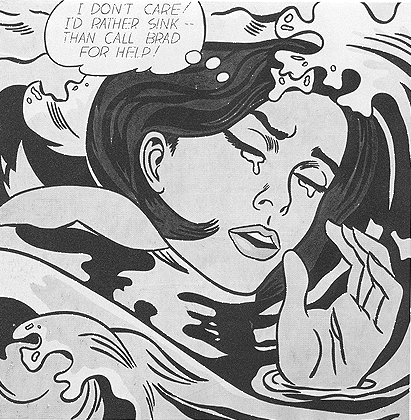
c. The Waste Land (1922
)
Part 1
- Burial of the Dead
April is the cruellest month, breeding
Lilacs out of the dead land, mixing
Memory and desire, stirring
Dull roots with spring rain.
Winter kept us warm, covering
Earth in forgetful snow, feeding
A little life with dried tubers.
Summer surprised us, coming over the Starnbergersee
With a shower of rain; we stopped in the colonnade,
And went on in sunlight, into the Hofgarten
And drank coffee, and talked for an hour.
Bin gar keine Russin, stamm' aus Litauen,
echt deutsch.
And when we were children, staying at the arch-duke's,
My cousin's, he took me out on a sled,
And I was frightened. He said, Marie,
Marie, hold on tight. And down we went.
In the mountains, there you feel free.
I read, much of the night, and go south in the winter.
What are the roots that clutch, what branches grow
Out of this stony rubbish? Son of man,
You cannot say, or guess, for you know only
A heap of broken images, where the sun beats,
And the dead tree gives no shelter, the cricket no relief,
And the dry stone no sound of water. Only
There is shadow under this red rock,
(Come in under the shadow of this red rock),
And I will show you something different from either
Your shadow at morning striding behind you
Or your shadow at evening rising to meet you;
I will show you
fear in a handfull of dust.
Frish
weht der Wind
Der Heimat zu
Mein
Irisch Kind,
Wo weilest du?
'You gave me hyacinths first a year ago;
They called me the hyacinth girl.'
--Yet when we came back, late, from the <hhyacinth
garden,
Your arms full and your hair wet, I could not
Speak, and my
eyes failed, I was neither
Living nor dead, and I knew nothing,
Looking into the heart of light, the silence.
Oed'und leer das Meer.
Madame Sosostris, famous clairvoyante,
Had a bad cold, nevertheless
Is known to be the wisest woman in Europe,
With a wicked pack of cards. Here, said she,
Is your card, the drowned Phoenician Sailor,
(Those are pearls that were his eyes. Look!)
Here is Belladonna, the Lady of the Rocks,
The lady of situations.
Here is the man with three staves, and here the Wheel,
And here is the one-eyed merchant, and this card,
Which is blank, is something he carries on his back,
Which I am forbidden to see. I do not find
The Hanged Man. Fear death by water.
I see crowds of people, walking round in a ring.
Thank you. If you see dear Mrs. Equitone,
Tell her I bring the horoscope myself:
One must be so careful these days.
Unreal City,
Under the brown fog of a winter dawn,
A crowd flowed over London Bridge, so many,
I had not thought death had undone so many.
Sighs, short and infrequent, were exhaled,
And each man fixed his eyes before his feet.
Flowed up the hill and down King William Street,
To where Saint Mary Woolnoth kept the hours
With a dead sound on the final stroke of nine.
There I saw one I knew, and stopped him, crying: 'Stetson!
'You who were with me in the ships at Mylae
'That corpse you planted last year in your garden,
'Has it begun to sprout? Will it bloom this year?
'Or has the sudden frost disturbed its bed?
'O keep the Dog far hence, that's friend to men,
'Or with his nails he'll dig it up again!
'You! hypocrite lecteur!--mon
semblable,--mon frere!'
Part 2
- A Game of Chess
The Chair she sat in, like a burnished throne,
Glowed on the marble, where the glass
Held up by standards wrought with fruited vines
From which a golden Cupidon peeped out
(Another hid his eyes behind his wing)
Doubled the flames of seven-branched candleabra
Reflecting light upon the table as
The glitter of her jewels rose to meet it,
From satin cases poured in rich profusion.
In vials of ivory and coloured glass
Unstoppered, lurked her strange synthetic perfume
Unguent, powdered, or liquid--troubled, vondused
And drowned the sense in odours; stirred by the air
That freshened from the window, these ascended
In fattening the prolonged candle-flames,
Flung their smoke into the laquearia,
Stirring the pattern on the coffered ceiling.
Huge sea-wood fed with copper
Burned green and orange, framed by the colored stone
In which sad light a carved dolphin swam
Above the antique mantel was displayed
As though a window gave upon the sylvan scene
The change of Philomel, by the barbarous king
So rudely forced; yet there the nightingale
Filled all the desert with inviolable voice
And still she cried, and still the world pursues,
'Jug Jug' to dirty
ears.
And other withered stumps of time
Were told upon the walls; staring forms
Leaned out, leaning, hushing the room enclosed.
Footsteps shuffled on the stair.
Under the firelight, under the brush, her hair
Spread out in fiery points
Glowed into words, then would be savagely still.
'My nerves are bad t-night. Yes, bad. Stay with me.
'Speak to me. Why do you never speak? Speak.
'What are you thinking of? What thinking? What?
'I never know what you are thinking. Think.'
I think we are in rat's alley
Where the dead men lost their bones.
'What is that noise?'
The wind under the door.
'What is that noise now? What is the wind doing?'
Nothing again nothing.
'Do
'You know nothing? Do you see nothing? Do you remember
'Nothing?'
I remember
Those pearls that were his eyes.
'Are you alive, or not? Is there nothing in your head?'
But
O O O O
that Shakespeherian Rag--
It's so elegant
So intelligent
'What shall I do now? What shall I do?'
'I shall rush out as I am, walk the street
'With my hair down, so. What shall we do to-morrow?
'What shall we ever do?
The hot water at ten.
And if it
rains, a closed car at four.
And we shall play a game of chess,
Pressing lidless eyes and waiting for a knock upon the door.
When Lil's husband got demobbed,
I said--
I didn't mince my words, I said to her myself,
HURRY UP PLEASE ITS TIME
Now Albert's coming back, make yourself a bit smart.
He'll want to know what you done with that money he gave you
To get yourself some teeth. He did, I was there.
You have them all out, Lil, and get a nice set,
He said, I swear, I can't bear to look at you.
And no more can't I, I said, and think of poor Albert,
He's been in the army for four years, he wants a good time
And if you don't give it him, there's others will, I said.
Oh is there, she said. Something o' that, I said.
Then I'll know who to thank, she said, and give me a straight look.
HURRY UP PLEASE ITS TIME
If you don't like it you can get on with it, I said.
Others can pick and choose if you can't.
But if Albert makes off, it won't be for lack of telling.
You ought to be ashamed, I said, to look so antique.
(And her only thirty-one.)
I can't help it, she said, pulling a long face,
It's them pills I took, to bring it off, she said.
(She had five already and nearly died of young George.)
The chemist said it would be all right, but I've never been the same.
You are a proper fool, I said.
Well, if Albert won't leave you alone, there it is, I said,
What you get married for if you don't want children?
HURRY UP PLEASE ITS TIME
Well, that Sunday Albert was home, they had a hot gammon
And they asked me in to dinner, to get the beauty of it--
HURRY UP PLEASE ITS TIME
HURRY UP PLEASE ITS TIME
Goodnight Bill. Goodnight Lou. Goodnight May. Goodnight.
Ta ta. Goodnight. Goodnight.
Good night, ladies, good night, sweet ladies, good night, good night.
Part 3
- The Fire Sermon
The river's tent is broken: the last fingers of leaf
Clutch and sink into the wet bank. The wind
Crosses the brown land, unheard. The nymphs are departed.
Sweet Thames, run softly, till I end my song.
The river bears no empty bottles, sandwich papers,
Silk handkerchiefs, cardboard boxes, cigarette ends
Or other testimony of summer nights. The nymphs are departed.
And their friends, the loitering heirs of City directors;
Departed, have left no addresses.
By the waters of Leman I sat down and wept...
Sweet Thames, run softly till I end my song,
Sweet Thames, run softly, for I speak not loud or long.
But at my back in a cold blast I hear
The ratttle of bones, and chuckle spread from
ear to ear.
A rat crept softly through vegetation
Dragging its slimy belly on the bank
While I was fishing
in the dull canal
On a winter evening round behind the gashouse
Musing upon the king my brother's wreck
And the king my father's death before him.
White bodies naked on the low damp ground
And bones cast in a little low dry garret,
Rattled by the rat's foot only, year to year.
But at my back from time to time I hear
The sound of horns and motors, which shall bring
Sweeney to Mrs. Porter in the spring.
O the moon shone bright on Mrs. Porter
And on her daughter
They wash their feet in soda water
Et O ces voix d'enfants, chantant dans la coupole!
Twit twit twit
Jug jug jug jug jug jug
So rudely forc'd
Under the brown fog of a winter
Mr. Eugenides, the
Unshaven, with a pocket full of
currants
C.i.f. London: documents at sight,
Asked me in demotic French
To luncheon at the Cannon Street Hotel
Followed by a weekend at the Metropole.
At the violet hour, when the eyes and back
Turn upward from the desk, when the human engine waits
Like a taxi throbbing waiting,
I Tiresias, though blind, throbbing between two
lives,
Old man with wrinkled female breasts, can see
At the violet hour, the evening hour that strives
Homeward, and brings the sailor home from sea,
The typist home at teatime, clears her breakfast, lights
Her stove, and lays out food; in tins.
Out of the window perilously spread
Her drying combinations touched by the sun's last rays,
On the divan are piled (at night her bed)
Stockings, slippers, camisoles, and stays.
I Tiresias, old man with wrinkled dugs
Perceived the scene, and foretold the rest--
I too awaited the expected guest.
He, the young man carbuncular, arrives,
A small house agent's clerk, with one bold stare,
One of the low on whom assurance sits
As a silk hat on a Bradford millionaire.
The time is now propitious, as he guesses,
The meal
is ended, she is bored and tired,
Endeavours to engage her in caresses
Which are still unreproved, if undesired.
Flushed and decided, he assaults at one;
Exploring hands rencounter no defence;
His vanity requires no response,
And makes a welcome of indifference.
(And I Tiresias have foresuffered
all
Enacted on this same divan or bed;
I who have sat by Thebes below the wall
And walked amongh the lowest of the dead.)
Bestows one final patronising kiss,
And gropes his way, finding the stairs unlit...
She turns and looks a moment in the glass,
Hardly aware of her departed love;
Her brain allows one-half formed thought to pass:
'Well now that's done: and I'm glad it's over.'
When lovely woman stoops to folly and
Paces about her room again, alone,
She smooths her hair with automatic hand,
And puts a record on the gramaphone.
'This music crept by me upon the waters'
And along the Strand, up Queen Victoria Street.
O City city, I can sometimes hear
Beside a public bar in Lower Thames Street,
The pleasant whining of a mandolin
And a clatter and a chatter from within
Where fishmen lounge at noon: where the walls
Of Magnus Martyr hold
Inexplicable splendour of Ionian white and gold.
The river sweats
Oil and tar
The barges drift
With the turning tide
Red sails
Wide
To leeward, swing on the heavy spar.
The barges wash
Drifting logs
Down Greenwich reach
Past the Isle of Dogs.
Weialala
leia
Wallala
leialala
Elizabeth and Leicester
Beating oars
The stern was formed
A gilded shell
Red and gold
The brisk swell
Rippled both shores
Southwest wind
Carried down stream
The peal of bells
White towers
Weialala
leia
Wallala
leialala
'Trams and dusty trees
Highbury bore me. Richmond and Kew
Undid me. By Richmond I raised my knees
Supine on the floor of a narrow canoe.'
'My feet are Moorgate, and my heart
Under my feet. After the event
He wept. He
promised "a new start."
I made no comment. What should I resent?'
'On Margate Sands.
I can connect
Nothing with nothing.
The broken fingernails of dirty hands.
My people humble people who expect
Nothing.'
la la
To Carthage then I
came
Burning burning burning burning
O Lord Thou pluckest me out
O Lord Thou pluckest
burning
Part 4 - Death by Water
Phelbas the Phoenician, a fortnight dead,
Forgot the cry of gulls, and the deep sea swell
And the profit and loss.
A current under sea
Picked his bones in whispers. As he rose and fell
He passed the stages of his age and youth
Entering whirpool.
Gentile or Jew
O you who turn the wheel and look to windward,
Consider Phlebas, who was once handsome and tall as you.
Part 5
- What the Thunder Said
After the torchlight red on sweaty faces
After the frosty silence in the gardens
After the agony in stony places
The shouting and the crying
Prison and palace and reverberation
Of thunder of spring over distant mountains
He who was living is now dead
We who were living are now dying
With a little patience
Here is no water but only rock
Rock and no water and the sandy road
The road winding above among the mountains
Which are mountains of rock without water
If there were water we should stop and drink
Amongst the rock one cannot stop or think
Sweat is dry and feet are in the sand
If there were only water amongst the rock
Dead mountain mouth of carious teeth that cannot spit
Here one can neither stand nor lie nor sit
There is not even slience in the mountains
But dry sterile thunder without rain
There is not even solitude in the mountains
But red sullen faces sneer and snarl
From doors of mudcracked houses
If there were water
And no rock
If there were rock
And also water
And water
A spring
A pool among the rock
If there were
the sound of water only
And dry grass singing
But sound of water over a rock
Where the hermit-thrush sings in the pine trees
Drip drop drip drop drop drop
drop
But there is no water
Who is the third who walks always beside you?
When I count, there are only you and I together
But when I look ahead up the white road
There is always another one walking beside you
Gliding wrapt in a brown mantle, hooded
I do not know whether a man or a woman
--But who is that on the other side of
What is that sound high in the air
Murmur of maternal lamentation
Why are those hooded hordes swarming
Over endless plains, stumbling in cracked earth
Ringed by the flat horizon only
What is the city over the mountains
Cracks and reforms and burst in the violet air
Falling towers
Jerusalem Athens Alexandria
Vienna London
Unreal
A woman drew her long black hair out tight
And fiddled whisper music on those strings
And bats with baby faces in the violet light
Whistled, and beat their wings
And crawled head downward down a blackened wall
And upside down in air were towers
Tolling reminiscent bells, that kept the hours
And voices singing out of empty cisterns and exhausted wells
In this decayed hole among the mountains
In the faint moonlight, the grass is singing
Over the tumbled graves, about the chapel
There is an empty chapel, on the wind's home.
It has no windows, and the door swings,
Dry bones can harm no one.
Only a cock stood on the rooftree
Co co rico co co rico
In a flash of lightning. Then a damp gust
Bringing rain
Ganga was sunken, and the limp leaves
Waited for rain, while the black clouds
Gathered far distant, over Himavant.
The jungle crouched, humped in silence.
Then spoke the thunder
DA
Datta: what have we give?
My friend, blood shaking my heart
The awful daring of a moment's surrender
Which an age of prudence can never retract
By this, and this only, we have existed
Which is not to be found in our obituaries
Or in memories draped by the beneficient spider
Or under seals broken by the lean solicitor
In our empty rooms
DA
Dayadhvam: I have heard the key
Turn in the door once and turn once only
We think of the key, each in his prison
Thinking of the key, each confirms a prison
Only at nightfall, aethereal rumours
Revive for a moment a broken Coriolanus
DA
Damyata: The boat responded
Gaily, to the hand expert with sail and oar
The sea was calm, your heart would have responded
Gaily, when invited, beating obedient
To controlling hands
I sat upon the shore
Fishing, with arid plain behind me
Shall I at least set my lands in order?
London Bridge is falling down falling down falling down
Poi s'ascose nel foco che gli
affina
Quando fiam uti chelidon--O swallow swallow
Le Prince d'Aquitaine a la tour abolie
These fragments I have shored against my ruins
Why then Ile fit you. Hieronymo's
mad againe.
Datta. Dayadhvam. Damyata.
Shantih
Shantih
Shantih
2.T.S.Eliot and Symbolism
|
symbolists |
symbolists, in literature, a school originating in France toward the end of the 19th cent. in reaction to the naturalism and realism of the period. Designed to convey impressions by suggestion rather than by direct statement, symbolism found its first expression in poetry but was later extended to the other arts. The early symbolists experimented with form, revolting against the rigidity of the Parnassians with a free verse that has outlived the movement itself. The precursors of the school, all influenced by Baudelaire, included Verlaine, Mallarmé, and Rimbaud. They were accused of writing with a decadent morbidity, partly as the result of their utilization of imagination as a reality. The movement was continued in poetry by Laforgue, Moréas, and Régnier; in drama by Maeterlinck; in criticism by Remy de Gourmont; and in music by Debussy. Among the later symbolists were Claudel, Valéry, Jammes, and the critic Camille Mauclair. The influence of the French symbolists not only gave rise to similar schools in England, Germany, and other countries, but also may be traced in the development of the imagists and decadents; it is likewise evident in the work of Arthur Symons, T. S. Eliot, Marcel Proust, James Joyce, Gertrude Stein, Eugene O'Neill, Hart Crane, Wallace Stevens, Dylan Thomas, William Faulkner, and E. E. Cummings.
See C. M. Bowra, The Heritage of Symbolism (1943); W. K. Cornell, The Symbolist Movement (1970); A. Balakian, The Symbolist Movement (1967, repr. 1977) and ed., The Symbolist Movement in the Literature of European Languages (1982).( The Columbia Electronic Encyclopedia, 6th ed. Copyright © 2003, Columbia University Press. ).
3. An Article on Eliot
Dry,
Allusive, and Ambiguous: A Close Reading of "The Wasteland"
by Theoderek Wayne
T.S. Eliot peppers "The Wasteland," his apocalyptic poem, with
images of modern aridity and inarticulacy that contrast with fertile allusions
to previous times. Eliot's language details a brittle era, rife with wars
physical and sexual, spiritually broken, culturally decaying, dry and dusty.
His references to the Fisher King and mythical vegetation rituals imply that
the 20th-century world is in need of a Quester to
irrigate the land. "The Wasteland" refuses to provide a simple
solution; the properties of the language serve to make for an ambiguous
narrative and conclusion, one as confusing and fragmented as Eliot's era
itself.
Eliot wastes no time drawing out the first irony of the poem. In the
first lines of "The Burial of the Dead," the speaker comments on
Jesus' crucifixion and Chaucer while using brutal sounds to relate his
spiritual coldness in a warm environment. In "The General Prologue"
to The Canterbury Tales, Chaucer poetically writes "Whan
that April with his showres soote/
The droughte of March hath perced
to the roote,/ And bathed every veine
in swich licour,/ Of which vertu engrendred is the flowr" (Norton Anthology to English Literature, sixth
edition, vol. 1, p.81). For "The Wasteland's" speaker, "April is
the cruellest month, breeding/ Lilacs out of the dead
land, mixing/ Memory and desire, stirring/ Dull roots with spring rain"
(Norton Anthology of Poetry, fourth edition, p.1236, lines 1-4). The harsh
"c's" and muted "d's"
throughout point to the speaker's disenchantment with a world full of paradoxes
and dichotomies. The "mixing" of "Memory and desire" only
hurts him, as do all the verbs, which Eliot places at the ends of their lines
to intensify their importance and action in an otherwise dead land.
The speaker continues his rants against the world and shows a personality
at odds with normal conceptions of happiness. "Winter kept us warm"
he says, as the delayed alliteration pairs up an unlikely couple (5). The
speaker turns back time, and possibly changes identity, by reminiscing her childhood.
Nostalgia is an essential component of "The Wasteland"; here, it
relates a young girl's escapist techniques of reading in the mountains and
flying "south for the winter" like a bird, while later Eliot imposes
literary and historical significance upon the poem's allusions (18). Central to
these allusion are images of the death of spirituality.
In the second stanza, Eliot moves into a new motif, that of stones and
broken idols. He questions what became of his landscape: "What are the
roots that clutch, what branches grow/ Out of this stony rubbish? Son of man,/
You cannot say, or guess, for you know only/ A heap of broken images"
(19-23). The roots, which were previously dull, now clutch in a sexually
perverse image, and stem from a "stony rubbish" which is to be
repeated later as a figure of dryness. The "Son of man," noted by
Eliot as Ezekiel, lives in a pagan era of "broken images," and
parallels modern man in "know[ing] only"
such a corrupt time. Eliot develops the metaphor of stone as an object with
"no sound of water. Only/ There is shadow under this red rock"
(24-5). He again places "only" at the end of a line to draw the
reader's attention to it, forcing his audience to consider its relation to the
poem's character. Indeed, the speaker next addresses: "(Come in under the
shadow of this red rock),/ And I will show you something different from either/
Your shadow at morning striding behind you/ Or your shadow at evening rising to
meet you" (26-9). In "The Hollow Men," another meditation on
broken spirituality, several stanzas use the word "between" to
reflect its travelers paralyzed state between life and death: "Between the
conception/ And the creation/ Between the emotion/ And the response/ Falls the
Shadow" ("The Hollow Men," V.). Using this as a reference point,
"The Wasteland's" next line explicitly suggests the inevitability of
death: "I will show you fear in a handful of dust" (30).
That oncoming death is ironically compared to Wagner's romantic opera,
"Tristan und Isolde," and further distances
the speaker from any emotional attachment. Wagner's sailor song shows love's
dominance over distance‹"Fresh blows the wind/ toward home"‹and even
though the "hyacinth girl," a love-object in the form of a vegetation
ritual, has "arms full, andŠhair wet," the
speaker confesses "I could not/ Speak, and my eyes failed, I was neither/
Living nor dead, and I knew nothing" (footnote 8, 38-40). The girl's
fertility and moisture fails on the nihilistic speaker who straddles between
life and death, who struggles to see and to communicate. The theme of sight and
communication continues in the next stanza with Madam Sosostris,
a "famous clairvoyante" (43).
"Sosostris" itself is a word of
speech; the two instances of "os" in her
name suggest the Latin word for "mouth." She commands her audience to
regain his sight: "(ŒThose are pearls that were
his eyes. Look!'") (48). One of her cards is a "one-eyed
merchant" who "carries [something] on his back which" she is
"forbidden to see" (53-4). This lack of depth perception, both the
one-eyed man's and hers, leads her to issue the ironic command "Fear death
by water" (55). Yet is it ironic, that one should fear a death that
seemingly drenches the exsiccative landscape, or has
even the Grail that the speaker searches for, water, failed him? Sosostris concludes with a vision of "crowds of
people, walking round in a ring" (56). This ritual, devoid of any motion
or meaning and similar to the children's recitation and encircling of the
prickly pear in "The Hollow Men," favors the latter, that even a
Fisher King or some other Quester is unable to help
the land.
Eliot shifts into less abstract terms as he describes London, the
"Unreal City/ Under the brown fog of a winter dawn" as a land of the
marching dead. Again using irony to magnify the barrenness of the land, Eliot
describes the crowd that "flowed over London Bridge, so many/ I had not
thought death had undone so many./ Sighs, short and infrequent, were
exhaled" (62-4). These breathless lives of exhalations only become the
object of the speaker's sarcastic wrath: "'Stetson!/ ŒYou
who were with me in the ships at Mylae!/ ŒThat corpse you planted last year in your garden,/ ŒHas it begun to sprout? Will it bloom this year?/ ŒOr has the sudden frost disturbed its bed?" (69-73).
"Stetson," by association of his name and to the capitalist-driven
battle at Mylae, ties modern commercialism to the
death of rituals, in this case that of a corpse instead of vegetation. Jesse
Weston, in "The Golden Bough," states that broken lands in need of a
Quest fall under two categories: those where the infertility is precedent to
the Quest, and those where it is caused by a Hero's failure to answer the call.
Until this point, Eliot has refrained from fingering man as the root of the
waste land's problem, but in his description of vapid London, he seems to blame
man's own declining value system for his dying landscape.
Along with man's flawed values comes a flawed sense of communication. In
"A Game of Chess," a queen-like woman sits in furniture that fits her
magnificent yet empty existence: "The Chair she sat in, like a burnished
throne,/ Glowed on the marble, where the glass/ŠDoubled
the flamesŠ/ Reflecting light upon the table as/ The
glitter of her jewels rose to meet it" (77-8, 82-4). The rich, seductive
prose that lavishes words like "burnished," "glowed," and
"glitter" onto the woman's possessions implies that her worth is as
false as her "strange synthetic perfumes,/ Unguent, powdered, or
liquid‹troubled, confused/ And drowned the sense of odours;
stirred by the air" (87-89). The "ed" or "id" endings,
as in "powdered," "troubled," and "drowned,"
connotes a passivity, as if the world is inflicting is troubles and confusions
on the woman. In this midst, the "odours"
now resemble the landscape from the first stanza as they, too, are stirred by
the outside (as is the smoke from the candles, "Stirring the pattern on
the coffered ceiling") (93). A conversation between the woman and her
husband is enacted: "'My nerves are bad to-night. Yes, bad. Stay with me./
ŒSpeak to me. Why do you never speak. Speak./ ŒWhat are you thinking of? What thinking? What?/ ŒI never
know what you are thinking. Think'" (111-4). The flat, short sentences
that withhold even the barest emotion in their questions and statement overtly
shift the poem into the theme of inarticulacy between the sexes. A nihilistic
component comes out their abysmal comments: "'You know nothing? Do you see
nothing? Do you remember/ Nothing?'" (121-2) The separation of
"Nothing" is no accident, and allows Eliot to finish with his
aristocratic duelists and explore a working-class example of desperate
communication.
Eliot uses colloquial slang to relate a one-sided conversation in a pub.
This bustling scene at first seems like a reminder of how humans can
communicate, and Eliot leads the reader to this suspicion by using the word
"said" twice in the first two lines: "When Lil's
husband got demobbed, I said‹/ I didn't mince my
words, I said to her myself" (139-40). She is intermittently interrupted
by the bartender, whose call to "HURRY UP PLEASE IT'S TIME" carries
ominous implications of death and comes at more rapid intervals. The woman
tells of an abortion, and humanity's infertility that dominates its need to
avoid loneliness is summed up in her question "What you get married for if
you don't want children?" (164)
That loneliness returns Eliot to the bleak landscape in "The Fire
Sermon." Personification aids the comparisons between human and
environmental death: "the last fingers of leaf/ Clutch and sink into the
wet bank" (173-4). The Fisher King makes an appearance here, but in the
middle of a corrupted ritual: "A rat crept softly through the vegetation/
Dragging its slimy belly on the bank/ While I was fishing in the dull canal"
(187-9). The snake-like rat is reminiscent of man's Edenic
fall, another example of man's bringing this "dull" plague on
himself. Further accusations are made against man for his robotic nature:
"the human engine waits/ Like a taxi throbbing waiting" (216-7). Tiresias, explained by Eliot as the joining of both sexes,
is recalled again to witness the sexually grotesque meeting between a man and
woman. The man's connections to a conqueror or colonizer comes through as he
"assaults her at once;/ Exploring hands encounter no defence"
(239-40). Following this encounter, "The Wasteland" becomes far less
poetic; its lines shorten and make no effort at lyricism: "The river
sweats/ Oil and tar/ The barges drift/ With the turning tide" (266-9).
The climax of the poem call on a series of images of water. In
"Death by Water," Madame Osostris's
admonition, Eliot laments the passing of Phlebas the
Phoenician, when "A current under sea/ Picked his bones in whispers. As he
rose and fell/ He passed the stages of his age and youth/ Entering the
whirlpool" (315-8). Indeed, the genitive form of "os"
is "ossis," meaning bones, and the clairvoyante's morbid vision has come to fruition in this
nostalgic look at a man "who was once as handsome and tall as you"
(321). In the final section, "What the Thunder Said," rocks and
stones dominate: "After the agony in stony places/ŠHere
is no water but only rock/ Rock and no water and the sandy road/ŠWhich are mountains of rock without water/ŠAmongst the rock one cannot stop or think/ŠIf there were only water amongst the rock" (324,
331-2, 334, 336, 338). The alternating lines that include "rock"
layer an image of dryness without salvation in the narrative. Where once Marie
felt free in the mountains, now "There is not even solitude in the mountains"
(343). The speaker feels there must be an intruder that has caused this:
"Who is the third who walks always beside you?/..I do not know whether a
man or woman/ ‹But who is that on the other side of you?" (360, 365-6).
Eliot again points to the "Falling towers" of "the city over the
mountains" that "Cracks and reforms and bursts in the violet
air" as the source of the problem.
The desolate air is interrupted by "a damp gust/ Bringing
rain," and the poem plants the translated words of "be restrained,"
"give alms," and "have compassion" much like the bartender
shouted his closing call. The speaker concludes "The sea was calm, your
heart would have responded/ Gaily, when invited, beating obedient/ To
controlling hands" (421-3). Though the sea, which once separated lovers,
is now a peaceful, wet arena for a gay heart, Eliot's word choice‹"beating
obedient/ To controlling hands"‹suggests a more sinister intent. Perhaps
the struggle is now gone, and with that a drugged complacence. Death still
looms; the Fisher King takes over the role of speaker: "I sat upon the
shore/ Fishing, with the arid plain behind me/ Shall I at least set my lands in
order?" (424-6). This is an allusion to a Biblical quote that gives an
ambiguous view of death: "Set thine house in order:
for thou shalt die, and not live." Is the Fisher
King merely tying up the loose ends before the world ends with a whimper, or is
he permanently fixing his land? The final three words‹"Shantih
shantih shantih"‹with
their lengthy spaces and meaning ("The Peace which passeth
understanding") hints that we will die first, then understand our folly,
or that a peaceful death will supersede any hope of learning from our mistakes.
In any case, the invocation of a spiritual chant returns the poem full circle, restoring
the idea that a broken spirituality is the dull root of our wasted land.
The cryptic allusions to more fertile times has placed
"The Wasteland" at the head of 20th-century alienation poetry. Eliot
himself passed it off as a
·
4. Books by Eliot or
about Him
T.S. Eliot: An Imperfect Life (1999)
Complete
Book Review by ST
·
Collected Poems, 1909-1962 (1963)
Well, here it is, the collected poems of T.S. Eliot for about $15. Tough to
beat that.
·
Selected Prose of T. S. Eliot (1975)
Well, here it is again. This is great stuff. Continue to not read it and
continue to be in great intellectual peril.
·
Eliot's Complete Poems and Plays: 1909-1950 (1952)
Apparently this book leaves off the last two plays, "The Confidential
Clerk" and "The Elder Statesman."
·
Confidential Clerk : A Play (1964)
Well, so here is one of them. It's only $7.
·
T. S. Eliot : A Collection of Critical
Essays (by Hugh Kenner)
God damn it. Why do the best books always have to be out of print. Let em know.
·
Inventions of the March Hare: Poems 1909-1917 (1998)
Christopher Ricks gets you into Eliot's head in the early days. Focus on J.
Alfred Prufrock.
·
The Waste Land and Other Poems (1998)
What may be quality analysis from Frank Kermode.
·
Time and T.S. Eliot : His Poetry, Plays and
Philosophy (Sharma, 1985)
No idea about this one, but who knows, maybe something insightful is said about
Eliot's work here?
A Reader's Guide to T.S. Eliot : A
Poem-By-Poem Analysis (Williamson, 1998)


