A couple of weeks ago the brother of one of our teachers passed away, and while we certainly mourn his passing (he was only 48 years old) we appreciate the opportunity to see this aspect of Thai culture. In much the same way that a Thai wedding is much more elaborate than a western wedding, a Thai funeral is also much more elaborate.
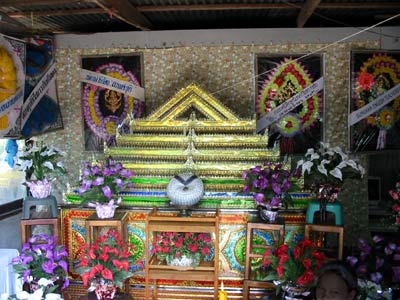
After a person passes away, the family rents an elaborately decorated refrigerated casket (with a smaller inner casket made of wood) for the body, and is then displayed in their house for several days. (See photo to the right). Friends and family can come by and light incense sticks and say prayers in front of the coffin. They also give the family colorful decorations which are placed around the coffin (see the rectangular wall hangings behind the coffin shown here, or look at the crematorium photos shown below). The decorations/wall hanging things are all large pieces of cardboard with either fake flowers arranged in a wreath pattern, or a piece of terry cloth folded into the shape of a bird (as was the case for the one we bought for the family). The person giving the decoration writes their name on a white paper "sash" across the front of the decoration. The family will usually put up a large open-sided tent in their front yard for their guests to sit out of the sun, and naturally, a large stereo is rented for the occasion. For this particular funeral, we were not blown away by the music, but funerals often happen near our house, and the music will run continuously for several days. The first time we heard funeral music here, we were rather surprised - it sounds like an old electric organ in a Southern Baptist church playing a sad tune. However, the tune is only about 2 minutes long, and after hearing it continuously repeated for 3 days, the surprise wore off.
 In the same way that our newlywed friends consulted a spiritual leader to
determine an "auspicious" day to have the wedding, the family of
the deceased will consult a spiritual leader to determine an auspicious day
for cremation (the only cemeteries we have seen in Thailand are Chinese -
Thais always cremate bodies). In the case of extremely well known monks, the
cremation is postponed for more than a year to allow many people to come pay
respects, and to find an extremely good day. For important officials, the
family will often wait a week or so for a good day. The funeral/cremation
ceremony we visited was 4 days after the man died.
In the same way that our newlywed friends consulted a spiritual leader to
determine an "auspicious" day to have the wedding, the family of
the deceased will consult a spiritual leader to determine an auspicious day
for cremation (the only cemeteries we have seen in Thailand are Chinese -
Thais always cremate bodies). In the case of extremely well known monks, the
cremation is postponed for more than a year to allow many people to come pay
respects, and to find an extremely good day. For important officials, the
family will often wait a week or so for a good day. The funeral/cremation
ceremony we visited was 4 days after the man died. While the funeral process is rather long, the funeral ceremony itself started in a familiar way. Friends, family, and co-workers came to the temple and several people gave speeches about the deceased. In the case of government workers, the ceremony can become more complex. Here in Thailand almost all government workers are direct employees of the national government. Thailand, being a former monarchy, still has the King as head of state (incidentally, the current Thai King is the longest reigning monarch in the world). Our friend's brother, being a teacher and therefore a federal government employee, was eligible for a special flame from the royal family to ignite his cremation. Interspersed throughout Thailand are flame "stations" monitored by attendants. The nearest station to us is in the capital city of Surin, and a local group is responsible for driving up to Surin and transporting the flame to requesting families. Since all government workers in Thailand have a uniform, there was a big collection of teachers on hand in their dress white uniforms to receive the royal flame. After the eulogies and the royal flame, the family of the deceased publicly gave money and gifts to various worthy causes - mostly to schools and to the monks at the ceremony. There is a strong sense of what they translate as "merit" here in Thailand, and giving gifts to these worthy causes by the family earns the deceased extra merit for the life hereafter. Also, the sons (and in this case, the nephew) of the deceased can ordain as monks for a short period of time (a couple of days to a week) to earn merit for the deceased.
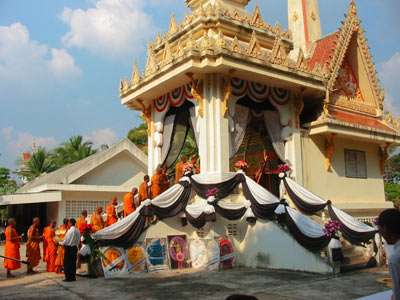
The final bit of the public ceremony involves everyone shuffling past the casket and laying a flower (provided by the family, at the foot of the steps) in front of the casket. The procession is started by the monks, followed by the government officials, and then the rest of the crowd. After the official ceremony, the body will be cremated - the inner wooden coffin is burned along with the body. After the cremation, the family will come back and collect the bone fragments left over. They will keep these fragments in an urn, and every year around the Thai new year they will take them back to the temple and wash them with holy water.
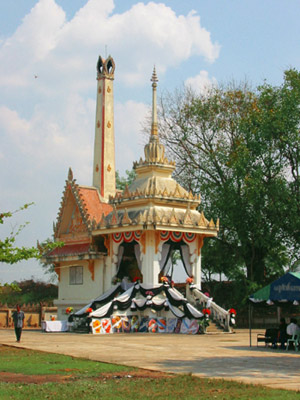
Final note - Thai funeral colors are both black and white. Interestingly, the crematorium is not painted in black and white but instead is decorated in traditional Thai temple style, festooned with the red, white, and blue of the Thai flag. The white and black swaths of cloth are provided (by the family) each time there is a funeral.
Our best to all of you, and we wish you Peace,
Denny & Lisa