 The
wedding we attended was that of two English teachers that we know. We have known
both of them for nearly a year, which is longer than they have known each other.
Denny taught with the groom last term, and this term he taught with the bride.
Their wedding took place in a nearby town, and they asked Denny to be their
photographer. Like almost all ceremonies in Thailand, the couple had to consult
a local shaman to determine an auspicious date for the wedding.
The
wedding we attended was that of two English teachers that we know. We have known
both of them for nearly a year, which is longer than they have known each other.
Denny taught with the groom last term, and this term he taught with the bride.
Their wedding took place in a nearby town, and they asked Denny to be their
photographer. Like almost all ceremonies in Thailand, the couple had to consult
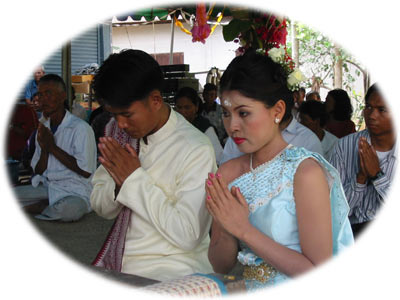
a local shaman to determine an auspicious date for the wedding.The day started at 7:00am with a ceremony at the bride's house, conducted by five monks (it's best to have an odd number of monks at a ceremony). There were about 60 people present who were mostly family members or members of the community. The young couple lit candles and incense to pay respect to Buddha and to the monks. The monks chanted blessings and gave instructions to the young couple on how to lead a good life. The spot on the forehead of the woman (and also the man, although in this picture you can barely see it) was part of the ceremony. Monks bless many things - people, buildings, cars, temples - by dabbing them with moistened talcum or baby powder. The ceremony ended with everybody giving the monks food for breakfast. (Every morning, Buddhist monks leave their temple and walk around the town with an alms bowl and people give them food. When monks are invited to a ceremony in the morning, it is customary to give them food, since they would otherwise "miss" their morning rounds.)
 After
the ceremony with the monks, there was a short break while the bride changed
into a different dress. The second ceremony had a lot of symbolic offerings
to local animist spirits - each village here has it's own spirits and it's own
traditions of making offerings to them. These local animist ceremonies are not
officiated by Buddhist monks, but rather by a local spiritual leader or shaman.
This particular ceremony was rooted in the Khmer culture of the people in the
village. The focal point of the ceremony, aside from the couple, is the centerpiece
of flowers, banana trees, and other items. They are kind of the local equivalent
of "something old, something new, something borrowed, something blue",
only they are more specifically significant.
After
the ceremony with the monks, there was a short break while the bride changed
into a different dress. The second ceremony had a lot of symbolic offerings
to local animist spirits - each village here has it's own spirits and it's own
traditions of making offerings to them. These local animist ceremonies are not
officiated by Buddhist monks, but rather by a local spiritual leader or shaman.
This particular ceremony was rooted in the Khmer culture of the people in the
village. The focal point of the ceremony, aside from the couple, is the centerpiece
of flowers, banana trees, and other items. They are kind of the local equivalent
of "something old, something new, something borrowed, something blue",
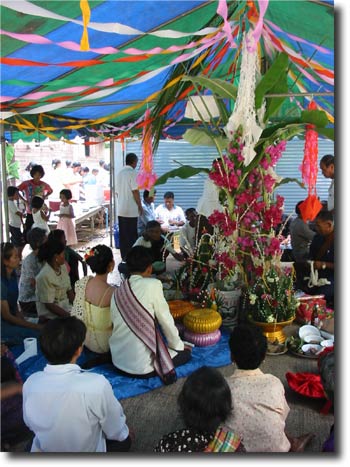
only they are more specifically significant.This second ceremony began as a traditional arranged marriage would have started. In Thailand it is customary for the groom to give a large sum of money to the bride's parents. Sometimes modern couples will share the burden of coming up with the money, and recently some parents have started giving the money back to the young couple. The money is counted at the beginning of the ceremony, in front of the guests, to prove that it's all there. In this case, the total amount was 100,000 Baht ($2,500). Then the groom presents the bride with several pieces of gold jewelry - here it was a ring, several necklaces, and a bracelet. The family and the spiritual leader inspect the pieces of jewelry, and then the groom puts all of them on his new wife.
After the money/jewelry exchange, a large skein of yarn/string was tied around the couples heads, a host of miscellaneous items were placed in their hands (see below - items include small pieces of food and a sickle, presumable symbols of fertility and a good life) and the shaman chanted more blessings. During prescribed breaks in the chanting, the family and friends of the couple uttered blessings for the couple while presenting ritual offerings of rice, meat (including a pig's head and a freshly killed piglet), flowers, money, and various beverages to the spiritual centerpiece of the room.
 In American
weddings, we throw rice at the bride and groom after the ceremony. Thais throw
rice at the bride and groom during the ceremony. What starts out as a ritual
to bless the new couple ends up as a wild free-for-all with everybody throwing
rice at everybody else. The bride and groom got the worst of it of course, but
we ended up being popular targets as well, as everybody wanted to make sure
that we learned about this particular bit of Thai culture. The flowers in the
centerpiece also have small strings attached to them, and people took a few
strings and tied them around the wrists of the couple while saying a blessing
for their long happy life together. The strings are another free-for-all kind
of ceremony, where the couple was certainly the focus, but people also tied
strings on their friends and the foreigners.
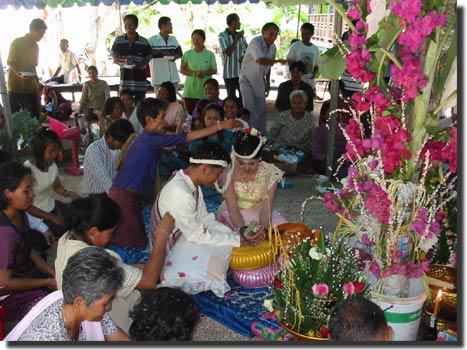
In American
weddings, we throw rice at the bride and groom after the ceremony. Thais throw
rice at the bride and groom during the ceremony. What starts out as a ritual
to bless the new couple ends up as a wild free-for-all with everybody throwing
rice at everybody else. The bride and groom got the worst of it of course, but
we ended up being popular targets as well, as everybody wanted to make sure
that we learned about this particular bit of Thai culture. The flowers in the
centerpiece also have small strings attached to them, and people took a few
strings and tied them around the wrists of the couple while saying a blessing
for their long happy life together. The strings are another free-for-all kind
of ceremony, where the couple was certainly the focus, but people also tied
strings on their friends and the foreigners.By this time, everyone was hungry, so lunch was served. The bride changed into dress number 3. After lunch, the bride and groom gave presents to the groom's family. They started by giving the parents of the groom new cloth wraps. A crowd of folks then gathered, wrapped the parents in the new cloth and removed the parent's old clothes from underneath. Then the bride and groom bathed the grooms parents in the front yard. After the bath, the parents were then dressed in new clothes and everyone started dancing. The freshly washed parents in their new clothes are to symbolize a new beginning, which seemed a bit confusing to us, as it would stand to reason that the bride and groom are the ones making a new beginning.
Then the couple continued giving presents to other members of the groom's family. Every time a present was given, money was offered in return (again, counted in front of all the guests) and there was a bit of one-upsmanship to try to donate more than the previous person.
After this ceremony, as it was about 1:30 PM and starting to get really hot, there was a break for siestas, snacking, chatting, etc. The bride left at this point to go into Sangkha to get her hair and make-up redone for the evening party. The bride also changed into dress #4, a traditional western wedding gown, to wear to the evening party (essentially the reception). Generally, the evening party consists of a large banquet in a school auditorium or large field where a catering company has come in and set up chairs and tables. This party was no different, there were about 50 tables set up, with 8 chairs at each. For those of you doing the math, that's 400+ guests. The catering company serves a 7-course meal, and each table has two bottles of soda pop, some soda water, and a bottle of whiskey. Needless to say, these parties can get very expensive. Thai people rarely bring gifts for the couple, like at an American wedding. However, Thai wedding invitations are sent out with an extra envelope, and it is expected that you will attend the reception with the envelope in hand, filled with some money to offset the cost of the party.
The heart of the reception party is when several community leaders (in this case, the town mayor and the principal from each of their schools) stand up to tell stories of and say blessings for the new couple. Then the couple goes around the room to greet all of their guests, giving each a small token, and having their photo taken at every table. By this time Lisa was tired and went home. Denny was tired too, but didn't have the option of going home until the last photograph was taken.
We were picked up before 6:30 AM and returned home around midnight. But at least we weren't the bride & groom - their day stared before 3:00 AM when the bride went in to town to get her hair and makeup done, and they had to clean up after the party at the end. With the exception of early afternoon, they were too busy greeting people and changing clothes to ever sit down and eat. And the wedding wasn't even followed up by a honeymoon. The couple was lucky that their "auspicious" day was on a Friday, so they at least had a weekend to sleep it off.
Take care,
Denny & Lisa